Autumn False Morel (Paragyromitra infula)
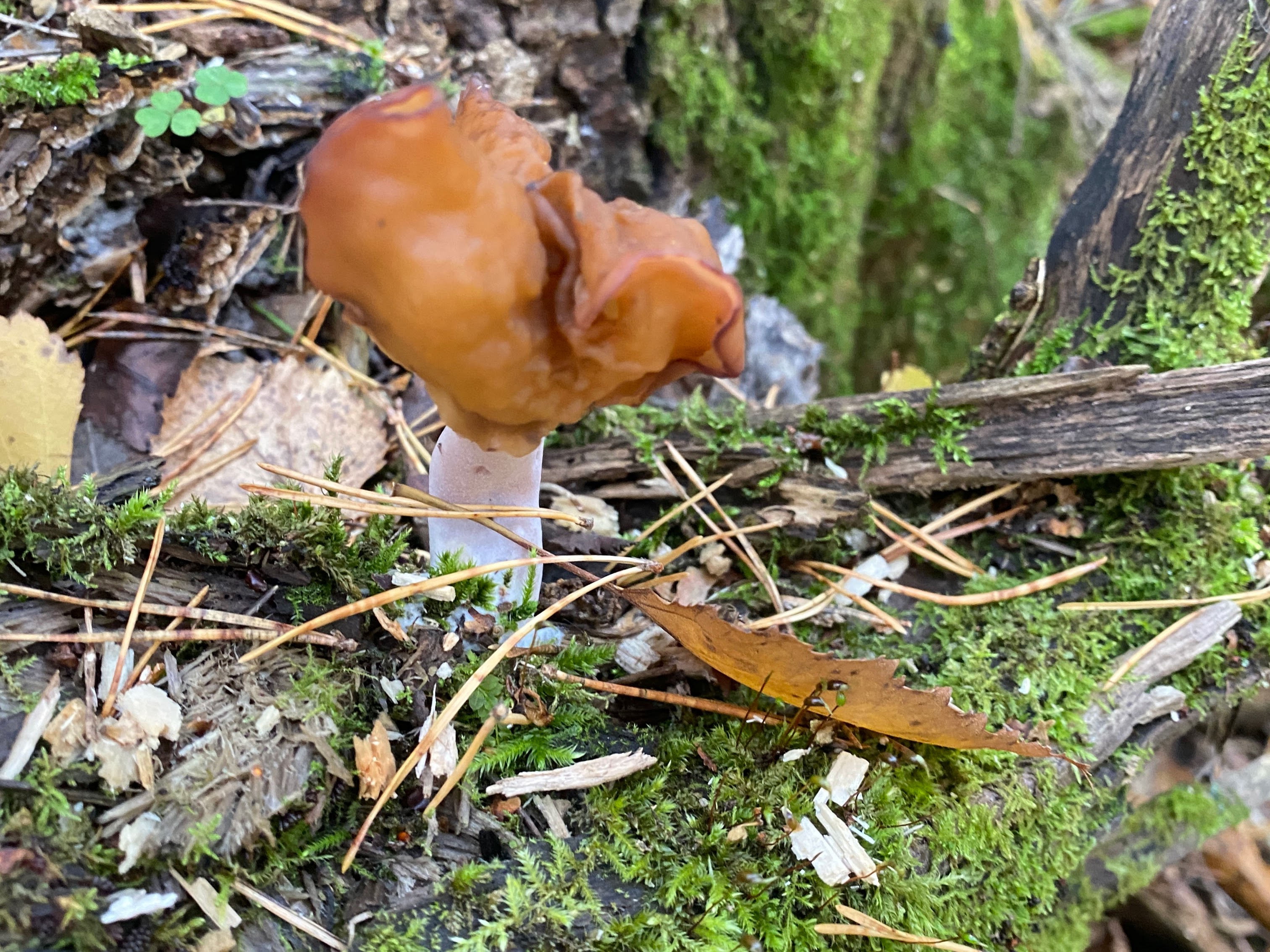
Строчок осенний
Current name

Index Fungorum   Paragyromitra infula (Schaeff.) X.C. Wang & W.Y. Zhuang
MycoBank   Paragyromitra infula (Schaeff.) X.C. Wang & W.Y. Zhuang
 

Other names

Autumn False Morel, Infula-like Gyromitra, Autumn Lobster Mushroom.

This representative of the family is deliberately distinguished by its fruiting period—autumn, rather than spring—and by its association with rotting wood rather than soil. Fruiting bodies affected by mycoparasites are frequently encountered.

Systematic position
Specific epithet etymology

Infula, ae, noun f. — infula, a heavy band of twisted wool worn by Roman priests during sacrifices.

Synonyms

Physomitra infula (Schaeff.) Boud., Icones Mycologicae Sér. 1 (Livr. 2): [2] (1904)

Elvela infula Schaeff. (1774) 

Helvella infula var. infula (?) 

Helvella infula f. infula Schaeff.: 105 (1774) 
Habit
Fruiting body
Agaricoid (cap and stipe)
Cup-shaped, saucer-shaped, ear-shaped (discomycetes)
Hymenophore
Smooth, indistinct
Fruiting period (list)
AugAugust (21st–31st)SepSeptember (1st–10th)September (11th–20th)September (21st–30th)OctOctober (1st–10th)October (11th–20th)October (21st–31st)
Mushroom cap

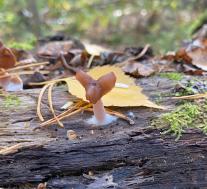
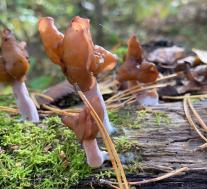
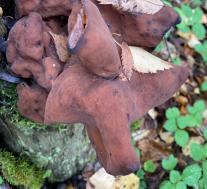
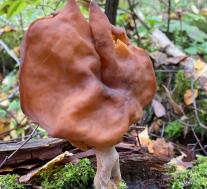
Fruiting body false morel-like, of completely arbitrary outline, on a long light stem or without one. Among the predominant forms are saddle-shaped, multi-lobed, or simply a shapeless brown mass on a stem. Cap two- or four-lobed, saddle-shaped, sometimes unevenly wrinkled, attached to the stem in several places; margins incurved. Upper, spore-bearing surface smooth, reddish-brown to dark brown; lower, sterile surface lighter, whitish, finely velvety. Hymenium: external, arranged in folds and cushions; this is due to the lower surface of the cap joining with the stem, while the mushroom continues to grow afterwards.

Stem

2–12 cm long, 1–3.5 cm in diameter; cylindrical, hollow, sometimes slightly folded but never ribbed. Surface finely granular, light, whitish, sometimes with a pinkish tint.

Flesh

Thin, fragile, brittle. Odor very faint, mushroom-like.

Microscopy

Spores 19–20 × 7–8.5 µm, ellipsoid, transparent, smooth, with two oil droplets. Asci 250–330 × 14–15 µm, cylindrical, 8-spored. Paraphyses branching, septate, enlarged at the tips up to 10 µm.

Ecology and distribution

Grows singly and in groups on decaying wood, less often on compacted soil near unpaved roads, in coniferous and mixed forests. Widely distributed in Eurasia and northern North America.

Fruiting

September–October

Nutritional properties
Conditionally edible

Poisonous when raw. Contains the toxic compound gyromitrin. Within the fungal tissue, it occurs not only as a free fraction but also in the form of various compounds. Ethylidene-gyromitrin is the most toxic fraction; its mass in the fiber of fresh mushrooms can reach 87.5% of the total gyromitrin content. During the life and growth of the mushroom, non-enzymatic transformations of ethylidene-gyromitrin occur, forming the toxic compound N-methyl-N-formyl-hydrazine (MFH), which is subsequently converted into the even more toxic compound N-monomethyl-hydrazine (MMH). It has been established that the MMH content in fresh false morels can vary considerably. Concentrations may range from 50 to 300 mg/kg, but in some cases reach 1200–1600 mg/kg. The lethal concentration of gyromitrin for an adult human is 20–50 mg/kg; for children, 10–30 mg/kg. Recalculated to the amount of fresh mushrooms, a lethal dose is reached when an adult consumes 400–1000 g of mushrooms.

In Russian literature, P. infula is often listed as conditionally edible, i.e., suitable for consumption after preliminary processing. For detoxification, the mushrooms are boiled for 15–30 minutes, rinsed under running water, and the cooking water is discarded. They can also be subjected to prolonged drying in open air.

Gyromitrin and other hydrazine derivatives are volatile compounds; during boiling and drying, they are almost completely removed from the mushrooms, remaining only in negligible amounts. In small doses, these substances do not cause acute poisoning, but according to literature, they may accumulate in the body; there are mentions of the carcinogenicity of these compounds.

Conservation status

Not listed in the Red Data Book of the Russian Federation or regional Red Lists.

Similar species

Common False Morel (Gyromitra esculenta) — fruits in spring.
Giant False Morel (Gyromitra gigas) — fruits in spring.

Notes

To briefly summarize the toxicity of the Autumn False Morel: the toxin gyromitrin is converted in the human body into monomethylhydrazine—a highly toxic, volatile compound. Notably, monomethylhydrazine is also used as a component of rocket fuel in bipropellant rocket engines.

Link to this page for printed editions
Шиповалов А.Г. Autumn False Morel (Paragyromitra infula) - Mushrooms of Vologda Region [Electronic resource] URL: https://xn----7sbancweblffgklubds60aja.xn--p1ai/en/autumn-false-morel-paragyromitra-infula (accessed: 13.04.2026).
Share link

Add new comment

One file only.
2 MB limit.
Allowed types: png jpeg jpg jpe gif webp svg.
Allowed types: png gif jpg jpeg webp svg.

Plain text

  • No HTML tags allowed.
  • Lines and paragraphs break automatically.
  • Web page addresses and email addresses turn into links automatically.
Add image
Maximum 8 files.
2 MB limit.
Allowed types: png jpeg jpg jpe gif webp svg.
Allowed types: png gif jpg jpeg webp.
January (1st–10th)
January (1st–10th)
January (11th–20th)
January (11th–20th)
January (21st–31st)
January (21st–31st)
February (1st–10th)
February (1st–10th)
February (11th–20th)
February (21st–28th/29th)
March (1st–10th)
March (1st–10th)
March (11th–20th)
March (11th–20th)
March (21st–31st)
March (21st–31st)
April (1st–10th)
April (1st–10th)
April (11th–20th)
April (11th–20th)
April (21st–30th)
April (21st–30th)
May (1st–10th)
May (1st–10th)
May (11th–20th)
May (11th–20th)
May (21st–31st)
May (21st–31st)
June (1st–10th)
June (1st–10th)
June (11th–20th)
June (11th–20th)
June (21st–30th)
June (21st–30th)
July (1st–10th)
July (1st–10th)
July (11th–20th)
July (11th–20th)
July (21st–31st)
July (21st–31st)
August (1st–10th)
August (1st–10th)
August (11th–20th)
August (11th–20th)
August (21st–31st)
August (21st–31st)
September (1st–10th)
September (11th–20th)
September (21st–30th)
October (1st–10th)
October (1st–10th)
October (11th–20th)
October (11th–20th)
October (21st–31st)
October (21st–31st)
November (1st–10th)
November (1st–10th)
November (11th–20th)
November (21st–30th)
December (1st–10th)
December (1st–10th)
December (11th–20th)
December (21st–31st)