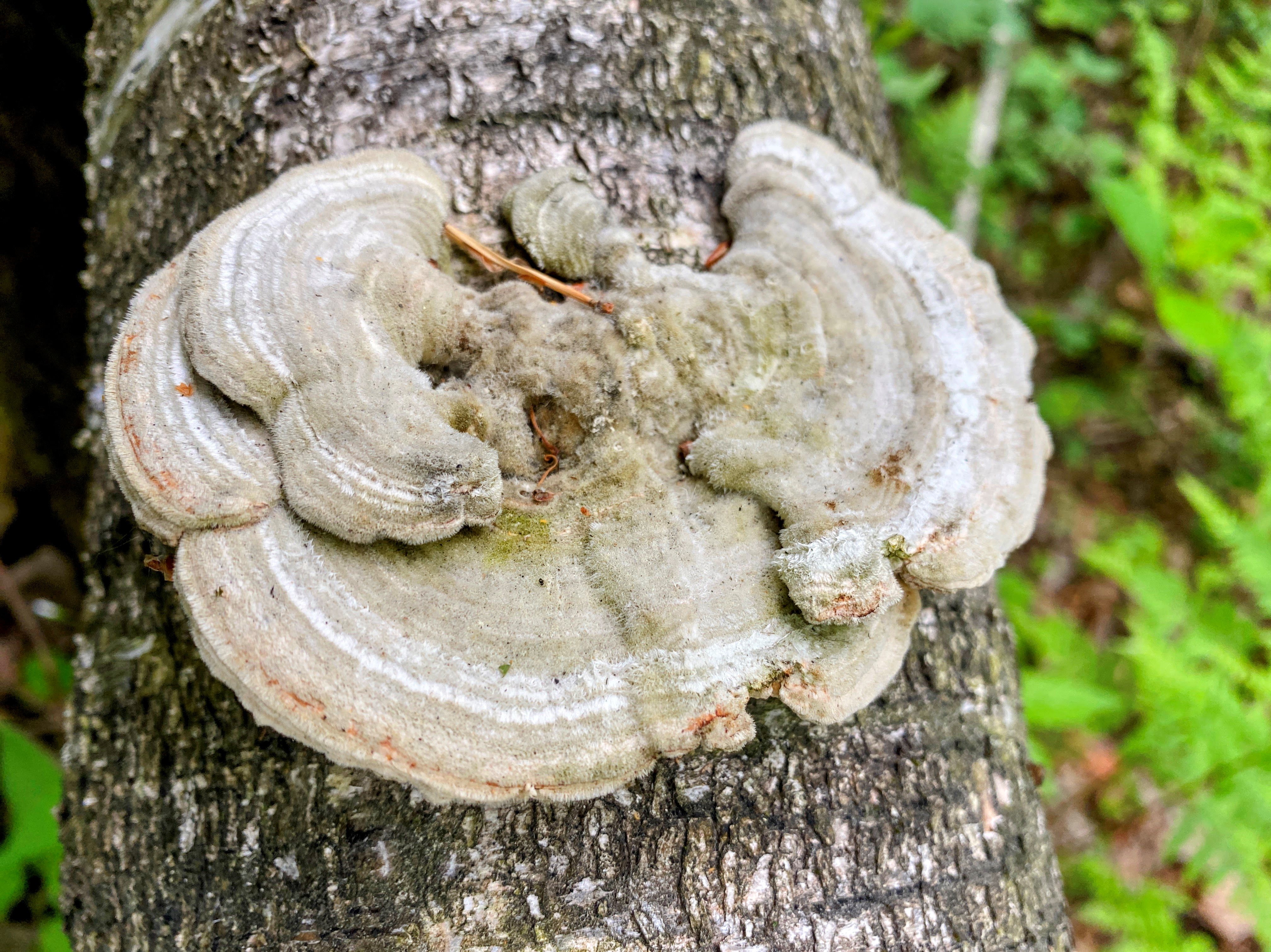
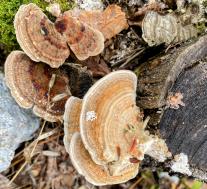
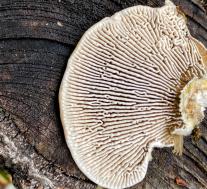
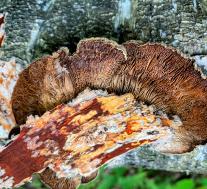
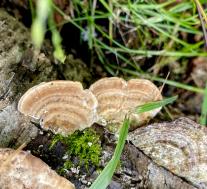
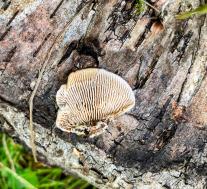
Annual, sessile, fan-shaped, often narrower at the base, usually growing in groups but rarely fusing with one another. Cap 2–10 cm wide, 0.3–1.5 cm thick at the base, with a sharp margin. Upper surface stiff-tomentose, with concentric furrows and numerous zones of whitish, yellowish, gray, and brown shades. With age, it usually becomes covered with a greenish layer of algae. The lower, spore-bearing surface is lamellate (gilled), initially white, then turning brownish. Gills 2–10 mm high, sometimes forked.
Grows on stumps, deadwood, fallen logs, and processed wood of deciduous trees, most commonly on birch (Betula). Causes white rot. One of the widely distributed species, serving as an indicator of anthropogenic impact on the natural environment. Can develop in rural-type buildings as a house-rot fungus.
Similar species
When viewed from above, L. betulina resembles certain species of the genus Trametes: Turkey Tail (Trametes versicolor); Rough-haired Trametes (Trametes hirsuta), but is easily distinguished by its lamellate (gilled) hymenophore.
Other "polypore-like" fungi with a lamellate hymenophore, such as Gloeophyllum spp., are distinctly darker in coloration, both in the flesh and in the gills.
Related resources
Bondartseva M. A. Order Aphyllophorales. Issue 2. / Keys to the Fungi of Russia. — Saint Petersburg: Nauka, 1998. — 391 p. — Pp. 199–246.
Breitenbach J, Kränzlin F. Fungi of Switzerland. A contribution to the knowledge of the fungal flora of Switzerland. Vol 2. Heterobasidiomycetes, Aphyllophorales, Gasteromycetes. — Lucerne: Verlag Mykologia, 1986. — 412 p. — P. 284.
Add new comment