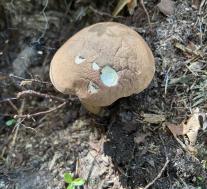
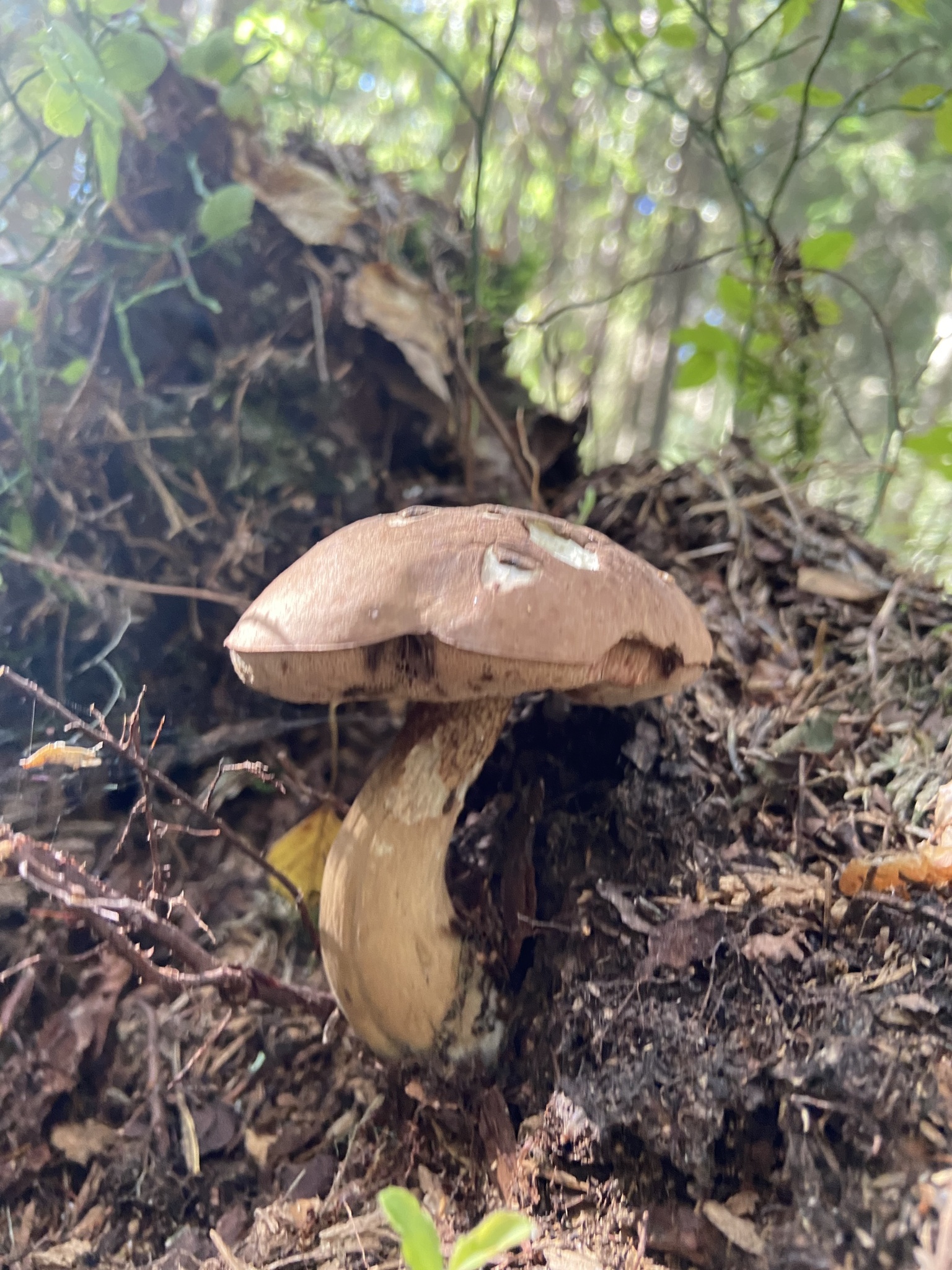
Bitter Bolete (Tylopilus felleus)
Желчный гриб
Current name

Index Fungorum    Tylopilus felleus (Bull.) P. Karst
MycoBank    Tylopilus felleus (Bull.) P. Karst
 

Other names

Bitter Bolete, False Porcini.

Systematic position
Specific epithet etymology

Felleus, a, um — biliary, gall-like, pertaining to bile.

Synonyms

Boletus alutarius Fr., Observ. mycol. (Havniae) 1: 115 (1815)

Boletus alutarius Rostk., in Sturm, Deutschl. Fl., 3 Abt. (Pilze Deutschl.) [5](23/24): 131 (1844)

Boletus felleus Bull., Herb. Fr. (Paris) 8: pl. 379 (1788) [1787-88]

Dictyopus felleus (Bull.) Quél., Enchir. fung. (Paris): 159 (1886)

Rhodoporus felleus (Bull.) Quél., Fl. mycol. France (Paris): 421 (1888)

Suillus alutarius (Fr.) Kuntze, Revis. gen. pl. (Leipzig) 3(3): 535 (1898)

Suillus felleus (Bull.) Kuntze, Revis. gen. pl. (Leipzig) 3(3): 535 (1898)

Tylopilus alutarius (Fr.) Henn., in Engler & Prantl, Nat. Pflanzenfam., Teil. I (Leipzig) 1(1**): 190 (1898) [1900]
 

Habit
Fruiting body
Agaricoid (cap and stipe)
Hymenophore
Tubulate, poroid
Fruiting period (list)
JunJune (1st–10th)June (11th–20th)June (21st–30th)JulJuly (1st–10th)July (11th–20th)July (21st–31st)AugAugust (1st–10th)August (11th–20th)August (21st–31st)SepSeptember (1st–10th)September (11th–20th)September (21st–30th)OctOctober (1st–10th)October (11th–20th)
Mushroom cap

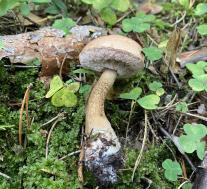
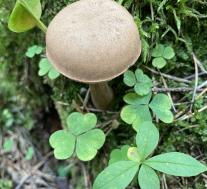
Fleshy, 5–20 cm in diameter; initially hemispherical, then cushion-shaped or expanded; surface finely velvety, slightly sticky in wet weather; ochre-brown, grayish-brown, sometimes with olive tones. Margin even, slightly overhanging the hymenophore.

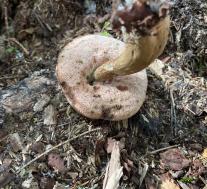
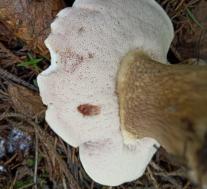
Hymenophore: tubulate (poroid), adnate; initially white or beige, becoming pinkish at spore maturity; darkening to reddish-brown on damaged areas.

Stem

5–10 cm in height, 1–5 cm thick; cylindrical, club-shaped, or swollen, with a characteristic thickening in the lower part. Stem color yellowish-ochre; surface covered with dark fibrous scales, often forming a net-like pattern, similar to that of the Porcini mushroom (Boletus edulis).

Flesh

Thick, elastic, rarely damaged by insects; flesh color on cut initially waxy-white, then slowly turning pink. Taste bitter, unpleasant. Odor very weak, mushroom-like.

Microscopy

Spore print dirty pink. Spores fusiform (spindle-shaped), smooth.

Ecology and distribution

Solitary and in groups in coniferous and mixed forests with pine (Pinus), spruce (Picea), chestnut (Castanea), beech (Fagus), oak (Quercus), alder (Alnus), on acidic soils. Often found at the base of trees. Also occurs on decaying wood. Sometimes very abundant.

Fruiting

June–October

Nutritional properties
Inedible

The mushroom is considered inedible due to its bitter taste; however, in some countries—Romania, Germany, France—there are recipes using this species, but its preparation necessarily involves boiling in milk, after which the bitterness disappears. Some describe the taste of this mushroom as disgusting. Online sources sometimes claim this species is poisonous, but there is no confirmation of this; it can be assumed that any digestive upset is caused by the same compounds responsible for the bitter taste.

Conservation status
Red Data Book of Krasnoyarsk Krai.

Status 3. Rare species.

Similar species

The Bitter Bolete is not without reason called the "False Porcini"—although the resemblance is far from 100 percent, the relatively low prevalence of Tylopilus felleus often leads to the fact that many mushroom foragers are poorly acquainted with it (or not acquainted at all) and, so to speak, "are not ready for surprises." The Bitter Bolete can be distinguished from the Porcini (Boletus edulis) by the pinkish tint of the tubular layer, the dark net-like pattern on the stem, and, of course, by its habitat: the Porcini does not grow at the base of trees, let alone on stumps. It is also not difficult to distinguish the Bitter Bolete from Birch Boletes (Leccinum scabrum): in addition to the strange, completely atypical growth conditions for boletes, the Bitter Bolete has a net-like pattern on its stem, which is unusual for Birch Boletes.

Notes

Nemoral relict of the Tertiary period. Has a discontinuous range within the territory of Russia. Limiting factors have not been studied.

Link to this page for printed editions
Shipovalov A.G. Bitter Bolete (Tylopilus felleus) - Mushrooms of Vologda Region [Electronic resource] URL: https://xn----7sbancweblffgklubds60aja.xn--p1ai/en/bitter-bolete-tylopilus-felleus (accessed: 13.04.2026).
Share link

Add new comment

One file only.
2 MB limit.
Allowed types: png jpeg jpg jpe gif webp svg.
Allowed types: png gif jpg jpeg webp svg.

Plain text

  • No HTML tags allowed.
  • Lines and paragraphs break automatically.
  • Web page addresses and email addresses turn into links automatically.
Add image
Maximum 8 files.
2 MB limit.
Allowed types: png jpeg jpg jpe gif webp svg.
Allowed types: png gif jpg jpeg webp.
January (1st–10th)
January (1st–10th)
January (11th–20th)
January (11th–20th)
January (21st–31st)
January (21st–31st)
February (1st–10th)
February (1st–10th)
February (11th–20th)
February (21st–28th/29th)
March (1st–10th)
March (1st–10th)
March (11th–20th)
March (11th–20th)
March (21st–31st)
March (21st–31st)
April (1st–10th)
April (1st–10th)
April (11th–20th)
April (11th–20th)
April (21st–30th)
April (21st–30th)
May (1st–10th)
May (1st–10th)
May (11th–20th)
May (11th–20th)
May (21st–31st)
May (21st–31st)
June (1st–10th)
June (1st–10th)
June (11th–20th)
June (11th–20th)
June (21st–30th)
June (21st–30th)
July (1st–10th)
July (1st–10th)
July (11th–20th)
July (11th–20th)
July (21st–31st)
July (21st–31st)
August (1st–10th)
August (1st–10th)
August (11th–20th)
August (11th–20th)
August (21st–31st)
August (21st–31st)
September (1st–10th)
September (11th–20th)
September (21st–30th)
October (1st–10th)
October (1st–10th)
October (11th–20th)
October (11th–20th)
October (21st–31st)
October (21st–31st)
November (1st–10th)
November (1st–10th)
November (11th–20th)
November (21st–30th)
December (1st–10th)
December (1st–10th)
December (11th–20th)
December (21st–31st)