Black Phellodon (Phellodon niger)
Index Fungorum Phellodon niger (Fr.) P. Karst.
MycoBank Phellodon niger (Fr.) P. Karst.
Black tooth
Niger, nigra, nigrum 1) black, dark, dark green; 2) thick, dense; 3) tanned, swarthy; 4) darkening, covering with darkness, shrouding with clouds;
Calodon niger (Fr.) Quél., Enchir. fung. (Paris): 191 (1886)
Hydnellum nigrum (Fr.) P. Karst., Meddn Soc. Fauna Flora fenn. 5: 41 (1879)
Hydnum nigrum Fr., Observ. mycol. (Havniae) 1: 134 (1815)
Hydnum nigrum var. polyceps Pers., Mycol. eur. (Erlanga) 2: 168 (1825)
Hydnum nigrum var. pullum Wahlenb., Flora suecica enumerans plantas sueciae indigenas 2: 1005 (1833)
Hydnum pullum Sw., K. Vetensk-Acad. Nya Handl. 31: 248 (1810)
Phellodon niger var. macrosporus J.Aug. Schmitt, Abhandlungen der DELATTINIA 47: 150 (2022)
To date, Phellodon niger is a cryptic species. Molecular genetic studies show that numerous specimens identified by macro- and micromorphological features as Ph. niger represent different taxa [13]. However, this is partly due to the fact that the species description encompasses fungi with significant differences in micro- and macromorphology, collected in different biotopes at various locations around the globe. This is clearly visible when looking at the variety of forms, photographs of which are posted on the Internet under the name Phellodon niger.
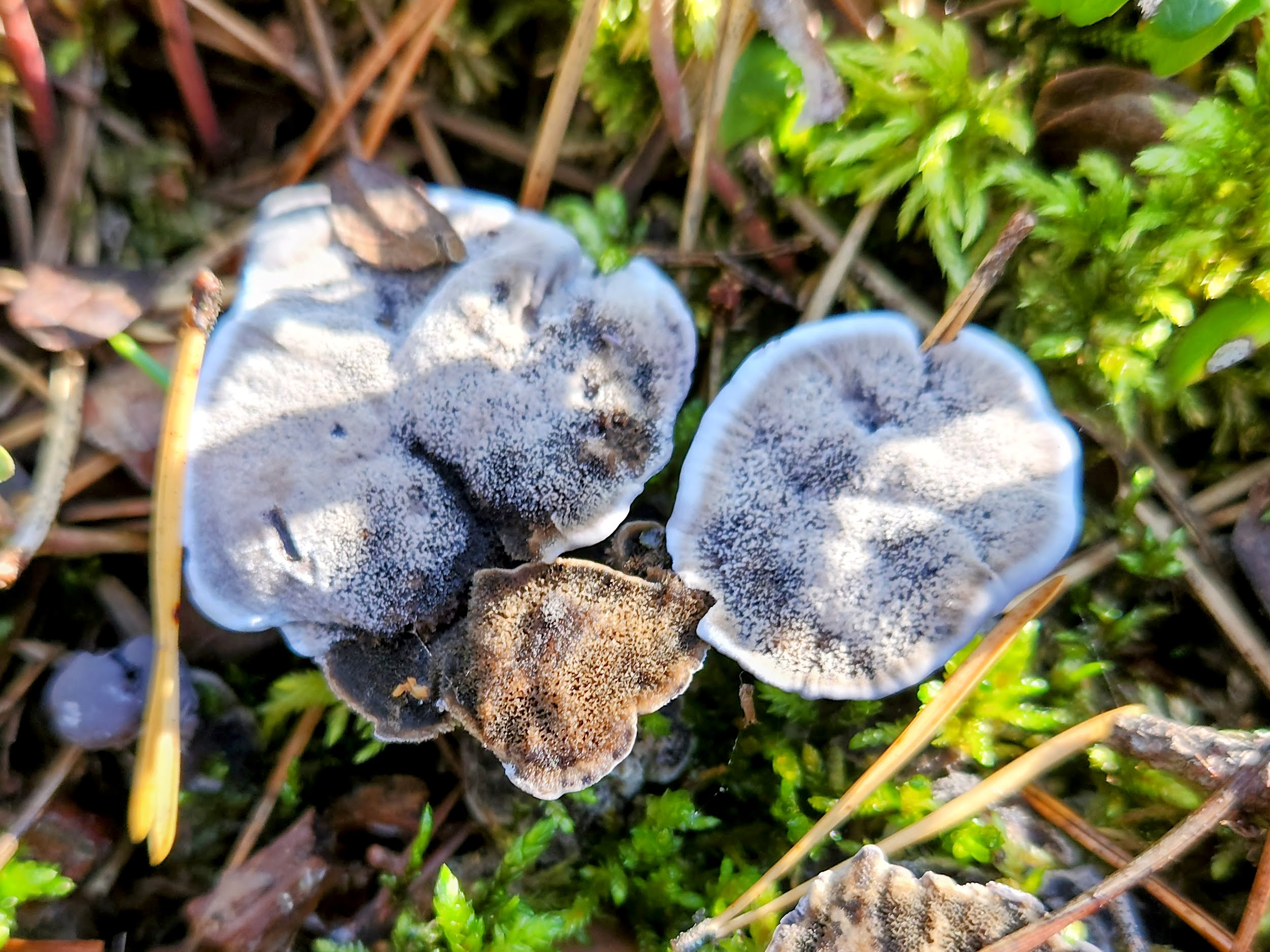
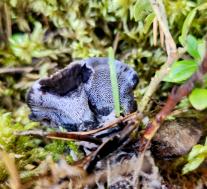
5–45 cm in diameter. Most often inversely conical, convex in the upper part, spreading or funnel-shaped. The surface is uneven, felt-like pubescent. With age, the pubescence disappears, starting from the center of the cap. The surface of young fruiting bodies is gray, grayish-bluish. Starting from the center, it darkens, acquiring dark brown, dark olive shades. On exposed areas, it blackens. The margin is sharp, always lighter than the center of the cap. In humid weather, the fungus is capable of guttation, exuding a black liquid.
The hymenophore is spiny, decurrent onto the stipe. The spines are thin, up to 3 mm long, initially white, bluish, becoming gray with time.
Fruiting bodies with a central stipe often fuse by their caps during growth, forming multi-tiered clusters. During development, they envelop plants and litter elements.
1–5 cm long and 1–2 cm in diameter, cylindrical, uneven. The surface is felt-like, of the same color as the cap or black. Often densely covered with fragments of litter. The felt-like element of the stipe represents a multilayered mycelium capable of absorbing water.
Corky, woody, two-layered, black or dark gray.
Weak. Intensifies upon drying. Subjectively, the odor is described as variable, ranging from fenugreek to all-purpose soup seasoning.
Spore print white. Spores ellipsoid, almost spherical, hyaline, covered with fine spines.
Forms ectomycorrhiza with Scots pine. Grows in groups or singly. Prefers shaded areas. Limiting factors have not been fully studied. Analysis of stable carbon-13 isotope content shows that P. niger possesses metabolic characteristics close to those of saprotrophic fungi, indicating that it may obtain carbon from sources other than the host tree.
Status 4. A species of indeterminate status and category based on current knowledge.
Status 3. A vulnerable species.
Fenugreek Phellodon (Phellodon melilotinus) is presumed to grow in association with spruce. Compared with the black Phellodon (P. niger s.str.), the caps are more funnel-shaped, concentric zones are always present, and an olive tint may occur. For identification, specialists recommend using DNA sequencing in all cases except the most obvious ones.
Northern black Phellodon (P. aquiloniniger) occurs predominantly in dry pine forests on acidic sandy soils. Concentric zones on the cap are absent.
Deciduous black Phellodon (P. frondosoniger) inhabits broadleaf forests, apparently forming mycorrhiza with beech, oak, and chestnut (Castanea).
From other similar fungi, for example from blue Hydnellum (Hydnellum caeruleum), the listed species are most easily distinguished by the black color of the flesh.
Based on preliminary assessment for inclusion in the Red List of threatened British fungi, P. niger is considered rare. In Switzerland, it is regarded as a vulnerable species.
Fruiting bodies of Phellodon niger are used for dyeing fabrics and wool. Depending on the dyeing technique and mordants used, various colors can be obtained: light and dark blue-green, dark blue, gray, etc.
Add new comment