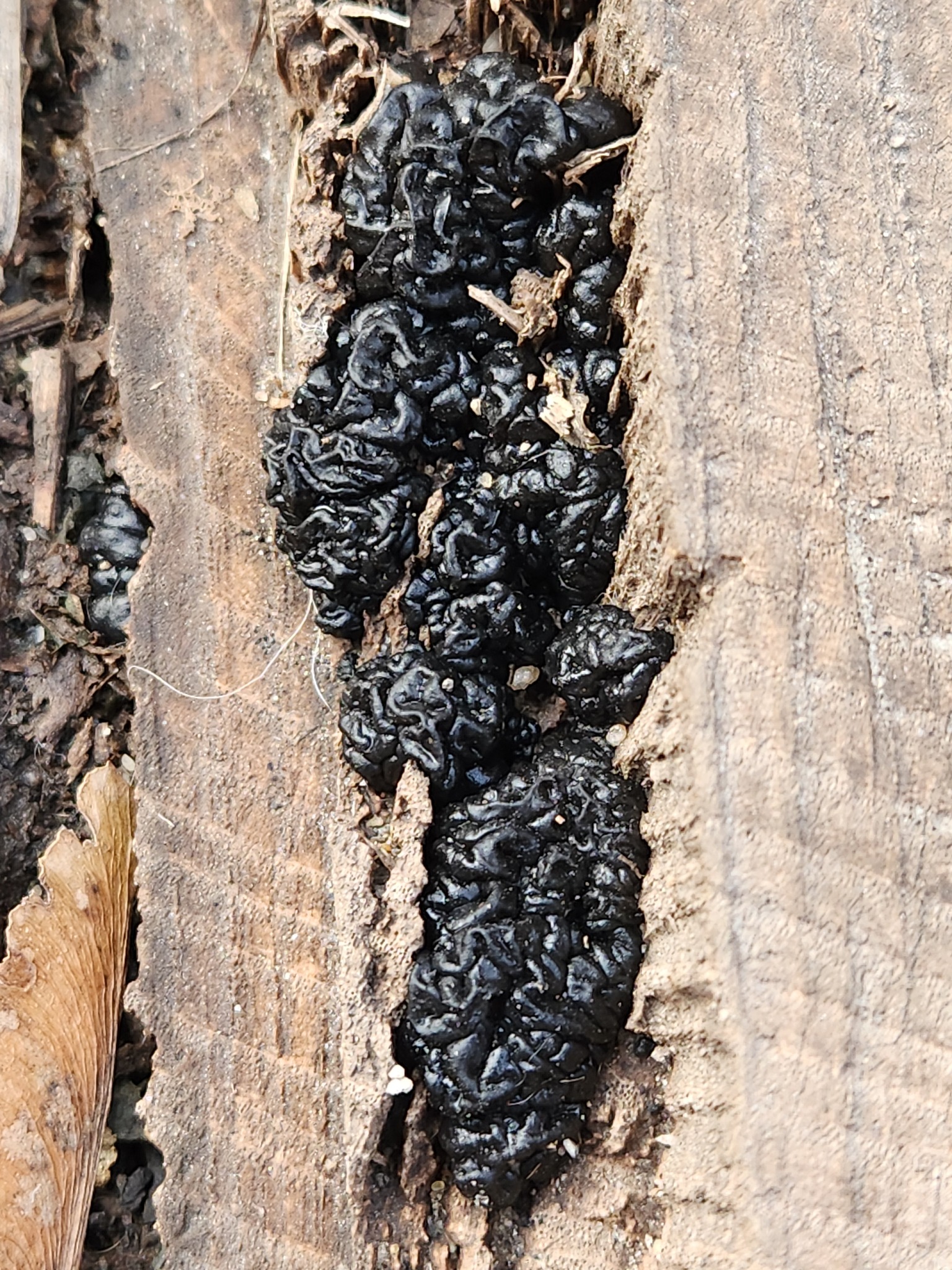
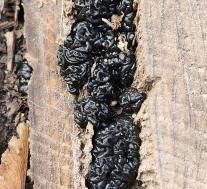
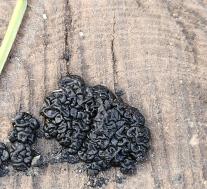
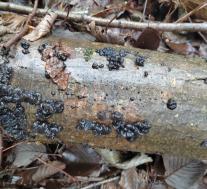
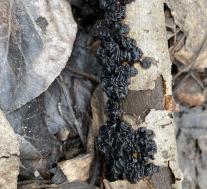
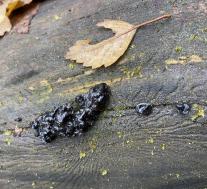
Individual fruiting bodies of Blackening Exidia are rounded, 1–3 cm in diameter; during growth they soon merge with neighboring ones, forming a single amorphous mass that tightly covers the substrate and appears as overlapping lumps and folds. The total length usually does not exceed 20 cm, but can be significantly larger. The surface is smooth, glossy, covered with barely visible tubercles indiscernible to the naked eye. The color is most often black, sometimes dark brown in wet weather. During drought, the fungi flatten out; at subzero temperatures they freeze, but restore their former shape when favorable conditions return.
Blackening Exidia (Exidia nigricans)
Index Fungorum Exidia nigricans (With.) P. Roberts
MycoBank Exidia nigricans (With.) P. Roberts
Blackish Exidia, Black Exidia
In English-speaking countries, it has the figurative name "warlock's butter"
Nigricans — blackening. Present active participle of nigrico, are — to be blackish, to have a dark coloration.
Exidia pithya (Alb. & Schwein.) Fr., Syst. mycol. (Lundae) 2(1): 226 (1822)
Exidia pithya subsp. friesiana P. Karst., Bidr. Känn. Finl. Nat. Folk 37: 199 (1882)
Exidia pithya var. friesiana (P. Karst.) P. Karst., Finl. Basidsvamp.(no. 11): 176 (1889)
Exidia plana Donk, Persoonia 4(2): 228 (1966)
Exidia plana var. pithya (Alb. & Schwein.) Krieglst. [as 'pitya'], Beitr. Kenntn. Pilze Mitteleur. 12: 36 (1999)
Tremella auricula-judae var. pithya Alb. & Schwein., Consp. fung. (Leipzig): 302 (1805)
Tremella nigricans With., Bot. arr. veg. Gr. Brit. (London) 2: 732 (1776)
Tremella pithya (Alb. & Schwein.) Schwabe, Flora anhaltina 2: 281 (1839)
Tremella plana F.H. Wigg., Prim. fl. holsat. (Kiliae): 95 (1780)
The first recognizable description of Blackish Exidia was made by the German-English botanist J.J. Dillenius as early as 1741, that is, earlier than the vast majority of well-known mushrooms. Later, Glandular Exidia was described. In the early 19th century, during the first attempt at systematization, these species were merged, and the common name became Glandular Exidia (Exidia glandulosa). Over the next two centuries, routine scientific work proceeded: these two taxa accumulated synonyms, were split and reunited into one, but the priority name for the Exidia forming a unified mass from numerous fruiting bodies remained Glandular Exidia. Finally, in 2009, British specialist P. Roberts restored historical justice by naming the described species Blackening Exidia (Exidia nigricans), and reserving Glandular Exidia for the fungus with separate fruiting bodies. This is precisely how these two taxa are currently understood by Russian mycologists and enthusiasts. Nevertheless, this interpretation has not become universally accepted. For example, North American field guides and advanced online resources still retain the 20th-century concept.
Flesh gelatinous, tender.
Weak, mushroom-like, pleasant.
Spore print white. Spores 12–16 × 4–5.5 µm, allantoid, hyaline, thin-walled, with a distinct apex and oil droplets in the protoplast.
A common species, widely distributed in the Northern Hemisphere, including throughout Russia. It occurs on dead but not heavily decomposed wood of various hardwoods, mainly birch and aspen fallen logs and stumps; exceptionally, on coniferous trees.
Most similar to Blackening Exidia is Glandular or Truncate Exidia (Exidia glandulosa), whose fruiting bodies are larger and more distinctly formed: they never merge into an indivisible whole. Moreover, Glandular Exidia occurs only on broad-leaved trees.
Occasionally, the bright yellow ascomycete Sulphur Hypocrea (Hypocrea sulphurea) parasitizes the fruiting bodies and mycelium of Blackening Exidia.
Add new comment