Chestnut Polypore (Picipes badius)
Трутовик каштановый
Current name

Index Fungorum  Picipes badius (Pers.) Zmitr. & Kovalenko

MycoBank   Picipes badius (Pers.) Zmitr. & Kovalenko
 

Other names

Polyporus badius

Systematic position
Specific epithet etymology

Badius, a, um. chestnut-colored, bay (of horses).

Synonyms

Grifola badia (Pers.) Gray, A natural arrangement of British plants 1: 644 (1821) 

Polyporus durus (Timm) Kreisel, Boletus 8: 30 (1984) 

Boletus badius Pers., Synopsis methodica fungorum: 523 (1801) 

Boletus batschii J.F. Gmel., Systema Naturae 2 (2): 1435 (1792)

Boletus durus Timm, Flora megapolitanae Prodomus exhibeus plantas ductatus Megapolitano: 271 (1788)

Polyporellus badius (Pers.) Imazeki, Colored Illustrations of Mushrooms of Japan 2: 136 (1989) 

Royoporus badius (Pers.) A.B. De, Mycotaxon 65: 471 (1997) 
Habit
Fruiting body
Agaricoid (cap and stipe)
Hymenophore
Tubulate, poroid
Fruiting period (list)
MayMay (21st–31st)JunJune (1st–10th)June (11th–20th)June (21st–30th)JulJuly (1st–10th)July (11th–20th)July (21st–31st)AugAugust (1st–10th)August (11th–20th)August (21st–31st)SepSeptember (1st–10th)September (11th–20th)September (21st–30th)OctOctober (1st–10th)October (11th–20th)
Mushroom cap

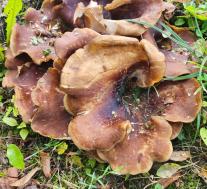
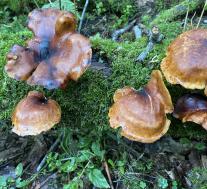
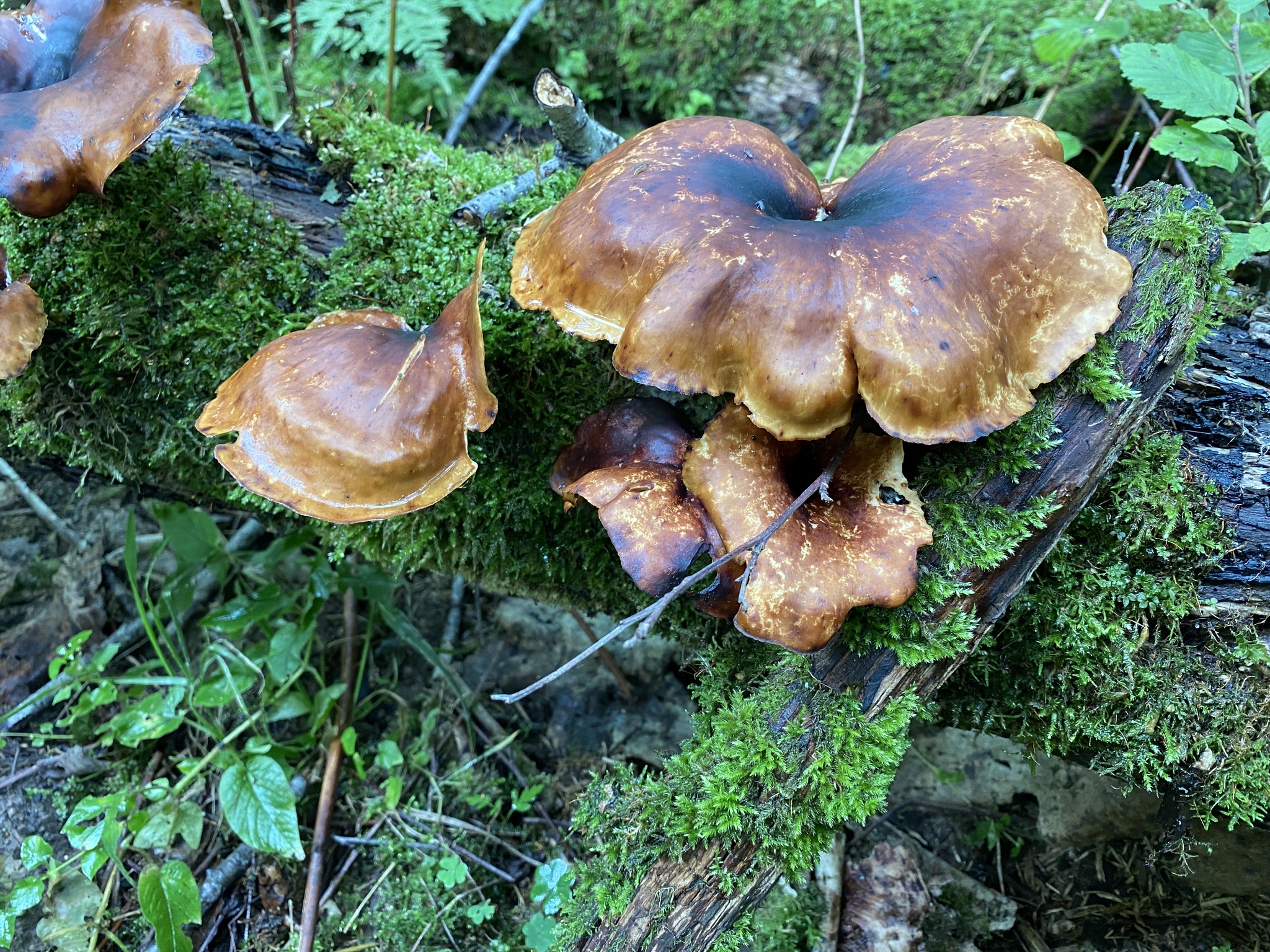
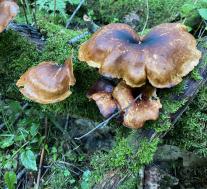
Usually large, reaching up to 25 cm in diameter under favorable conditions (typically 5–15 cm), irregularly funnel-shaped, as if composed of several fused "lobes"; margins wavy. Color ranges from rich brown to nearly black, darker in the center than at the edges (the margins may even be light, beige); surface smooth to glossy.

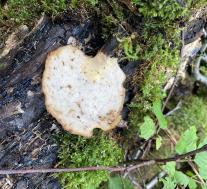
Hymenophore tubular, decurrent onto the stipe. Tubes white or pale ochre, darker than the flesh, 1–2 mm long, usually somewhat more decurrent on one side of the stipe. Pores round to angular, 5–7(8) per 1 mm, i.e., very small, with thin margins that become fringed-toothed with age.

Stem

Relatively short and thick (2–4 cm high, 0.5–1.5 cm thick), partly or completely eccentric, black or brown, with a velvety surface.

Flesh

Thin, very elastic, difficult to tear, later becoming corky, hard, and brittle. Tasteless.

Odor

Pleasant, mushroom-like.

Microscopy

Spore print white. Spores elongate-ellipsoid, nearly cylindrical, often somewhat fusiform, with granular contents.

Ecology and distribution

Xylotroph causing white rot of wood. Develops on large fallen logs of deciduous trees, at the base of dead standing trunks, on stumps, and on wood buried in soil. Recorded on aspen, linden, elm, black alder, and birch. Fruiting bodies are annual. Picipes badius has been recorded in Asia, Australia, Europe, and North America.

Fruiting

June–October.

Nutritional properties
Inedible

Of no culinary value due to tough flesh and tastelessness.

Conservation status
Red Data Book of Tver Oblast.

Status 5 — recovering species.

Similar species

Picipes badius is a distinctive fungus, notable for its large size and radially brown cap. Therefore, it is difficult to find similar species.
There are no inedible or poisonous look-alikes.

Notes

In English-language literature, it is reported that potent immunomodulating compounds have been obtained from the Chestnut Polypore. Furthermore, the use of Picipes badius for producing composite materials—an ecological alternative to plastic—appears promising. Yes, of course, this would involve artificially cultivated strains, not wild-harvested specimens.

Link to this page for printed editions
Shipovalov A.G. Chestnut Polypore (Picipes badius) - Mushrooms of Vologda Region [Electronic resource] URL: https://xn----7sbancweblffgklubds60aja.xn--p1ai/en/chestnut-polypore-picipes-badius (accessed: 13.04.2026).
Share link

Add new comment

One file only.
2 MB limit.
Allowed types: png jpeg jpg jpe gif webp svg.
Allowed types: png gif jpg jpeg webp svg.

Plain text

  • No HTML tags allowed.
  • Lines and paragraphs break automatically.
  • Web page addresses and email addresses turn into links automatically.
Add image
Maximum 8 files.
2 MB limit.
Allowed types: png jpeg jpg jpe gif webp svg.
Allowed types: png gif jpg jpeg webp.
January (1st–10th)
January (1st–10th)
January (11th–20th)
January (11th–20th)
January (21st–31st)
January (21st–31st)
February (1st–10th)
February (1st–10th)
February (11th–20th)
February (21st–28th/29th)
March (1st–10th)
March (1st–10th)
March (11th–20th)
March (11th–20th)
March (21st–31st)
March (21st–31st)
April (1st–10th)
April (1st–10th)
April (11th–20th)
April (11th–20th)
April (21st–30th)
April (21st–30th)
May (1st–10th)
May (1st–10th)
May (11th–20th)
May (11th–20th)
May (21st–31st)
May (21st–31st)
June (1st–10th)
June (1st–10th)
June (11th–20th)
June (11th–20th)
June (21st–30th)
June (21st–30th)
July (1st–10th)
July (1st–10th)
July (11th–20th)
July (11th–20th)
July (21st–31st)
July (21st–31st)
August (1st–10th)
August (1st–10th)
August (11th–20th)
August (11th–20th)
August (21st–31st)
August (21st–31st)
September (1st–10th)
September (11th–20th)
September (21st–30th)
October (1st–10th)
October (1st–10th)
October (11th–20th)
October (11th–20th)
October (21st–31st)
October (21st–31st)
November (1st–10th)
November (1st–10th)
November (11th–20th)
November (21st–30th)
December (1st–10th)
December (1st–10th)
December (11th–20th)
December (21st–31st)