Crepidotus calolepis

Крепидот красивочешуйчатый
Current name

Index Fungorum  Crepidotus calolepis (Fr.) P. Karst.

MycoBank  Crepidotus calolepis (Fr.) P. Karst.

Systematic position
Specific epithet etymology

Calolepis - beautifully scaled, beautifully scaly. From calo (κάλλος, εος τό beauty) - + -lepis (lepis, idis f scale. From λεπίς, ίδος η scale. Also λεπίδιον τό scale).

Synonyms

Agaricus calolepis Fr., Öfvers. Kongl. Vetensk.-Akad. Förh. 30 (5): 5 (1873) -  Basionym

Crepidotus mollis f. calolepis (Fr.) E. Ludw., Pilzkompendium (Eching) 1([2]): 71 (2001)

Crepidotus mollis subsp. calolepis (Fr.) Nordstein, Syn. Fung. (Oslo) 2: 67 (1990)

Crepidotus mollis var. calolepis (Fr.) Pilát, Annls hist.-nat. Mus. natn. hung., n.s. 2B: 74 (1940)

Derminus calolepis (Fr.) Henn., Nat. Pflanzenfam., Teil. I (Leipzig) 1(1**): 240 (1898)

Crepidotus fulvotomentosus (Peck) Peck, Rep. (Annual) Trustees State Mus. Nat. Hist., New York 39: 73 (1887)

Agaricus fulvotomentosus Peck, Ann. Rep. N.Y. St. Mus. nat. Hist. 26: 57 (1874)


Habit
Fruiting body
Cup-shaped, saucer-shaped, ear-shaped (discomycetes)
Hymenophore
Lamellate (gills present, including folded or rudimentary)
Fruiting period (list)
JulJuly (1st–10th)July (11th–20th)July (21st–31st)AugAugust (1st–10th)August (11th–20th)August (21st–31st)SepSeptember (1st–10th)September (11th–20th)September (21st–30th)OctOctober (1st–10th)October (11th–20th)
Fruit body

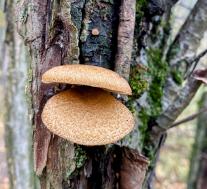
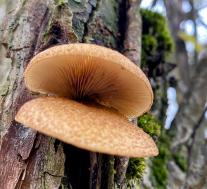
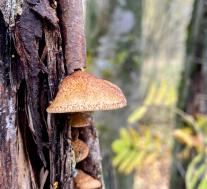
An annual. Sessile, attached laterally to the substrate, the rudimentary "stem" serves only as a point of attachment and a reference point for the divergence of the gills. The fruiting bodies are initially kidney-shaped, then oyster-shaped, slightly convex, with a slightly folded margin, sometimes uneven and wavy. The density of scales is less toward the margin, and they become increasingly spaced apart. The size is quite modest, 2-5 cm in diameter; in favorable seasons, some larger specimens are observed. The surface is light, gelatinous (especially along the edges), covered with scales. The color of the scales ranges from yellow to fulvous and brown. The scales are arranged quite densely, with a higher concentration near the point of attachment to the substrate. At the point where the cap attaches to the substrate, where the stem is supposed to be, extensive white "tomentose" pubescence can sometimes be seen.

The plates are frequent, narrow, smooth, fused to the point of attachment to the substrate (where the stem is visible), light ochre in color in young mushrooms, and with age they become brownish-brown from maturing spores.


Flesh

Гигрофанная, толстая, эластичная, желтовато-кремовая. Вкус очень слабый, сладковатый.

Odor

Weak, mushroomy, pleasant.

Microscopy

Spores 6-9 x 4.5-6.0 µm, elliptical, smooth; spore print is brownish brown.

The cuticle consists of loose hyphae immersed in a gelatinous substance 6-10 microns wide. On the surface they form a true epicutis and are very pigmented.

Ecology and distribution

It grows on decaying trunks and large fallen trees of deciduous trees, rarely conifers. It is sometimes found on living trees. It causes white rot. It has a substrate preferundum in the form of aspen (Populus tremula).

Fruiting

July - October (until the first frost)

Nutritional properties
Inedible

The mushroom is likely not poisonous, although there is no definitive data on this. Apparently, Crepidotus calolepis is of no culinary interest due to its small size and lack of flavor.

Similar species

Crepidotus mollis  is distinguished by the almost complete absence of scales on the cap.

Crepidotus variabilis  is smaller, the gills are more sparse, and the cap surface is not scaly, but tomentose.


Link to this page for printed editions
Шиповалов А.Г. Crepidotus calolepis - Applied mycology [Electronic resource] URL: https://xn----7sbancweblffgklubds60aja.xn--p1ai/en/crepidotus-calolepis (accessed: 02.07.2026).
Share link

Add new comment

One file only.
2 MB limit.
Allowed types: png gif jpg jpeg webp svg.

Plain text

  • No HTML tags allowed.
  • Lines and paragraphs break automatically.
  • Web page addresses and email addresses turn into links automatically.
Add image
Maximum 8 files.
2 MB limit.
Allowed types: png gif jpg jpeg webp.
January (1st–10th)
January (1st–10th)
January (11th–20th)
January (11th–20th)
January (21st–31st)
January (21st–31st)
February (1st–10th)
February (1st–10th)
February (11th–20th)
February (21st–28th/29th)
March (1st–10th)
March (1st–10th)
March (11th–20th)
March (11th–20th)
March (21st–31st)
March (21st–31st)
April (1st–10th)
April (1st–10th)
April (11th–20th)
April (11th–20th)
April (21st–30th)
April (21st–30th)
May (1st–10th)
May (1st–10th)
May (11th–20th)
May (11th–20th)
May (21st–31st)
May (21st–31st)
June (1st–10th)
June (1st–10th)
June (11th–20th)
June (11th–20th)
June (21st–30th)
June (21st–30th)
July (1st–10th)
July (1st–10th)
July (11th–20th)
July (11th–20th)
July (21st–31st)
July (21st–31st)
August (1st–10th)
August (1st–10th)
August (11th–20th)
August (11th–20th)
August (21st–31st)
August (21st–31st)
September (1st–10th)
September (11th–20th)
September (21st–30th)
October (1st–10th)
October (1st–10th)
October (11th–20th)
October (11th–20th)
October (21st–31st)
October (21st–31st)
November (1st–10th)
November (1st–10th)
November (11th–20th)
November (21st–30th)
December (1st–10th)
December (1st–10th)
December (11th–20th)
December (21st–31st)