Crown-tipped Clavicorona, box-like Clavicorona, little deer horns.
Specific epithet etymology
Pyxidatus, a, um mycol. having the shape of a little box, box-like; having the shape of the rim of a pistil. From pyxis, idis f 1) little box, jar; 2) rim of a pistil + -atus, a, um quality. Also pyxidium, i n bot. little cup, fruit type "capsule", opening with a lid.
Clavicorona pyxidata var. pyxidata (Pers.) Doty: 43 (1947)
General description
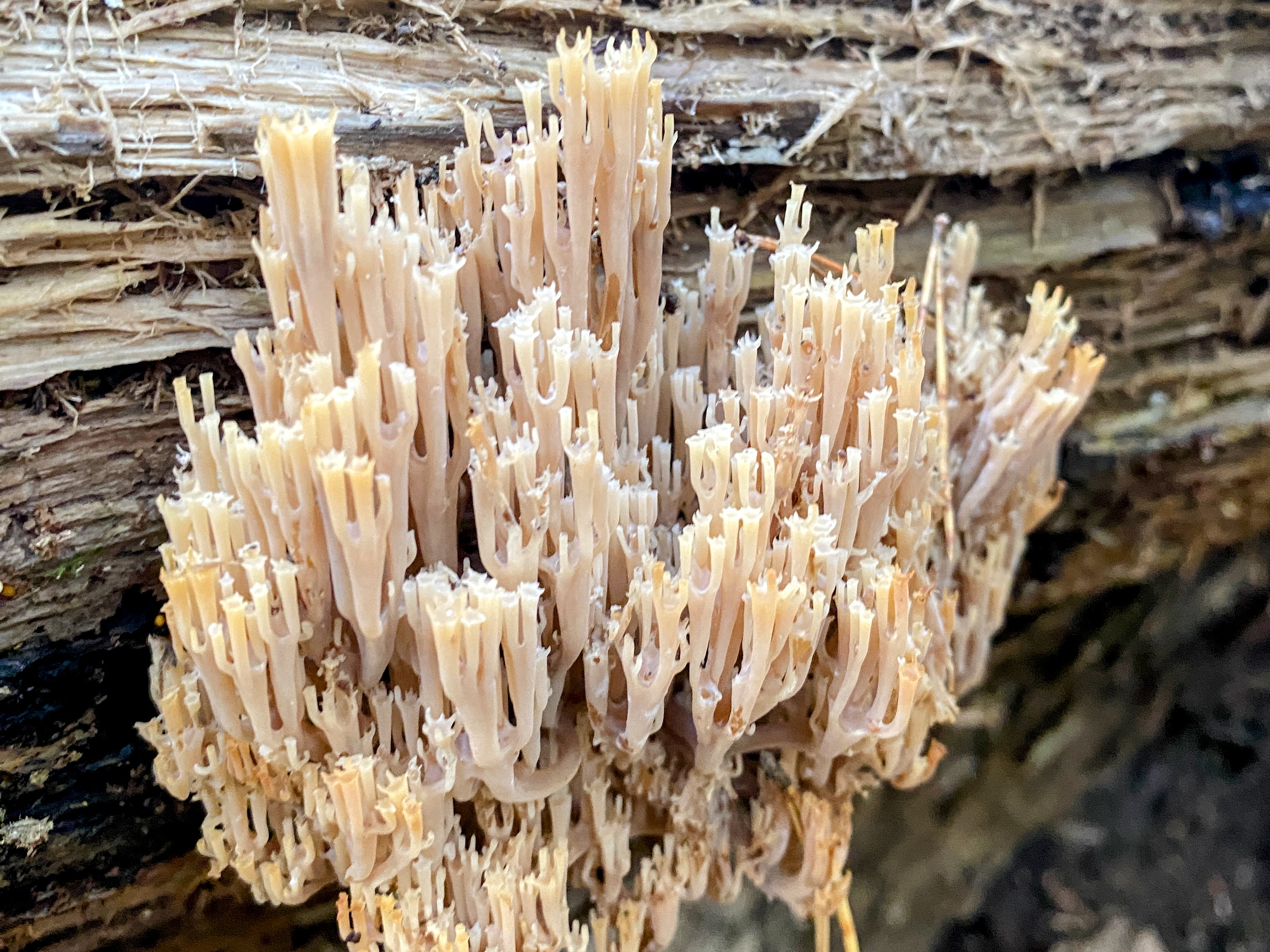
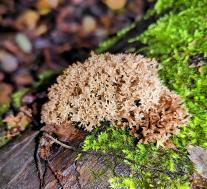
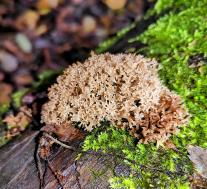
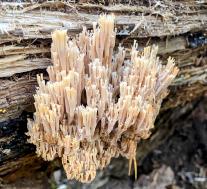
One of the most common coral fungi. The presence of clearly expressed "little crowns" at the tip of each branch allows with complete confidence to distinguish Clavicorona pyxidata from other common fungi of similar shape.
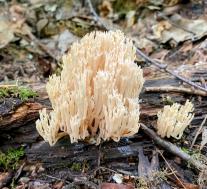
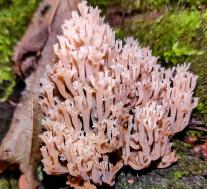
2–16 cm in height. Coral-like, bushy, branched form (the fungus "branches vertically" from a common base, on a whitish or brownish mycelial network). Each "branch" is crowned with a kind of "crown" or "little cup". The coloration of fruiting bodies is initially light yellow, then the upper branchlets fade to pale yellow, and closer to the base fade to yellowish-brown; with age, they become entirely brownish.
Flesh
Tough, elastic, yellowish, with a neutral or mildly peppery taste.
Odor
Weak, earthy.
Microscopy
Spore print white. Spores amyloid, finely spiny.
Ecology and distribution
Occurs in groups, both under the forest canopy and in well sun-warmed places (on rotten logs at forest edges). Can be found on leaf litter (including coniferous) and small twigs. Widespread throughout.
Similar species
There are no truly similar species; it may be mistaken for other forms of coral fungi at young or old stages.
Notes
From the liquid culture of this fungus, the sesquiterpene compounds pyxidatols A-C, tsuikolin E, and omphadiol have been obtained.
Related resources
Dunaev E. A., Barsukova T. N. Coral Fungi of the Moscow Region. — M.: "MosgorSYuN", 1999. — 40 p. — P. 27.
Perova N. V., Gorbunova I. A. Macromycetes of Southern Western Siberia. — Novosibirsk: Publishing House of the Siberian Branch of the Russian Academy of Sciences, 2001. — 158 p. — P. 101. [As Clavicorona pyxidata]
Zheng Y-B, Lu C-H, Zheng Z-H, Lin X-J, Su W-J, Shen Y-M (2008). "New sesquiterpenes from edible fungus Clavicorona pyxidata". Helvetica Chimica Acta. 91 (11): 2174–80. doi:10.1002/hlca.200890235
Add new comment