False Chanterelle (Hygrophoropsis aurantiaca)
Index Fungorum Hygrophoropsis aurantiaca (Wulfen) Maire
MycoBank Hygrophoropsis aurantiaca (Wulfen) Maire
Orange Chanterelle, Orange Hygrophoropsis, False Chanterelle.
Aurantiacus (= aurantius), a, um, mycol. — orange, pertaining to orange, from aurantium, i + -acus, a, um, indicating quality.
Agaricus aurantiacus Wulfen, in Jacquin, Miscell. austriac. 2: 107 (1781)
Agaricus subcantharellus Sowerby, Col. fig. Engl. Fung. Mushr., Suppl. (London)(no. 30 [no. 3 of suppl.]): tab. 413 (1814)
Cantharellus aurantiacus (Wulfen) Fr., Syst. mycol. (Lundae) 1: 318 (1821)
Cantharellus aurantiacus Krombh., Naturgetr. Abbild. Beschr. Schwämme (Prague): tab. 46, fig. 3-6 (1841)
Cantharellus aurantiacus var. congolensis Beeli, Bull. Soc. R. Bot. Belg. 61(1): 100 (1928)
Cantharellus aurantiacus var. pallidus Cooke, Ill. Brit. Fung. (London) 7: pl. 1057 (1104b) (1890)
Clitocybe aurantiaca (Wulfen) Stud.-Steinh., Hedwigia 39(Beibl.): (6) (1900)
Clitocybe aurantiaca var. albescens L. Corb., Bull. trimest. Soc. mycol. Fr. 40(1): 65 (1924)
Clitocybe aurantiaca var. lactea (Fr.) Rea, Brit. basidiomyc. (Cambridge): 273 (1922)
Clitocybe aurantiaca var. nigripes (Pers.) Rea, Brit. basidiomyc. (Cambridge): 274 (1922)
Hygrophoropsis aurantiaca (Wulfen) Maire, L'Empoisonn. Champ.: 99 (1921)
Hygrophoropsis aurantiaca var. lactea (Fr.) Corner, Monogr. Cantharelloid Fungi: 134 (1966)
Hygrophoropsis aurantiaca var. nana Singer, Farlowia 2(4): 546 (1946)
Hygrophoropsis lactea (Fr.) Rea ex Roux, Mille et Un Champignons: 100 (2006)
Merulius aurantiacus (Wulfen) J.F. Gmel., Syst. Nat., Edn 13 2(2): 1430 (1792)
Merulius brachypodus (Chevall.) Kuntze, Revis. gen. pl. (Leipzig) 2: 862 (1891)
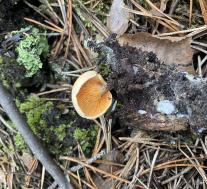
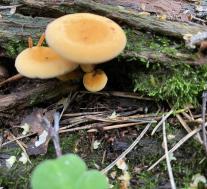
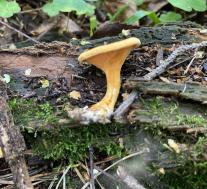
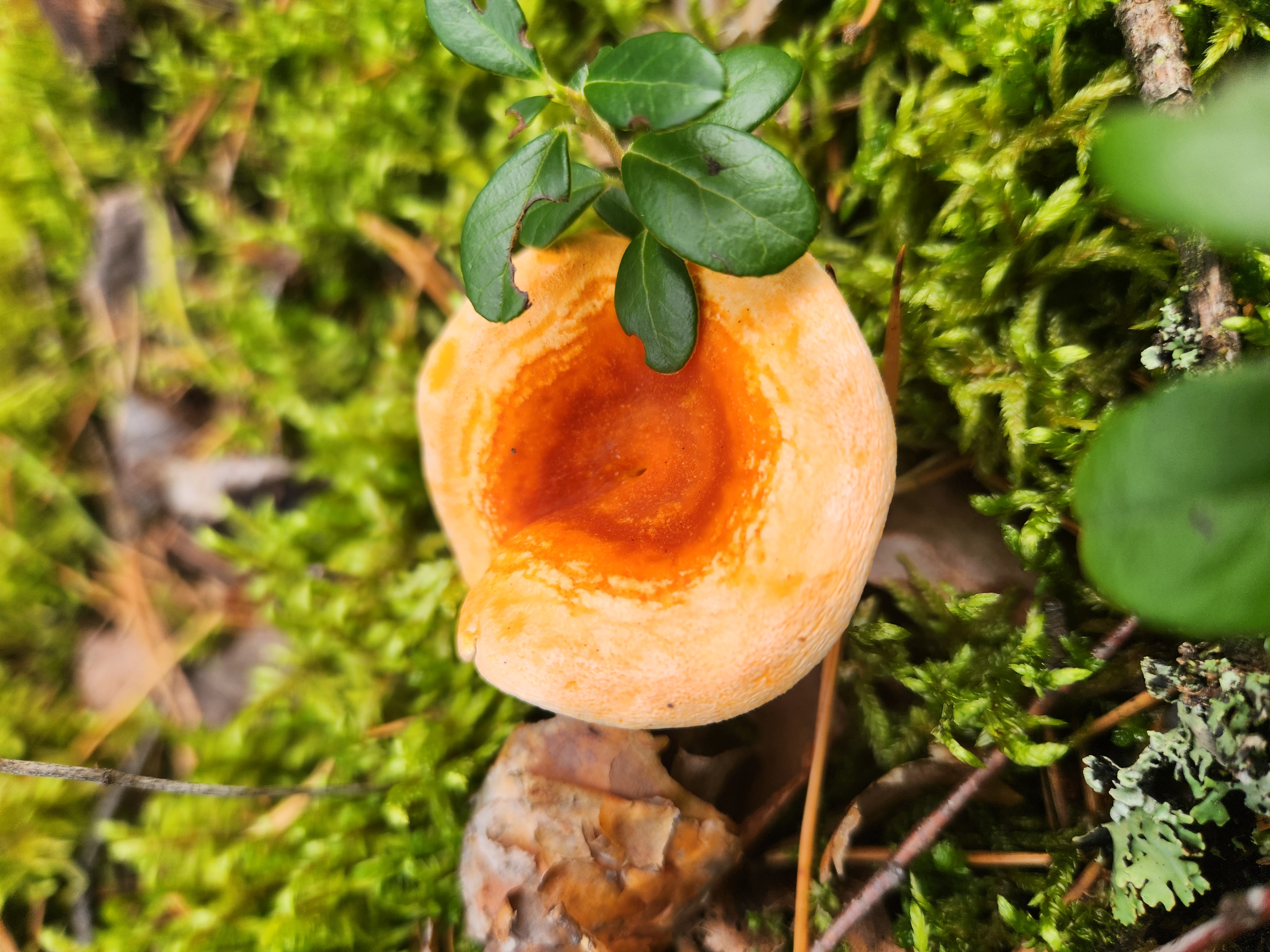
3–10 cm, plano-convex, later depressed to funnel-shaped, fleshy, with a downcurved or inwardly rolled, uneven wavy margin; dry, velvety, orange-red, ochre, golden-yellow, paler toward the margin, often finely scaly at the center, fading with age to whitish-rufous.
Hymenophore lamellate (gilled). Gills decurrent on the stem, crowded, branched, concolorous with the cap or more orange.
3–6 cm long and 0.3–1.0 cm in diameter; cylindrical, typically rather short, often curved at the base; becoming hollow with age; concolorous with the cap, darker in the lower part, with a very light narrow zone at the point where the gills meet the stem.
Dense, pinkish- and orange-yellow, thick in the center of the cap, with a somewhat unpleasant taste.
Odor: indistinct.
Spore print white. Spores thick-walled, dextrinoid, with a blunt base.
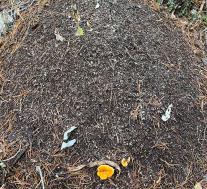
In coniferous and mixed forests, on soil and litter, on decaying and buried wood, on rotting stumps and roots, sometimes near anthills; singly and in large groups, very frequently. A widely distributed species throughout the Northern Hemisphere.
Not listed in the Red Data Book of the Russian Federation or regional Red Lists.
In mushroom literature, the False Chanterelle is often compared with the Common Chanterelle (Cantharellus cibarius), from which it is easily distinguished by the velvety surface of the cap and the presence of true gills instead of folds.
The ability to form sclerotia (compact masses of hardened fungal mycelium) has been documented for H. aurantiaca in laboratory studies. These structures contain glycogen and protein, which can be used as nutrient reserves during spore germination.
Add new comment