Funeral Bell (Galerina marginata)
Index Fungorum Galerina patagonica Singer
MycoBank Galerina marginata (Batsch) Kuhner
In colloquial usage, it bears names such as Funeral Bell, Deadly Skullcap, Autumn Skullcap, or Deadly Galerina. In honor of the lethal "funeral bell," the Estonian Post ("Eesti Post") issued a postage stamp featuring a menacing skull beneath these mushrooms. The stamp serves as a warning about the deadly danger posed by Galerina marginata, which appears so harmless and deceptively edible.
Part. perf. pass. of margino, āvī, ātum, āre — to border, to edge, to marginate.
Agaricus marginatus Batsch, Elench. fung., cont. sec. (Halle): 207 (1789)
Pholiota marginata (Batsch) Quél., Mém. Soc. Émul. Montbéliard, Sér. 2 5: 127 (1872)
Pholiota unicolor (Vahl) Gillet, Hyménomycètes (Alençon): 436 (1876)
Galerula unicolor (Vahl) Kühner, Bull. trimest. Soc. mycol. Fr. 50: 78 (1934)
Gymnopilus autumnalis (Peck) Murrill, N. Amer. Fl. (New York) 10(2) (1917)
Galerina autumnalis (Peck) A.H. Sm. & Singer, Monogr. Galerina: 246 (1964)
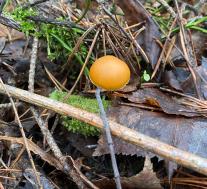
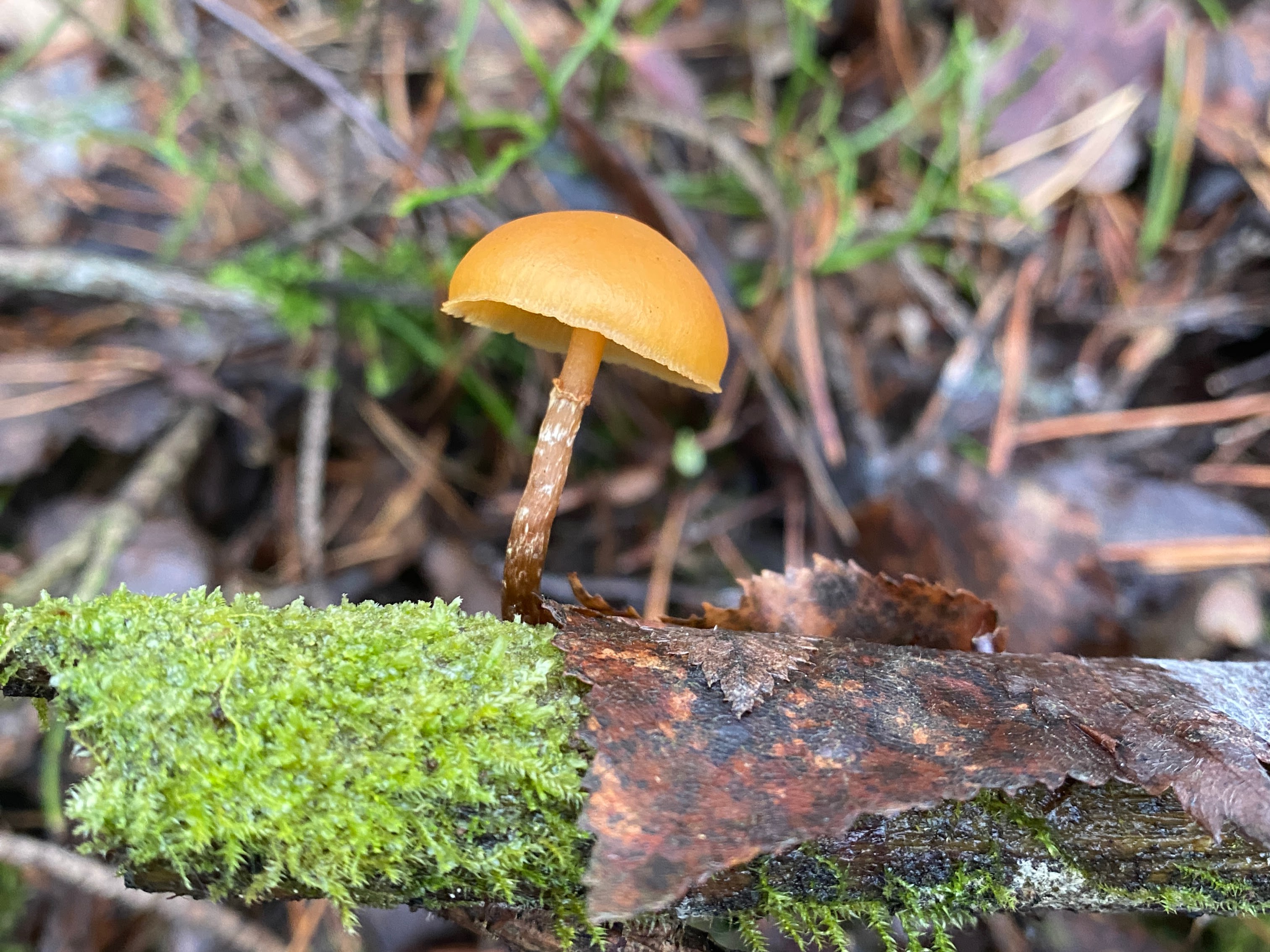
0.5–3 cm in diameter; initially bell-shaped or convex with an incurved margin, then convex or nearly flat with a small umbo; margin faintly striate-translucent; hygrophanous; when moist, slightly sticky, yellowish-brown or reddish-brown; when dry, shiny, yellow or yellow-ochre-brown.
Gills broadly adnate, often with a tooth, slightly decurrent onto the stipe, crowded, narrow; initially yellow-ochre or yellowish-brown, later yellow-brown or reddish-brown.
2–5 cm high and 0.1–0.5 cm in diameter; slightly thickened toward the base, hollow; with a whitish or yellowish, almost leathery or fibrous-filmy ring that sometimes nearly disappears; above the ring with a mealy coating, below the ring fibrous and concolorous with the cap.
Yellowish-brown, fibrous, with a mealy taste. Odor faint, mealy.
Spore print: rusty-brown. Spores almond-shaped, wrinkled-warty, usually with a slightly detachable, less often adherent or distinctly free perispore; with a suprahilar disc, and a callus or pore.
A xylotroph. Funeral Bell is widespread in the Northern Hemisphere, including Europe, North America, and Asia, and has also been found in Australia. It grows primarily in coniferous forests, on wood, stumps, at the base of tree trunks, and on exposed roots; it can also occur on soil rich in decaying wood, among mosses, or on wood buried beneath soil or leaf litter.
Not listed in the Red Data Books of the Russian Federation or its regional Red Lists.
The "classic" Summer Honey (K. mutabilis) fruits in large clusters (whereas Galerina, even when growing in groups, typically fuses in no more than 2–3 specimens). Overall, it is larger than Galerina (cap up to 6 cm in diameter); the lower part of its stipe is scaly (not fibrous, as in Galerina); and its flesh has a pleasant, somewhat fruity taste and odor (in Galerina, these are indistinct and mealy). The situation is much more complicated with the Woodland Brownie (K. lignicola), a rare and externally quite close relative of the Summer Honey. The main distinction of K. lignicola from K. mutabilis is precisely the absence of scales on the stipe below the ring. Sometimes K. lignicola is so similar to Galerina marginata that they can be considered look-alike species, indistinguishable without spore comparison. Therefore, only the most experienced foragers or field-working mycologists can confidently collect this mushroom.
The range of Funeral Bell has shifted significantly northward due to climate warming. It now grows quite abundantly in Central Russia, and most importantly, its range continues to expand further north.
Add new comment