Gallic Coriolopsis (Coriolopsis gallica)

Кориолопсис гальский
Current name

Index Fungorum   Coriolopsis gallica (Fr.) Ryvarden

MycoBank   Coriolopsis gallica (Fr.) Ryvarden

Other names

Gallic Polypore

Systematic position
Specific epithet etymology

Gallicus, a, um. 1) geographical: Gallic; from Gallia, ae f. Gaul (a region roughly covering the territories of present-day France and Belgium); 2) pertaining to a rooster; from gallus, i m. rooster + -icus, suffix denoting relation or belonging.

Synonyms

Funalia gallica (Fr.) Bondartsev & Singer, Ann. Mycol. 39 (1): 62 (1941) 

Trametes gallica (Fr.) Fr., Epicrisis Systematis Mycologici: 489 (1838) 

Trametella gallica (Fr.) Teixeira, Revista Brasil. Bot. 9 (1): 44 (1986) 

Hexagonia gallica (Fr.) Quél., Enchiridion Fungorum in Europa media et praesertim in Gallia Vigentium: 185 (1886)

Cerrena gallica (Fr.) Zmitr., Mycena 1 (1): 91 (2001) [MB#466360]

General description

In Coriolopsis gallica, as well as in phylogenetically related species of Trametes, laccases are the main mechanisms involved in lignin biodegradation.

Habit
Fruiting body
Sessile, bracket-shaped, hoof-shaped, or as an irregular crust/rosette
Hymenophore
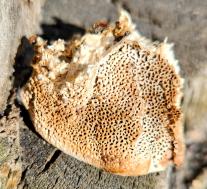
Tubulate, poroid
Fruiting period (list)
MayMay (11th–20th)May (21st–31st)JunJune (1st–10th)June (11th–20th)June (21st–30th)JulJuly (1st–10th)July (11th–20th)July (21st–31st)AugAugust (1st–10th)August (11th–20th)August (21st–31st)SepSeptember (1st–10th)September (11th–20th)
Fruit body

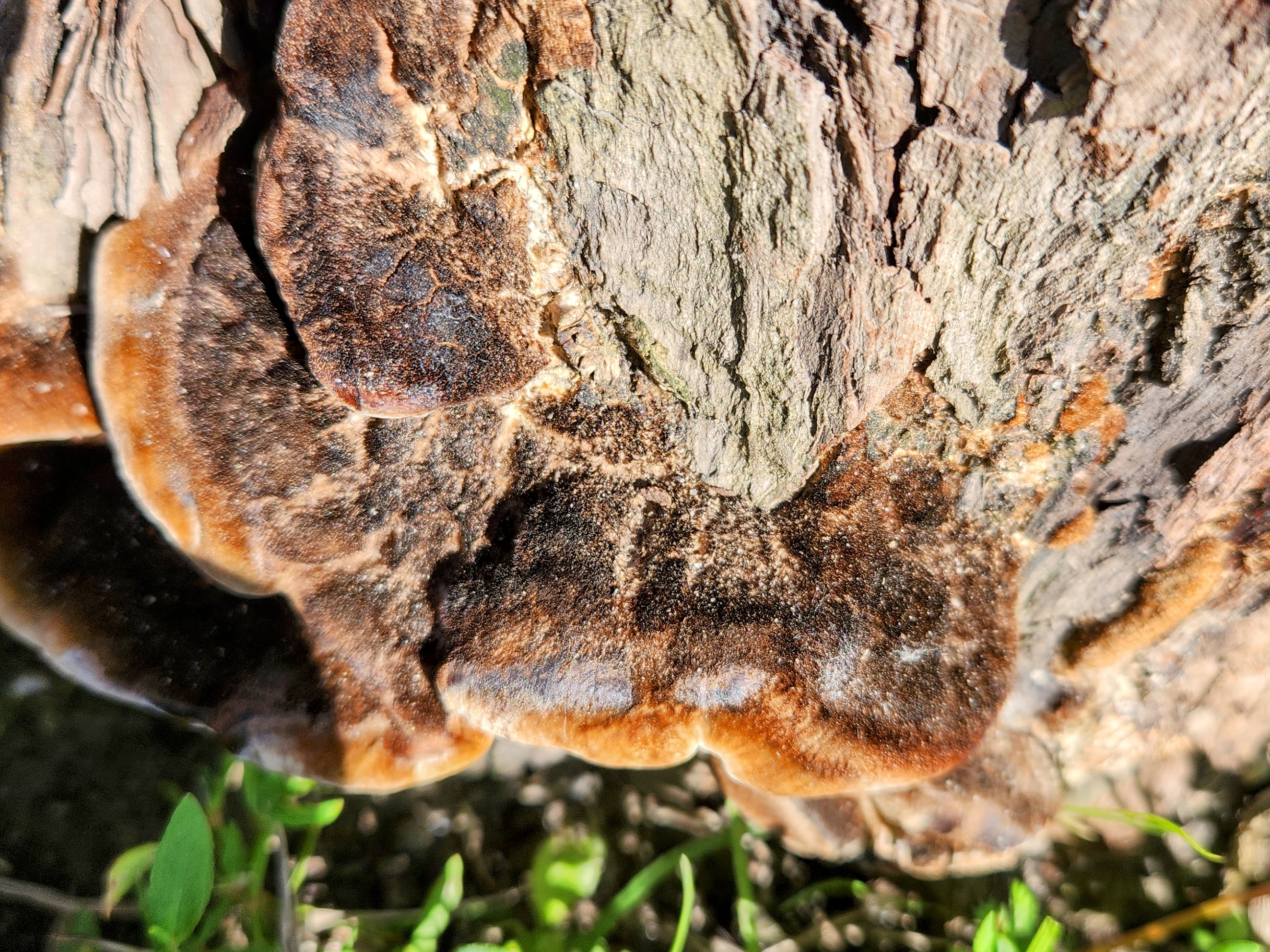
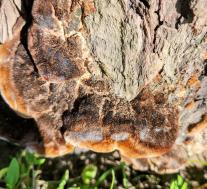
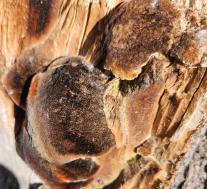
Annual, sometimes overwintering. Sessile, resupinate-reflexed, sometimes completely resupinate, solitary or imbricate, up to 2–7 cm wide and up to 3 cm thick at the base.

Cap surface: reddish-brown with faint zones and a tomentose pubescence.

Margin of the fruiting body: even, rather thin.

Hymenophore ochre-brown, darkening further with age.

Flesh

Dense, woody, brown, grayish-brown, sometimes with an olive tint; darkening (but not blackening) when treated with KOH.

Odor

Weak, mushroom-like with faint anise notes.

Microscopy

Spore print brown. Spores cylindrical, variable in size, 10–16 × 3–5 μm. Hyphal system trimitic, with clamped generative hyphae, thick-walled skeletal hyphae golden-brown in the trama and context, and branching binding hyphae. Skeletal hyphae cyanophilous and metachromatic.

Ecology and distribution

Xylotroph on dead deciduous trees; most commonly found on Salix (willow) and Populus (poplar, aspen); occurs on many native deciduous trees; may also colonize exotic trees in gardens and parks. Predominantly a southern (nemoral-subtropical) species. Found in Europe, North Africa, and Asia.

Fruiting

May–September.

Nutritional properties
Inedible
Similar species

Key identifying features are the large pores and the cap surface covered with stiff hairs, ranging from brown to gray; the cap color is brown.

Trog's Trametes (Trametes trogii) is generally a look-alike species. It is characterized by larger fruiting bodies, lighter coloration, and a more northern distribution range.

Link to this page for printed editions
Shipovalov A.G. Gallic Coriolopsis (Coriolopsis gallica) - Mushrooms of Vologda Region [Electronic resource] URL: https://xn----7sbancweblffgklubds60aja.xn--p1ai/en/gallic-coriolopsis-coriolopsis-gallica (accessed: 13.04.2026).
Share link

Add new comment

One file only.
2 MB limit.
Allowed types: png jpeg jpg jpe gif webp svg.
Allowed types: png gif jpg jpeg webp svg.

Plain text

  • No HTML tags allowed.
  • Lines and paragraphs break automatically.
  • Web page addresses and email addresses turn into links automatically.
Add image
Maximum 8 files.
2 MB limit.
Allowed types: png jpeg jpg jpe gif webp svg.
Allowed types: png gif jpg jpeg webp.
January (1st–10th)
January (1st–10th)
January (11th–20th)
January (11th–20th)
January (21st–31st)
January (21st–31st)
February (1st–10th)
February (1st–10th)
February (11th–20th)
February (21st–28th/29th)
March (1st–10th)
March (1st–10th)
March (11th–20th)
March (11th–20th)
March (21st–31st)
March (21st–31st)
April (1st–10th)
April (1st–10th)
April (11th–20th)
April (11th–20th)
April (21st–30th)
April (21st–30th)
May (1st–10th)
May (1st–10th)
May (11th–20th)
May (11th–20th)
May (21st–31st)
May (21st–31st)
June (1st–10th)
June (1st–10th)
June (11th–20th)
June (11th–20th)
June (21st–30th)
June (21st–30th)
July (1st–10th)
July (1st–10th)
July (11th–20th)
July (11th–20th)
July (21st–31st)
July (21st–31st)
August (1st–10th)
August (1st–10th)
August (11th–20th)
August (11th–20th)
August (21st–31st)
August (21st–31st)
September (1st–10th)
September (11th–20th)
September (21st–30th)
October (1st–10th)
October (1st–10th)
October (11th–20th)
October (11th–20th)
October (21st–31st)
October (21st–31st)
November (1st–10th)
November (1st–10th)
November (11th–20th)
November (21st–30th)
December (1st–10th)
December (1st–10th)
December (11th–20th)
December (21st–31st)