Gray Bolietopsis, Gray False Bolete (Boletopsis grisea)
Index Fungorum Boletopsis grisea (Peck) Bondartsev & Singer
MycoBank Boletopsis grisea (Peck) Bondartsev & Singer
Griseus, a, um, mycol. gray. From Latin griseus (gray, grizzled), possibly of Germanic origin (cf. Old High German grīs "gray, old").
Polyporus griseus Peck, Ann. Rep. N.Y. St. Mus. nat. Hist. 26: 68 (1874)
Scutiger griseus (Peck) Murrill, Bull. Torrey bot. Club 30(8): 431 (1903)
Polyporus involutus Britzelm., Botan. Zbl. 68(5): 140 (1896)
Polyporus earlei Underw., Bull. Torrey bot. Club 24: 84 (1897)
Polyporus maximovicii Velen., České Houby 4-5: 669 (1922)
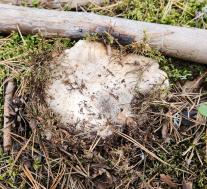
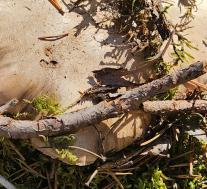
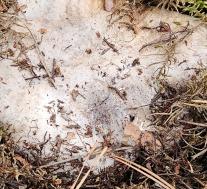
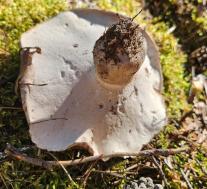
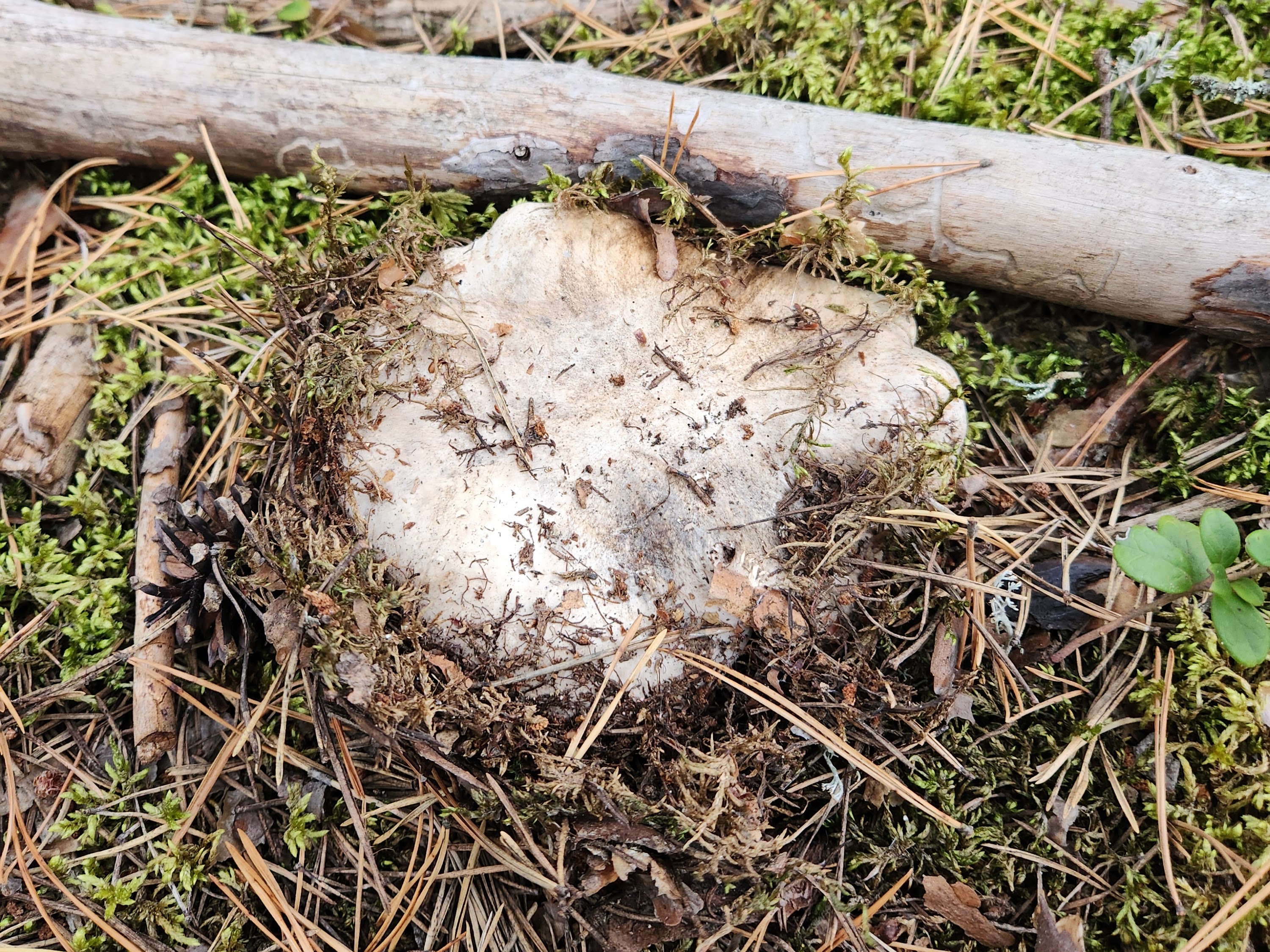
Cap 5–15 cm in diameter, occasionally even larger; initially plano-convex with an inrolled margin (young Boletopsis specimens resemble young Lactarius), quickly becoming flat, sometimes slightly depressed, with an uneven, wavy, or lobed margin. The surface is initially matte and smooth; with age, it gradually cracks radially or into small scale-like shields, especially toward the center. In very young fruiting bodies hidden in the litter and sand, the coloration is almost snow-white, but the mushroom soon begins to gray and darken rather unevenly; in mature specimens, the predominant cap color is slate-gray with lighter smudges and streaks, and darker areas—especially in cracks and damaged spots—with brownish or occasionally wine-red tones. Old or frost-damaged mushrooms turn brown, sometimes becoming completely black.
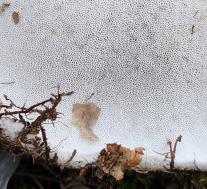
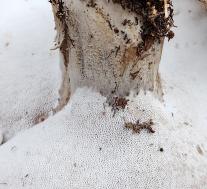
The hymenophore is tubular and slightly decurrent; initially snow-white, but as the mushroom grows and the pores expand, it acquires a brownish or pinkish-gray hue, because the pores are darker in their deeper parts; it darkens rapidly when damaged, developing brown or wine-red tones. The pores are initially rounded; as the mushroom matures, they become radially elongated, irregularly shaped in small areas of the hymenophore, labyrinthine, 3–4 per mm, with white margins.
Stipe short, 2–7 cm long, 1–3.5 cm in diameter, central, solid, concolorous with the cap surface; with age, it becomes covered with small scales and sometimes splits or cracks longitudinally. The flesh of the stipe is grayish-white, darker at the base with olive-green or malachite tones, and darkens rapidly when broken.
Flesh rather brittle, especially in the radial direction, not tough, white; when broken, it darkens relatively quickly and unevenly, acquiring brown or grayish-pink tones. Taste mild.
Mushroom-like odor with floral-perfumery notes; occasionally, specimens with a putrid smell have been encountered. The odor may depend on the associated host plant.
Spores 5–6.5 × 4–5 μm, angular or warted, nearly spherical, thin-walled, yellowish in mass, non-amyloid.
Basidia 15–25 × 5–7 μm, clavate, with a clamp connection at the base [5].
Cystidia absent.
Grows on sandy, nutrient-poor soils in dry pine forests; forms mycorrhiza with Scots pine (Pinus sylvestris). A consistently rare species throughout its range, it is highly sensitive to soil contamination by nitrogen compounds and therefore suffers from proximity to agricultural land and livestock grazing. The species serves as an indicator of biologically valuable forests. The fungal mycelium is considered long-lived, potentially persisting from several decades to centuries—comparable to the lifespan of its associated host plants.
In the Vologda Region, it has been recorded in the Kaduy and Babaevo districts, in white-moss pine forests.
In Eurasia, the Gray Bolete (Boletopsis grisea) is a species with declining numbers on a global scale. The population of this species is closely tied to the health of clean, old-growth natural pine forests, which are becoming increasingly scarce. It is included in the Red Data Books of several European countries; in Poland, it is considered extinct. In 2014, Boletopsis grisea was included in the IUCN Red List of Threatened Species. It is listed as Endangered under criteria A2c+3c+4c. The species is also included in several regional Red Data Books.
Category 3. Vulnerable species.
Category 2. Vulnerable species.
Category 4. Species of uncertain status and category based on current data.
Black-and-White Bolete (Boletopsis leucomelaena) — with more contrasting coloration; strictly associated with spruce forests, forms mycorrhiza with spruce (Picea). No data on its distribution in the Vologda Region.
Perplexing Bolete (Boletopsis perplexa) — a species externally similar to the black-and-white bolete (see above), but associated with pine (Pinus). Not yet recorded in the Vologda Region.
The actual distribution of *Boletopsis grisea*, its resilience, and generation time may be underestimated, and there is a need for further research and possibly a reassessment of the conservation status of its populations.
In 2022, two new *Boletopsis* species, *B. macrocarpa* and *B. tibetana*, were described and illustrated from Southwest China based on morphology, ecology, and phylogenetic analysis of the internal transcribed spacer regions (ITS) and the large subunit of the nuclear ribosomal RNA gene (nLSU).
Add new comment