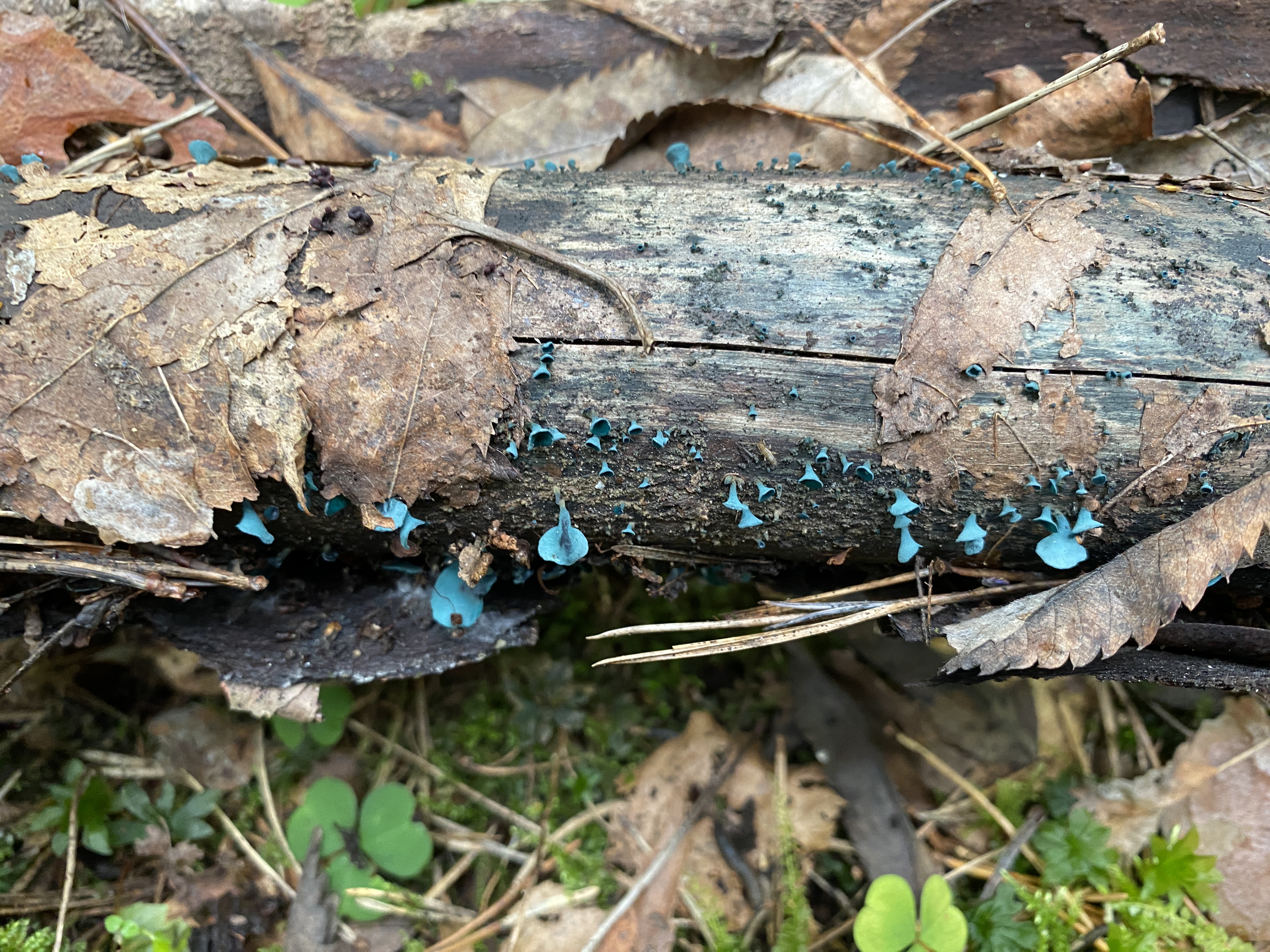
Rarely can a fungus be observed without the formation of fruiting bodies, but Green Elfcup (Chlorociboria aeruginascens) quite allows this. Colonizing dead wood, this fungus stains it in delicate blue-green tones. The pigment xylindein is responsible for this. Such wood, the so-called "green oak," was used by Italian Renaissance craftsmen for inlays and mosaics.
Specific epithet etymology
Aerūginascens (mycol.) becoming blue-green. From aerugo, inis, f, copper rust, blue-green + Part. praes. act. of nāscor, nātus sum, nāscī 1- to be born, to originate
Synonyms
Chlorociboria aeruginascens subsp. australis P.R. Johnst., in Johnston & Park, N.Z. Jl Bot. 43(3): 684 (2005)
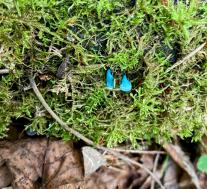
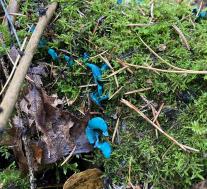
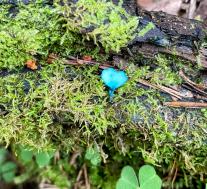
About 0.5–2 cm in height, cup-shaped when young, later resembling "ears" with an eccentric stem, often with an uneven wavy margin; surface smooth, blue-green, turquoise.
Hymenium: The upper spore-bearing (inner) surface is smooth, bright turquoise, darkening with age.
Stem: Short, 0.5–1.5 mm, rough, with a whitish bloom.
Flesh
Thin, turquoise. Odor weak, indistinct.
Microscopy
Spore print white. Spores from nearly cylindrical to fusiform, smooth, with an oil droplet at both ends.
Ecology and distribution
Saprotroph. Grows on dead wood of deciduous trees.
Conservation status
Similar species
Blue-green Chlorociboria (Chlorociboria aeruginosa) — fruiting bodies are saucer-shaped, on a central stem. Has longer spores.
Notes
The pigment xylindein is currently being actively researched both in biology—as this pigment exhibits, for example, algicidal activity—and in electronics, where researchers are studying the semiconductor properties of materials derived from this pigment.
Related resources
Breitenbach J, Kränzlin F. Fungi of Switzerland. A contribution to the knowledge of the fungal flora of Switzerland. Vol 1. Ascomycetes. — Lucerne: Verlag Mykologia, 1984. — 310 p. — P. 176. [As Chlorosplenium aeruginascens] Beug M. W., Bessette A. E., Bessette A. R. Ascomycete fungi of North America. A mushroom reference guide. — University of Texas Press, 2014. — 488 p. — P. 367.
Ramamurthi C. S., Korf R. P., Batra L. R. A revision of the North American species of Chlorociboria (Sclerotiniaceae). // Mycologia. — 1957. — V. 49 (6). — P. 854–863.
Blanchette R.A., Wilmering A.M., Baumeister M. The Use of Green-Stained Wood Caused by the Fungus Chlorociboria in Intarsia Masterpieces from the 15th Century. // Holzforschung. — 1992. — V. 46 (3). — P. 225–232.
Saikawa Y., Watanabe T., Hashimoto K., Nakata M. Absolute configuration and tautomeric structure of xylindein, a blue–green pigment of Chlorociboria species. // Phytochemistry. — 2000. — V. 55 (3). — P. 237–240.
Add new comment