Gymnopilus penetrans
Index Fungorum Gymnopilus penetrans (Fr.) Murrill
MycoBank Gymnopilus penetrans (Fr.) Murrill
Penetrāns penetrating. Part. praes. act. to penetro, āvī, ātum, āre, to penetrate.
Agaricus penetrans Fr., Observationes Mycologicae 1: 23 (1815) - Basionym
Flammula penetrans (Fr.) Quél., Mém. Soc. Émul. Montbéliard Ser. 2, 5: 252 (1872)
Dryophila penetrans (Fr.) Quél., Enchiridion Fungorum in Europa media et praesertim in Gallia Vigentium: 1-352 (1886)
Fulvidula penetrans (Fr.) Singer, Rev. Mycol. (Paris) 2 (6): 239 (1937)
Naucoria penetrans (Fr.) Henn. (1898)
Flammula penetrans var. penetrans (?)
Flammula croceolamellata Pilát, Bull. Soc. Mycol. Fr.: 251 (1939)
Flammula penetrans var. madagascariensis Henn., Bot. Jahrb. Syst. 17: 35 (1893)
Agaricus penetrans var. australis Berk., Bot. J. Linn. Soc. 13: 158 (1872)
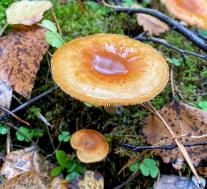
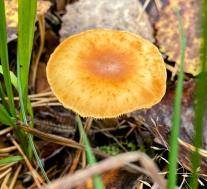
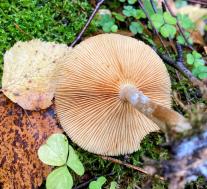
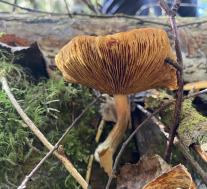
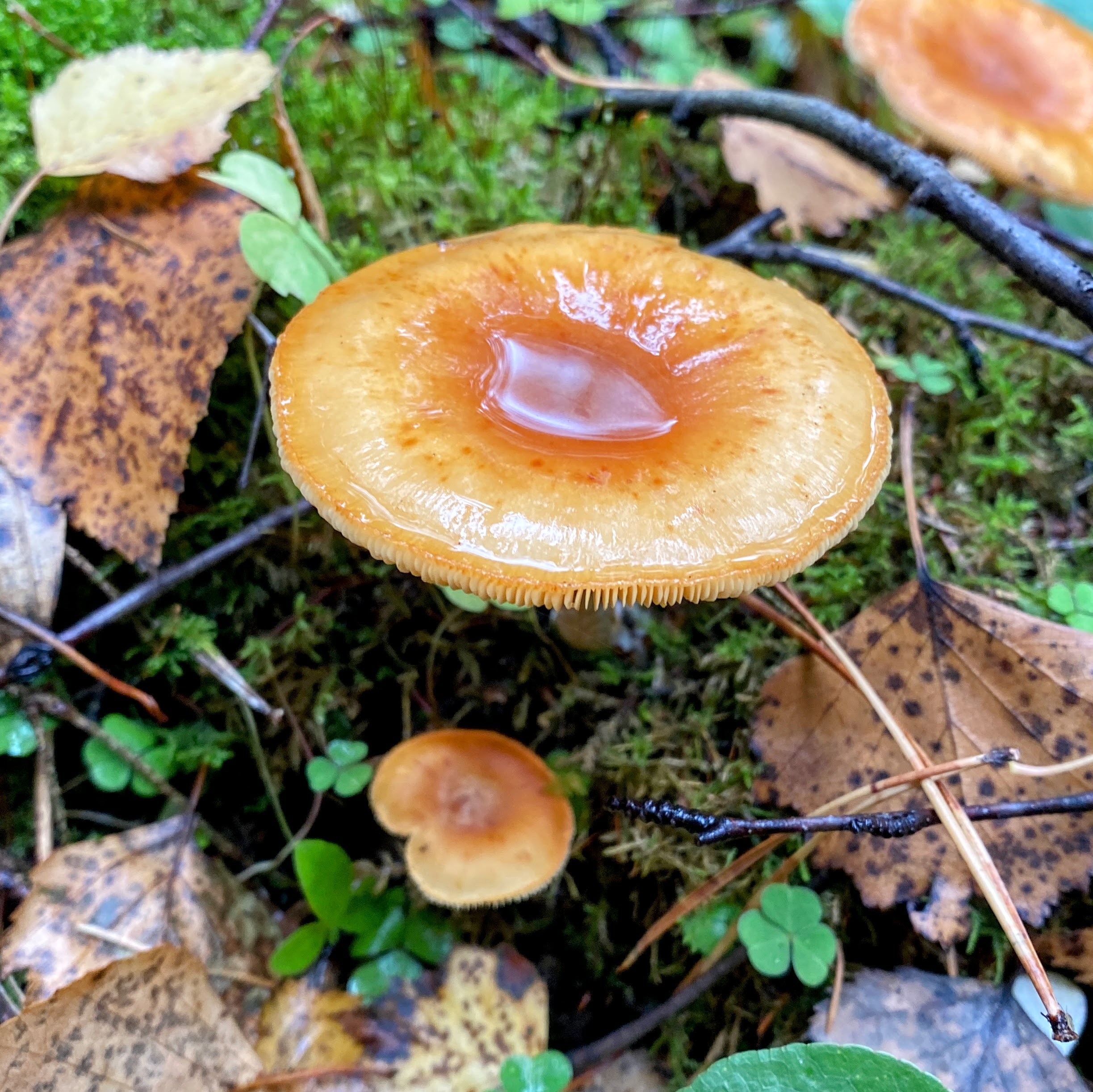
3–9 cm in diameter. Broadly bell-shaped or hemispherical, later convex-expanded, often nearly flat at maturity, sometimes with a broad, rounded umbo; occasionally slightly depressed in over-mature specimens.
Brownish-orange, reddish- or rusty-brownish, or brownish; sometimes paler towards the margins, ranging to straw-yellow or cream. The center may be brown. Sometimes marked with darker spots or streaks. Smooth; slightly slimy and sticky when wet and shiny; matte and finely fibrous when dry. Margin: initially incurved, later expanding; in dry weather, the margin of mature and old specimens may become wavy.
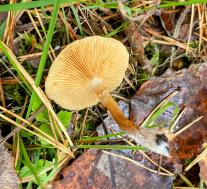
Gills adnate with a decurrent tooth to slightly decurrent, moderately spaced; initially cream or pale straw-colored, later developing darker brownish spots, and becoming rusty-brown at maturity.
3–7 cm long and up to 0.8 cm in diameter. Cylindrical, often tapering at the base, straight or curved. Near the gills at the top, it is nearly white or pale cream; the middle and lower sections feature longitudinal rusty-brown streaks and spots, often with a whitish bloom at the base. It has a longitudinally fibrous texture.
Thin, firm, and fibrous; yellowish to straw-yellow in the cap, and brownish and tough in the stem. The color does not change when broken. It tastes bitter in all parts of the mushroom.
Faint mushroom scent.
The spore print is rusty-brown. Spores are 7–8.5 x 4.5–5 µm, ellipsoid, slightly inequilateral in profile, and warty.
It is found frequently—and sometimes abundantly—in coniferous and mixed forests, growing in small, scattered groups, tight clusters, or singly on old, rotten stumps, fallen trunks, buried woody debris, mulch, and thick fallen branches (usually coniferous, occasionally deciduous).
Distribution: European Russia, Crimea, the Caucasus, the Urals, Western Siberia, Transbaikalia, and Kamchatka. It is widely distributed across Europe and North America (including Alaska), as well as in Central and South America, Southeast Asia, Australia, and New Zealand; on the African continent, it occurs only in the south. *G. penetrans* is often regarded as a complex of cryptic species, and some specimens may actually belong to other species.
-Gymnopilus sapineus (pine or spruce gymnopilus) is a larger species distinguished by an unpleasant odor of decaying wood; it also occurs frequently and abundantly on the same substrates. It is poisonous;
- Flammula alnicola (alder scalycap) and other *Flammula* species are lighter in color—featuring cream, straw, or golden tones—and grow in clusters in deciduous and mixed forests on the wood of various deciduous trees; only *F. alnicola* has a bitter taste. They are non-toxic;
- Pholiota species are distinguished by the presence of a ring or ring-like zone, even in mature specimens, and by gills that are paler at maturity—gray or grayish-brown rather than rusty. The genus includes both bitter, inedible species and non-bitter, edible ones; only *P. mixta* is poisonous;
- Gymnopilus can be distinguished from Kuehneromyces mutabilis (sheathed woodtuft/summer honey fungus) by the absence of a ring, the bitter taste of the flesh, and its growth on the wood of deciduous trees.
Add new comment