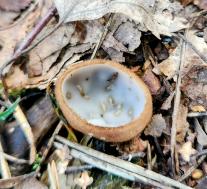
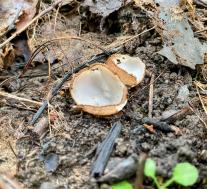
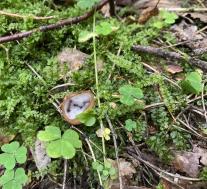
Apothecia are 10–30 mm in diameter and 10–20 mm in height, sessile, initially spherical, and open to cup- or saucer-shaped when mature. The upper, spore-bearing surface is smooth, white, pale yellow, or grayish. The lower, sterile surface is brownish-yellow or brown, densely covered with brown hairs 1–1.5 mm long.
Humaria hemisphaerica (Haarige Feenschale)
Index Fungorum Humaria hemisphaerica (F.H. Wigg.) Fuckel
MycoBank Humaria hemisphaerica (F.H. Wigg.) Fuckel
Hemisphaericus, a, um, hemispherical, semi-spherical. From ήμι- semi- + sphaericus, a, um, spherical. Also σφαίρα, ball, sphere.
Peziza hemisphaerica F.H. Wigg., Prim. fl. holsat. (Kiliae): 105 (1780) - Basionym
Lachnea hemisphaerica (F.H. Wigg.) Gillet, Champignons de France, Discom. (3): 73 (1880)
Sepultaria hemisphaerica (F.H. Wigg.) Lambotte, Mém. Soc. roy. Sci. Liège, Série 2 14: 302 [prepr.] (1887)
Scutellinia hemisphaerica (F.H. Wigg.) Kuntze, Revis. gen. pl. (Leipzig) 2: 869 (1891)
Mycolachnea hemisphaerica (F.H. Wigg.) Maire, Publ. Inst. Bot. Barcelona 3 (no. 4): 24 (1937)
Peziza replicata Tode, Schr. Ges. naturf. Freunde, Berlin 4: 269 (1783)
Lachnea hemisphaerica var. replicata (Tode) Sacc., Syll. fung. (Abellini) 8: 167 (1889)
Peziza hispida Sowerby, Col. fig. Engl. Fung. Mushr. (London) 2: tab. 147 (1798)
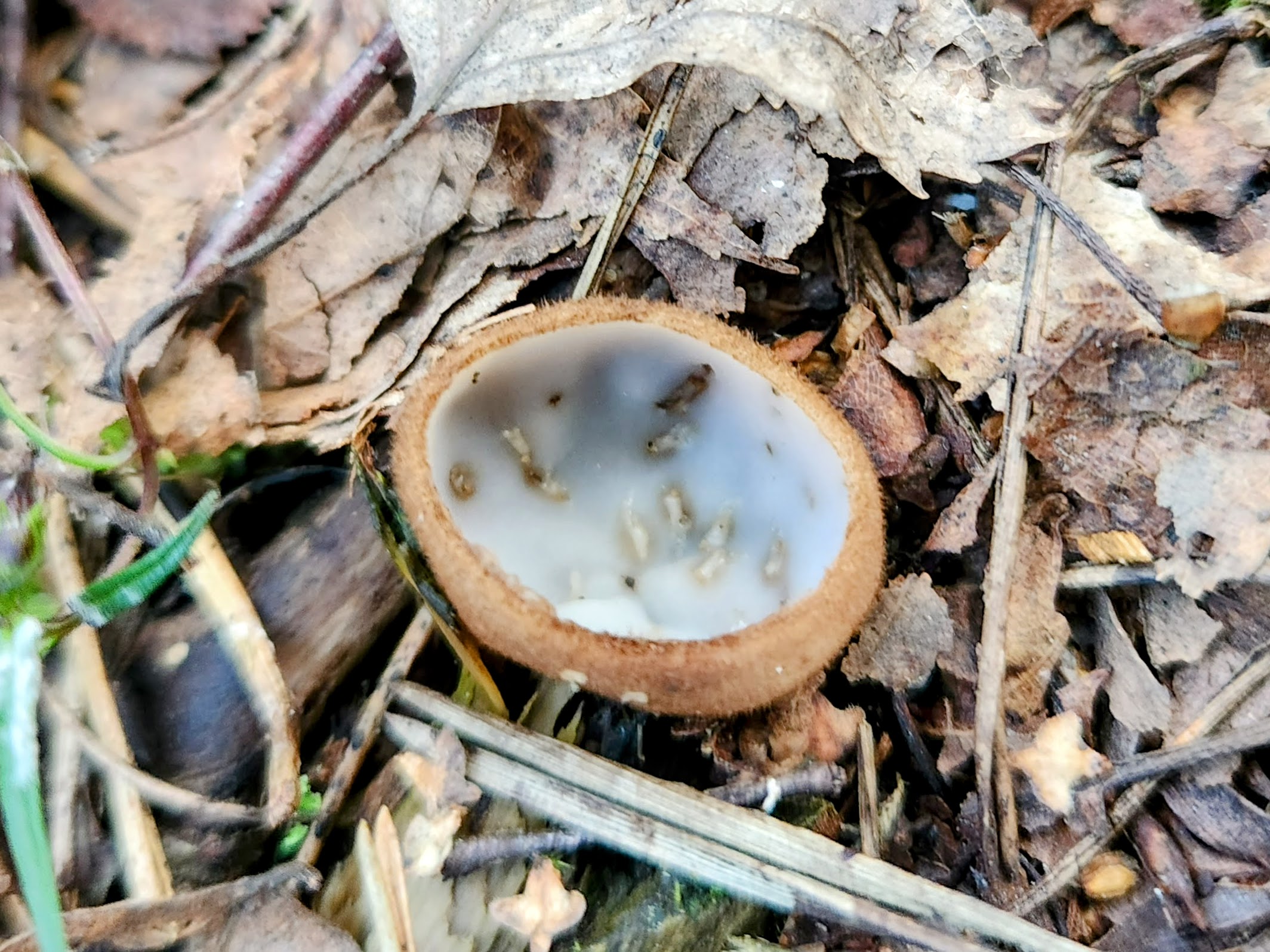
Thin, fragile, greyish, without a distinct taste.
Weak, mushroomy.
Spore powder: white. Spores: ellipsoidal, finely warty, 18-25 x 12-14 µm, hyaline, with two, rarely one drop of oil.
It grows in groups on the soil, among mosses, or on rotting wood. It forms mycorrhiza with deciduous trees.
Trichophaea hemisphaerioides, a very similar species, is distinguished by its much smaller spores.
Humaria hemispherica is often affected by the parasitic fungus Hypomyces stephanomatis, which deforms the fruiting bodies and colors them lead-blue.
Add new comment