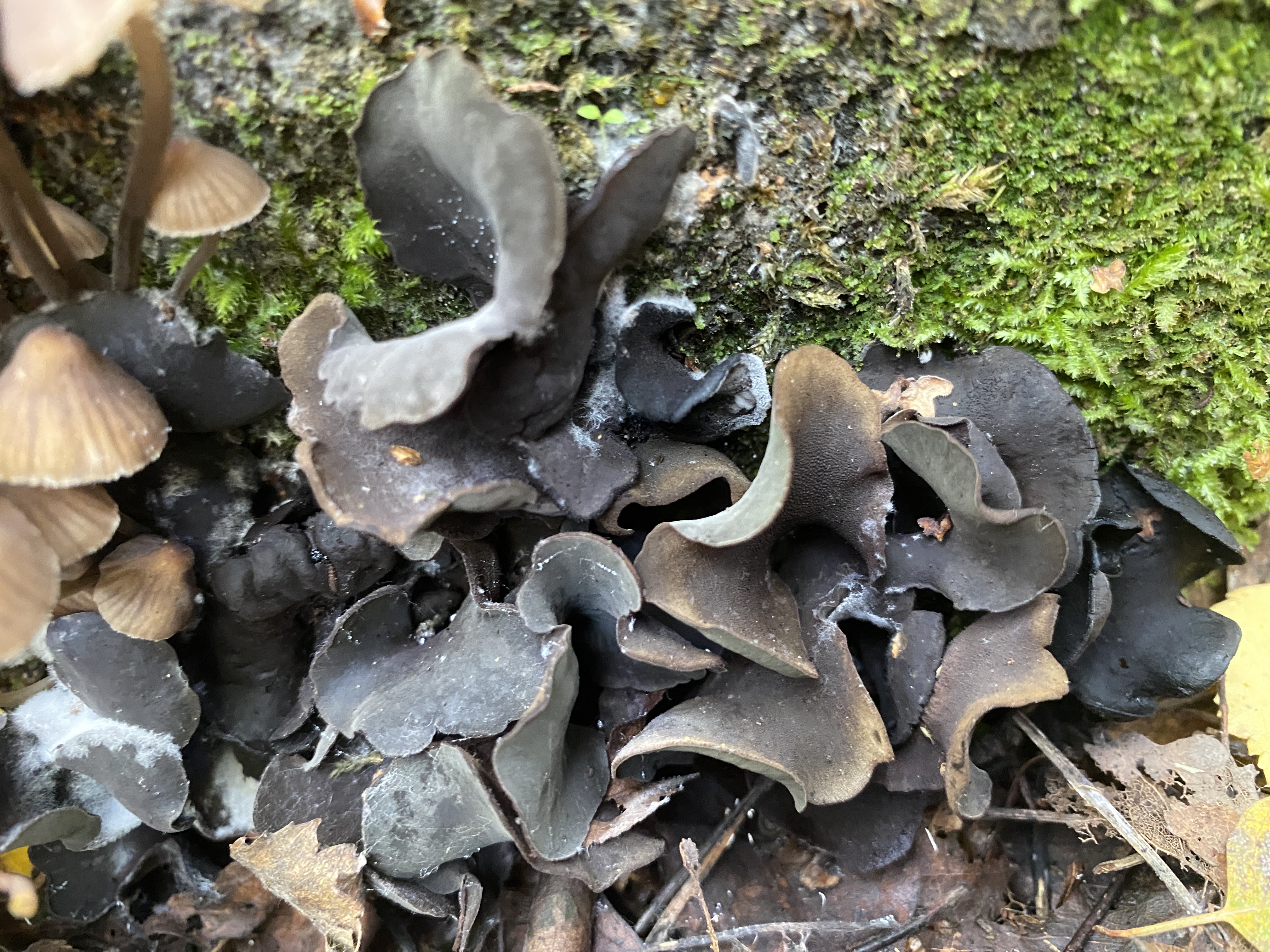
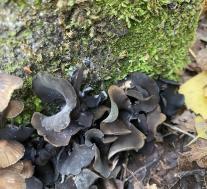
Small, clustered lobes, densely seated on short stipes. The outer surface is brown with an olive tint, covered with a powdery layer that rubs off easily. The hymenium is smooth, changing color from olive-black or violet-black to nearly black as it matures. The inner layer is gelatinous.
Flesh
Elastic, leathery.
Odor
Weak odor of decaying wood and musty meat.
Microscopy
Spore print white. Spores ellipsoidal, with large droplets. All parts of the fruiting body turn a drop of alkali purple.
Ecology and distribution
Xylotroph. The fungus is associated with deadwood and decaying wood of broad-leaved trees. It can be noted that in some cases a wide trophic specialization is observed—the fungus has been recorded on deadwood of birch, alder, and elm. However, when beech is present in the region, the fungus most often colonizes this substrate. The species is considered a good indicator of undisturbed forest ecosystems.
Conservation status
Red Data Book of the Leningrad Region.
Status 2 — vulnerable species.
Limiting factors: association with habitats rare in the region. Logging, construction of linear infrastructure, and development lead to fragmentation, reduction, and destruction of potential habitats, as well as removal of suitable substrates for the species.
Conservation measures: a ban on development, clear-cutting, and construction of linear infrastructure in the species' habitats is necessary, along with the establishment of planned protected natural areas.
Red Data Book of Saint Petersburg.
Status 3 — vulnerable species.
Conservation measures: A ban on logging in parks and forests at sites where the species occurs is necessary.
Red Data Book of Khanty-Mansi Autonomous Okrug – Yugra.
Status 4. Species of uncertain status.
Limiting factors: Not studied. Threats include habitat destruction (old-growth forests) and removal of woody debris in recreational areas.
Red Data Book of the Novgorod Region.
Status 3. Vulnerable species.
Limiting factors: Association with old-growth forest communities.
Similar species
Other species of Diplocarpa or Ionomitidis.
Notes
In the photograph above, it can be noted that Mycena sp. participates in the joint colonization of the substrate. It can also be noted that some other species from the genus Ionomitidis are associated in their development with fungi from the group Pyrenomycetes.
Related resources
Red Data Book of the Leningrad Region: Objects of the Plant Kingdom / Ed. by D. V. Geltman. St. Petersburg: Marathon, 2018. 848 p.
Red Data Book of Khanty-Mansi Autonomous Okrug–Yugra: Plants, Animals, Fungi. 3rd ed., revised and expanded / Ed. by V. P. Starikov. Kemerovo: LLC "Vector-Print", 2024. 520 p.
Red Data Book of Saint Petersburg / Committee for Natural Resource Use, Environmental Protection and Ecological Safety, Komarov Botanical Institute [et al.; editorial board: D. V. Geltman (executive ed.) et al.]. — Saint Petersburg: Diton, 2018. — 568 p.
Red Data Book of the Novgorod Region / Ed. by Yu. E. Vetkin, D. V. Geltman, E. M. Litvinova, G. Yu. Konechnaya, A. L. Mishchenko. — Saint Petersburg, Diton Publishing, 2015. — 480 p.
Add new comment