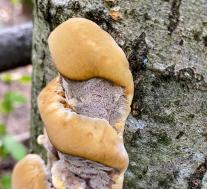
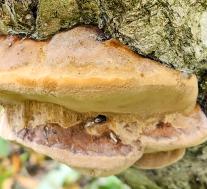
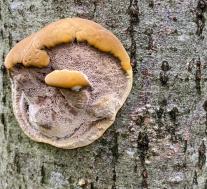
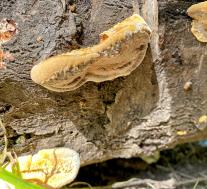
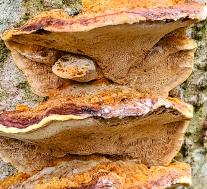
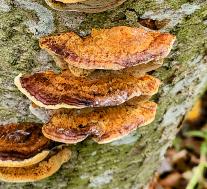
Annual, sessile, semicircular or kidney-shaped, and triangular in cross-section. They often grow on the wood in an imbricate (shingle-like) arrangement, with their bases fused together. Under favorable weather conditions, they exhibit guttation. They are relatively small in size. Resupinate (flat, crust-like) forms are sometimes found on fallen wood.
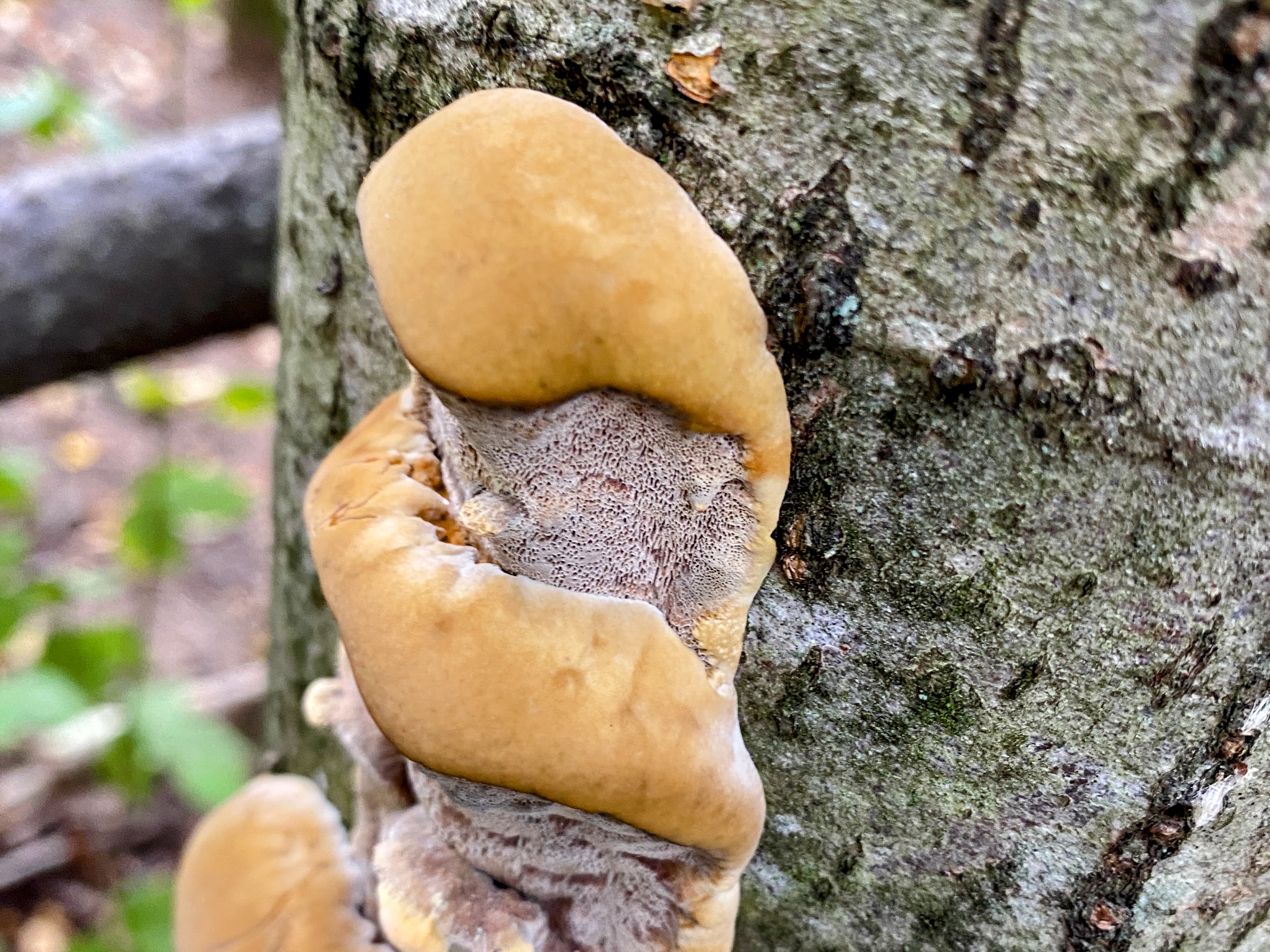
The upper surface is velvety or slightly downy and yellowish or light brown in young specimens. With age, it becomes smooth with a silky sheen, radially wrinkled or warty, and takes on rusty-brown or dark-brown hues with distinct concentric zones. Overwintered specimens turn black and crack.
The hymenophore is tubular, with small, angular pores (3–4 per mm). It is light yellow in young specimens, later becoming grayish-brown and darkening noticeably when touched or pressed.
Mensularia radiata
Index Fungorum Xanthoporia radiata (Sowerby) Ţura, Zmitr., Wasser, Raats & Nevo
MycoBank Mensularia radiata (Sowerby) Lázaro Ibiza
Radiātus, a, um: radiant; illuminated. Perfect passive participle of radio (radiāns - shining, sparkling, gleaming; present active participle of radio, āvī, ātum, āre - to emit rays, shine, sparkle, gleam).
Boletus radiatus Sowerby, Coloured Figures of English Fungi or Mushrooms 2: 83, t. 196 (1799) - Basionym
Inonotus radiatus (Sowerby) P. Karst., Rev. Mycol. (Toulouse) 3 (9): 19 (1881)
Polyporus radiatus (Sowerby) Fr., Systema Mycologicum 1: 369 (1821)
Inoderma radiatum (Sowerby) P. Karst., Meddeland. Soc. Fauna Fl. Fenn. 5: 39 (1879)
Inodermus radiatus (Sowerby) Quél., Enchiridion Fungorum in Europa media et praesertim in Gallia Vigentium: 174 (1886)
Ochroporus radiatus (Sowerby) J. Schröt., Krypt.-Fl. Schlesien 3(1): 485 (1888)
Microporus radiatus (Sowerby) Kuntze, Revisio generum plantarum 3 (3): 497 (1898)
Xanthochrous radiatus (Sowerby) Pat., Essai taxonomique sur les familles et les genres des Hyménomycètes: 100
Polystictus radiatus (Sowerby) Cooke, Grevillea 14 (71): 82 (1886)
Trametes radiata (Sowerby) Fr., Summa vegetabilium Scandinaviae 2: 323 (1849)
Xanthoporia radiata (Sowerby) Ţura, Zmitr., Wasser, Raats & Nevo: 270 (2012)
Polyporus coffeaceus Velen., České Houby 4-5: 684 (1922)
Polyporus aureonitens Pat., Rep. (Annual) New York State Mus. Nat. Hist. 42: 121 (1889)
Polyporus polymorphus Rostk., Deutschlands Flora, Abt. III. Die Pilze Deutschlands 4-17: 115, t. 56 (1838)
Rusty-brown, with zonate banding. In young mushrooms, it is soft and watery, but with age, it quickly becomes dry, hard, and fibrous.
Mushroom.
The spore print is yellowish. The spores are ellipsoid or ovoid, smooth, and hyaline, measuring 5–6.5 × 3–4.5 µm.
It is widely distributed in the temperate zone of the Northern Hemisphere. It prefers the weakened living or dead trunks of deciduous trees. It is found particularly often on Alnus (black and grey alder), as well as on Betula, Populus, and Salix. It causes white rot.
Mensularia nodulosa (lumpy bracket) is a southern species with small fruit bodies (1–2 cm) that can, however, fuse into large clusters. It fruits on beech and other deciduous trees [1].
Inocutis rheades (fox-colored bracket) is slightly larger, distinctly hairy, and has a reddish-brown cap; with rare exceptions, it grows on aspen. It also features a so-called "sandy core" at the base—a harder, brown core with white streaks.
Pseudoinonotus dryadeus (oak bracket) is a very large species characterized by profuse guttation. It is usually found singly at the base of living oaks, and less frequently on other broad-leaved trees.
Add new comment