In English, it is known by the common name "mulberry slime mold"
Specific epithet etymology
montānus, a, um — mountain, of the mountain. From mōns, montis m — mountain, rock, boulder + -ānus (suffix forming adjectives denoting relation or belonging).
General description
Mountain Tubifera was first described for science in 2015.
Plasmodium. Colorless or pale pink, inhabits moist, hard-to-reach places. Capable of active movement.
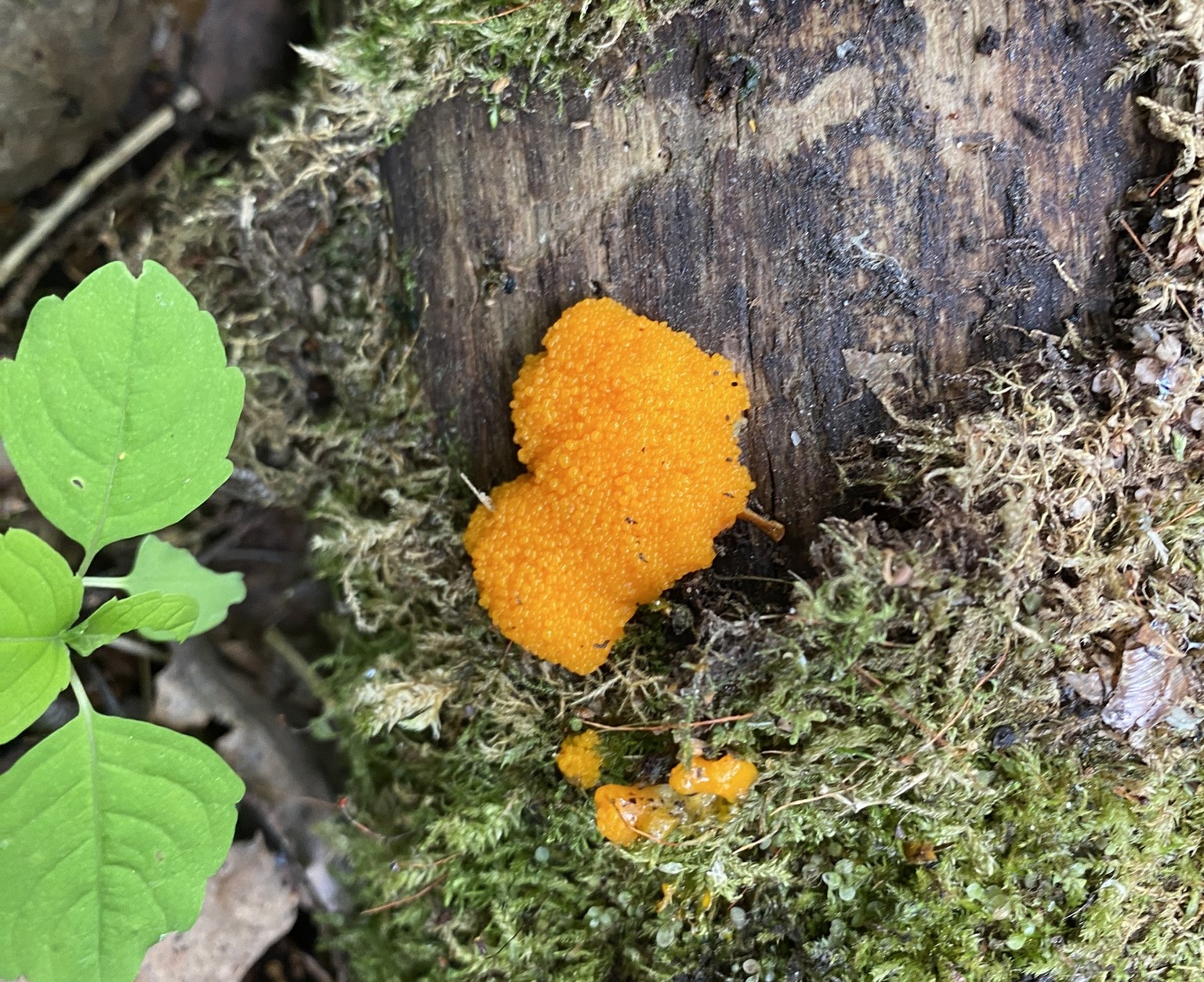
Pseudoaethalium. Formed by groups of sporangia. Arranged in clusters but not merging into a true aethalium, forming a pseudoaethalium consisting of vertically oriented tubes 2–8 mm high and 3–4 mm in diameter. The size of the pseudoaethalium varies from 1 to 10 cm. General shape cushion-like, hemispherical, or spread-out. Color changes depending on maturity: in young stage it has a bright, saturated orange color; at maturity the color fades, turns brown, and after the sporangia open and release the spore mass, it becomes almost black.
Flesh
In young stage tender, gelatinous, soft. At maturity brittle.
Odor
Absent
Microscopy
Pseudocapillitium absent. Spores rust-brown in mass, ornamented with a net-like pattern.
Ecology and distribution
Widely distributed in forest ecosystems around the globe. Common in coniferous and broad-leaved forests of the temperate zone of the Northern Hemisphere. On decaying wood.
Similar species
The most well-known is the polymorphic species Rusty Tubifera (Tubifera ferruginosa), widespread throughout forests of the Northern Hemisphere. It is distinguished by the red color of its pseudoaethalium.
Notes
Obviously, representatives of another kingdom are not the most expected guests on a mushroom website, but since mycologists are currently engaged in the study of slime molds, this seems quite justified to us.
Related resources
Dela Cruz T. E. E., Olayta C. O. M. Citizen Taxonomy in Social Media: The Use of Facebook for Mapping Species Distribution of Myxomycetes //The American Biology Teacher. – 2022. – Т. 84. – №. 4. – С. 189-194.
Dudka I. O., Leontyev D. V. The first records of myxomycetes in Cheremosh and Verkhovyna National Parks. – 2017.
Leontyev D. V., Schnittler M., Stephenson S. L. A critical revision of the Tubifera ferruginosa complex //Mycologia. – 2015. – Т. 107. – №. 5. – С. 959-985.
Add new comment