Index Fungorum Daedaleopsis septentrionalis (P. Karst.) Niemelä
MycoBank Daedaleopsis septentrionalis (P. Karst.) Niemelä
Specific epithet etymology
Septentriōnālis, e. northern. From septentrio, ōnis m. 1) the seven stars (septentrio major = Ursa Major, the Great Bear); 2) the north; 3) the north wind; 4) the North Pole + -ālis.
Synonyms
Cellularia septentrionalis (P. Karst.) Kuntze, Revisio generum plantarum 3 (3): 452 (1898)
Gloeophyllum septentrionalis (P. Karst.) P. Karst., Bidrag Kännedom Finlands Natur Folk 37: 80 (1882)
Lenzitina septentrionalis (P. Karst.) P. Karst., Bidrag Kännedom Finlands Natur Folk 48: 337 (1889)
For a long time, D. septentrionalis was considered a form of D. confragosa. Currently, based on analysis of ITS sequences, the species status of D. septentrionalis is confirmed.
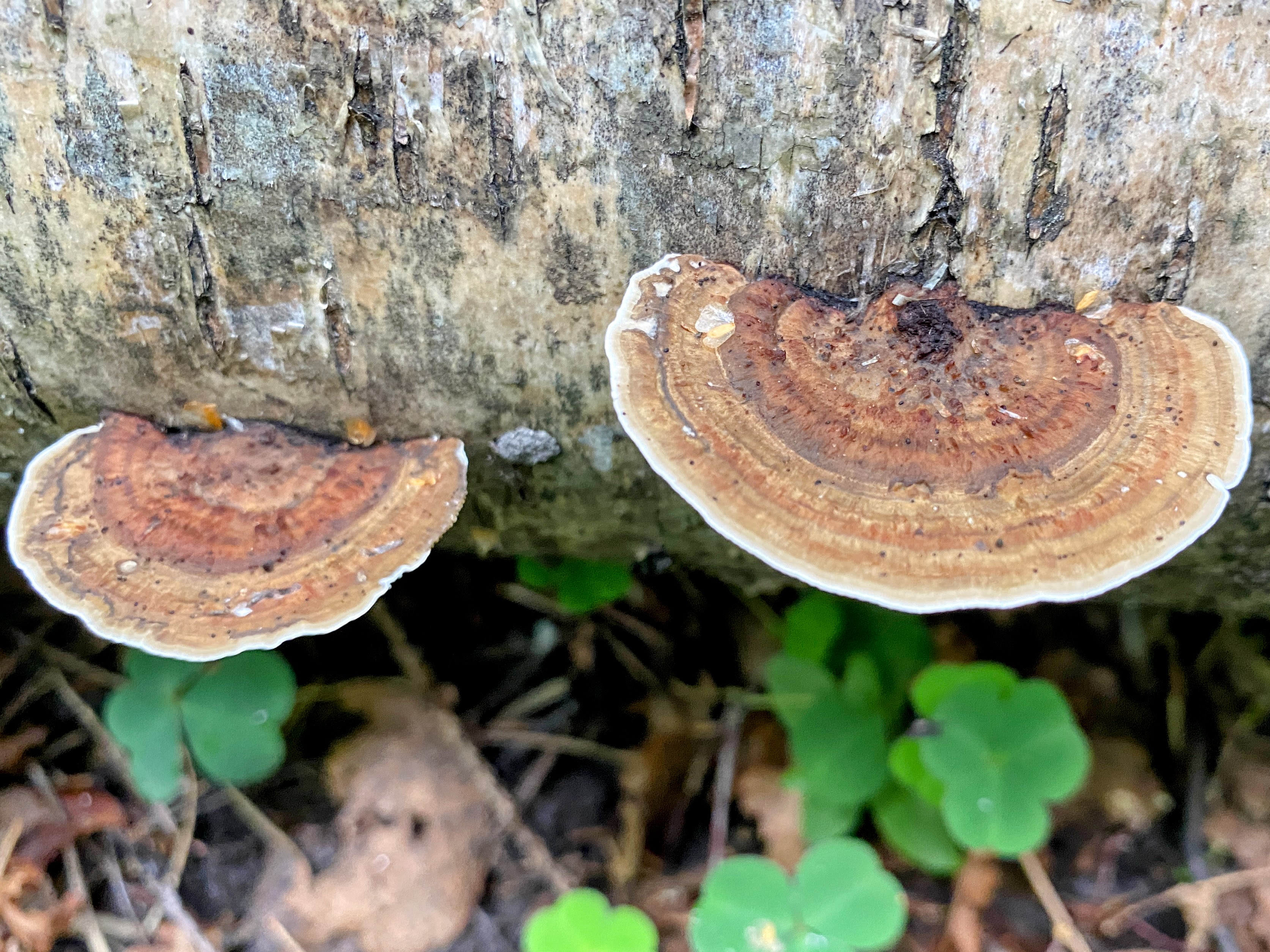
Relatively small, up to 7 cm in the largest dimension, with a smooth or slightly rough, finely tuberculate, finely radially wrinkled surface, colored in yellowish-brown to chocolate tones. The caps are characterized by zonation with alternating lighter and darker bands, and often have a tubercle at the base. Overwintered fruit bodies become almost white, darker at the base.
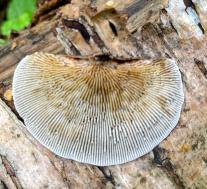
The hymenophore initially develops as elongated tubes and soon becomes lamellate; the gills are thin, dichotomously branched, up to 2.5 cm wide, colored in brownish tones.
Flesh
From yellowish-brown to wood-colored, with faintly expressed concentric zones, up to 1 cm thick.
Xylotroph. Causes white rot. Trophically associated almost exclusively with Betula wood. Distributed in northern regions and parts of the forest zone.
Similar species
Differs from D. confragosa by the smaller size of fruit bodies and the structure of the hymenophore. Differs from the three-colored polypore (D. tricolor), which is similar in hymenophore structure, by the coloration of fruit bodies and its association with Betula wood.
Related resources
Bondartseva M. A. Keys to the Fungi of Russia. Order Aphyllophorales. — Saint Petersburg: Nauka, 1998. — Issue 2. — 391 p.
Gilbertson R. L., Ryvarden L. North American Polypores, 1987. — 433 p.
Hansen L., Knudsen H. (eds.) Nordic Macromycetes. Vol. 3: Heterobasidioid, Aphyllophoroid and Gastromycetoid Basidiomycetes. — Copenhagen, Denmark: Nordsvamp, 1997. — 444 p.
Koukol O., Kotlaba F., Pouzar Z. Taxonomic evaluation of the polypore Daedaleopsis tricolor based on morphology and molecular data // Czech Mycology. — 2014. — Vol. 66, No. 2. — Pp. 107–119.
Ryvarden L., Gilbertson R. European Polypores. Part 1: Abortiporus to Lindtneria. Synopsis Fungorum 6. — Oslo, 1993. — Pp. 1–387.
Add new comment