Olive-leg Bolete (Gyrodon lividus)
Index Fungorum Gyrodon lividus (Bull.) Sacc
MycoBank Gyrodon lividus (Bull.) Sacc
Yellow Gyrodon, grayish Gyrodon.
lividinus, a, um — bluish-gray, with a bluish sheen.
Boletus alneti Lindgren, in Fries, Hymenomyc. eur. (Upsaliae): 519 (1874)
Boletus brachyporus Pers., Mycol. eur. (Erlanga) 2: 128 (1825)
Boletus brachyporus Rostk., in Sturm, Deutschl. Fl., 3 Abt. (Pilze Deutschl.) [5](21/22): 57 (1844)
Cladomeris sistotrema (Fr.) Bigeard & H. Guill., Fl. Champ. Supér. France (Chalon-sur-Saône) 1: 409 (1909)
Gyrodon alneti (Lindgr.) Mussat, in Saccardo, Syll. fung. (Abellini) 15: 154 (1901)
Gyrodon labyrinthicus (Fr.) Mussat, in Saccardo, Syll. fung. (Abellini) 15: 154 (1901)
Gyrodon lividus subsp. alneti (Lindgr. ex Fr.) Sacc., Syll. fung. (Abellini) 6: 53 (1888)
Suillus chrysenteron var. lividus (Bull.) Poiret, in Lamarck, Encycl. Méth. Bot. (Paris) 7: 497 (1806)
Uloporus lividus (Bull.) Quél., Enchir. fung. (Paris): 162 (1886)
Uloporus sistotrema (Fr.) Quél., C. r. Assoc. Franç. Avancem. Sci. 24(2): 619 (1896) [1895]
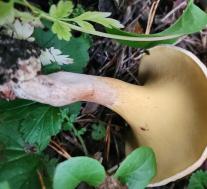
Fleshy, 4–15 cm in diameter, unevenly wavy, thin-fleshed toward the margin; dry, becoming sticky in wet weather. Color ranges from cream to grayish-yellow, yellowish-brown, or yellowish. Convex when young, with the margin curved inward; later expanding to cushion-shaped or broadly spread. The center is often depressed.
The hymenophore is tubular, not thick, decurrent onto the stipe. Tubes are very short; pores are labyrinthine, large, angular, yellow or golden-yellow, darkening with age. When damaged, both tubes and pores turn blue.
3–10 cm long and 1–2 cm in diameter, solid (not hollow), cylindrical, often thinner at the base and curved. The color is generally the same as the cap, sometimes lighter, often with reddish spots.
In the cap: fleshy; in the stipe: somewhat dense, fibrous, yellowish. Turns blue when cut.
Pleasant, mushroomy.
Spore print: ochre-brown. Spores are oval, nearly round, measuring 4.5–6 × 3–4 µm.
Forms mycorrhiza primarily with alder, and accordingly is found in wet alder groves, among moss. Prefers acidic soils. Grows singly or in groups. Encountered infrequently, as it does not produce fruiting bodies every year. The limiting factors are not fully understood.
Status 3. Rare species.
Status 3. Rare species.
It's difficult to confuse the Olive-leg Bolete with any other mushroom within our region. The Merulioid Bolete (*Boletinellus merulioides*), which was formerly placed in the genus *Gyrodon*, now belongs to the family Boletinellaceae. It is associated with ash wood, typically has an eccentric (off-center) stipe that is blackish at the base, and grows in large clusters.
There is some superficial resemblance to the Larch Bolete (*Psiloboletinus lariceti*), but that species is associated with larch and does not grow in wet alder groves.
It is important to discover new locations where this species grows and to monitor it in its natural habitat.
Molecular studies confirm that the genera *Gyrodon* and *Paxillus* are sister taxa, representing one of the earliest diverging lineages within the suborder Boletineae.
Add new comment