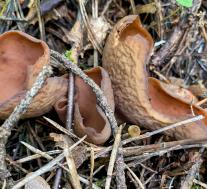
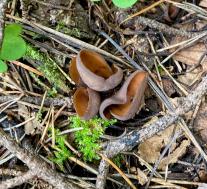
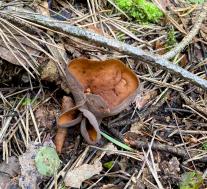
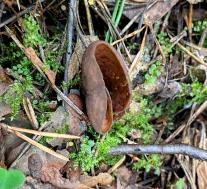
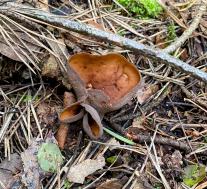
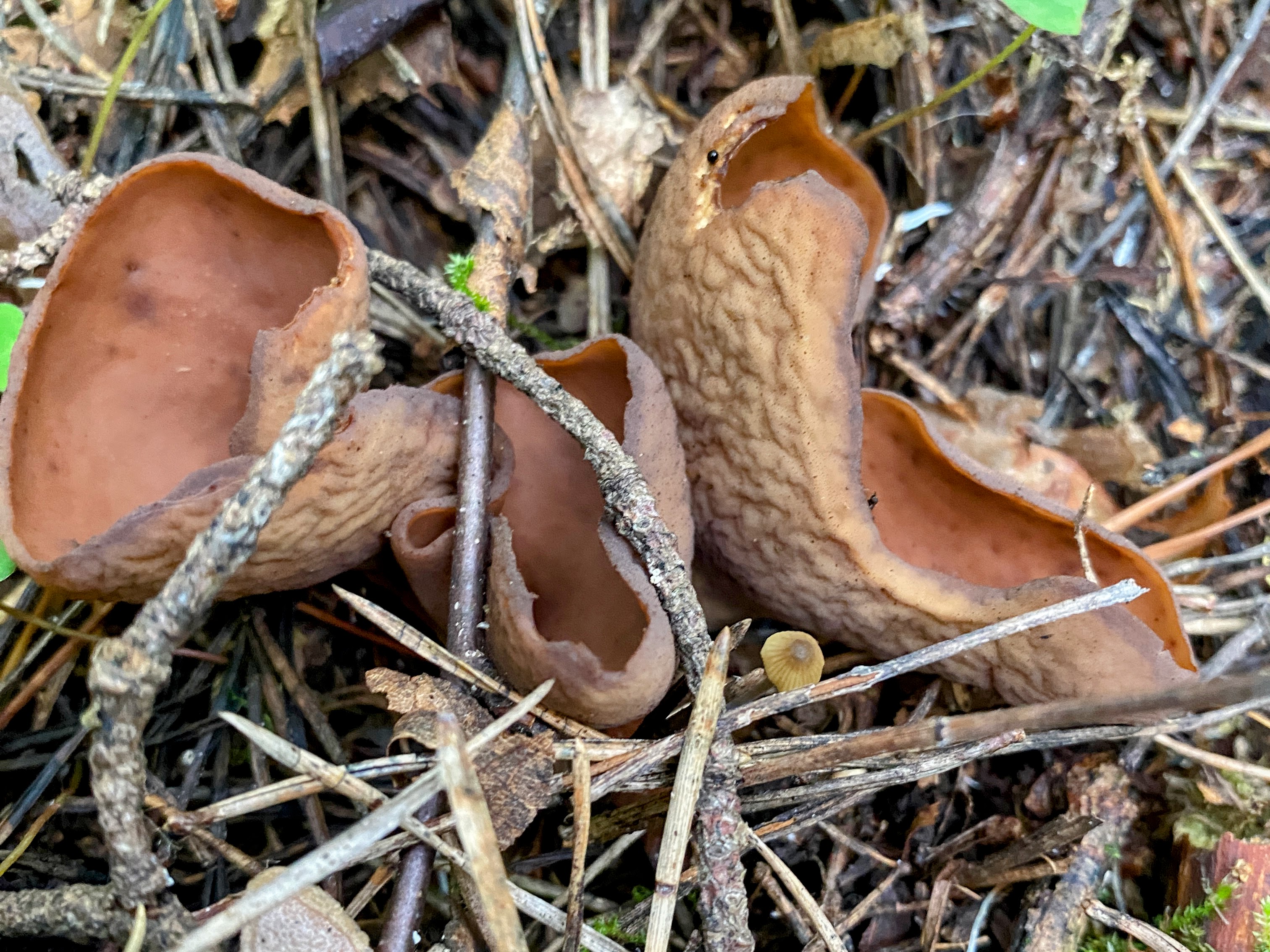
Upright, ear-shaped, or saddle-shaped apothecia are 2-6 cm tall and 1-5 cm wide, often with a short, almost sessile stem up to 1.7 cm long. The fruit bodies are deeply divided on one side from the edge to the base, forming an open bowl with a concave inner surface, and grow in dense groups or clusters. The size and color may vary as they mature, with younger apothecia having brighter hues and smaller sizes.
The hymenium is smooth to slightly wrinkled and initially colored from light ocher-yellow to olive-brown when fresh, darkening to dark reddish-ochre-brown or dark purple-brown when dried, and turning pale yellow or ocher-brown.The apothecium's outer surface is finely pubescent or granular, with brown tones and characteristic bluish-purple or greenish-blue hues in young specimens, which become more uniform, brown, or reddish with age. The base is covered with a whitish or pale brown felt-like.
Otidea mirabilis
Index Fungorum Otidea mirabilis Bolognini & Jamoni
MycoBank Otidea mirabilis Bolognini & Jamoni
mirabilis, e 1) strange; 2) surprising, amazing, remarkable, extraordinary. From miror, atus sum, ari, 1) to marvel, wonder, amaze; 2) to wonder, be perplexed, ask, wish to know; 3) to examine with surprise, admire, delight + -abilis.
In its original description, Otidea mirabilis was assigned to the family Pyronemataceae, and this classification has been maintained in several subsequent taxonomic classifications. No synonyms have been registered for this species, so its original binomial nomenclature remains unchanged.
First described for science in 2001 by mycologists G. Bolognini and G. A. Giamoni, based on specimens collected in northern Italy.
Thin, about 1 mm thick, fragile, yellow-brown in color. The taste is slightly resinous.
Weak, unexpressed.
The color of the spore print is whitish, and the spores are colorless. The spores are 0-12 × 5.5-7 μm elliptical or narrowly fusiform (subfusiform). Inside the mature spore, there are two large oil droplets. The surface of the spores is smooth.
A litter-dwelling saprotroph. It grows on soil, leaf litter, and among mosses. It is widespread, but it is rare everywhere. There is no information about its occurrence in North America. In 2022, it was discovered in China.
All mushrooms of the genus Otidea are similar to each other. A characteristic bluish-purple or lilac bloom on the outer side of mature fruiting bodies may help a little.
Add new comment