Stinking Morel (common name for stinkhorn fungi, particularly *Phallus impudicus* — the Common Stinkhorn)
Note: Despite the Russian name "Сморчок вонючий" (literally "stinking morel"), this is not a true morel but rather a stinkhorn fungus from the family Phallaceae.
Specific epithet etymology
Ravenelii — in honor of Ravenel (Henry William Ravenel, 1814–1887, American mycologist).
Synonyms
Corynites ravenelii Berk., Trans. Linn. Soc. London 21(2): 151 (1853) [1852] - Basionym
Ithyphallus ravenelii (Berk.) E. Fisch., Jb. Königl. Bot. Gart. Berlin 4: 88 (1886)
General description
From 1983 to 2005 inclusive, it was listed in the Red Data Book of the RSFSR (and subsequently of the Russian Federation), but was later removed due to its wide distribution and increasing frequency of occurrence. Until 2013, it was included in the Red Data Book of the Vologda Region, but was excluded due to the lack of herbarium confirmation of its growth within the region. Moreover, despite its detection in the region, it is not recommended for inclusion in the regional Red Data Book, as the species is invasive and native to North America; according to IUCN guidelines, such invasive species should not be included in Red Data Books.
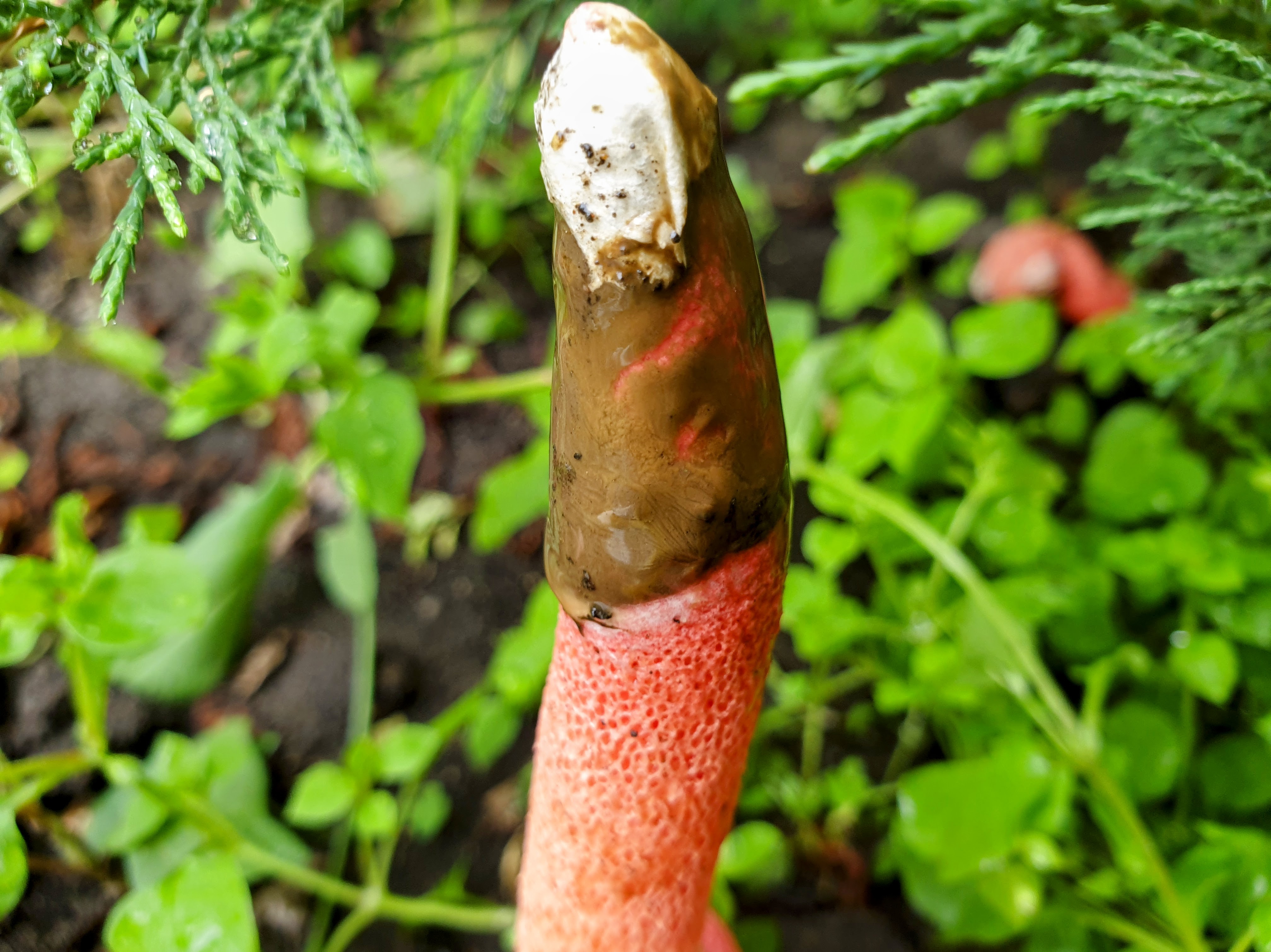
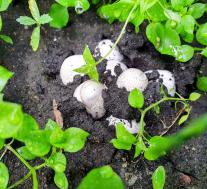
The young fruiting body is rounded or broadly ovate in shape, then becomes pointed toward the apex before opening, often with a mycelial cord at the base. The peridium is thin, two-layered, leathery, dirty-white, yellowish, or grayish; it ruptures at the upper part and persists as a bag-like, thick-filmed volva.
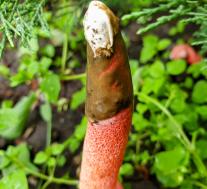
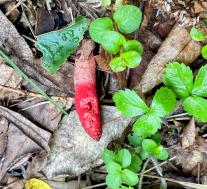
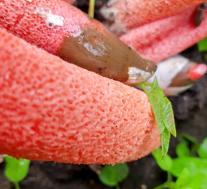
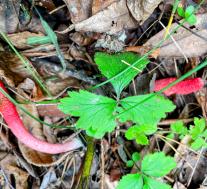
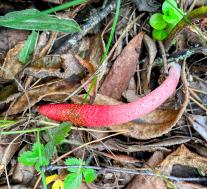
The receptacle is cylindrical, spongy, initially pinkish, then becoming pink-red, crimson-red, or dark pink, slightly lighter toward the base, with a pointed apex covered for 3–5 cm by dark green, dark gray-olive, slimy gleba; beneath the gleba, the receptacle is darker, crimson-red in color.
Flesh
In the egg stage, the immature gleba is dirty greenish to brownish-olive in color, translucent, jelly-like, gelatinous, and elastic; the embryonic tissue is denser, ranging from white to pinkish or coral-pink. At maturity, the gleba becomes spongy, loose, and light in texture.
Odor
A subjectively unpleasant odor of rotting meat (cadaverous smell). It is emitted by the spore-bearing slime and serves to attract insects.
A humus saprotroph, facultatively wood-inhabiting. Sometimes found singly, but more often in groups or clusters, on humus-rich soil, rarely on shallowly buried, heavily decomposed wood; occurs in deciduous and mixed forests, floodplain zones of water bodies, gardens, and urban areas, always in well-moistened locations. It is encountered infrequently overall but can be common within certain small localities. Occasionally it "invades" residential plots, becoming a major nuisance for property owners and their neighbors, who suffer from the foul odor and swarms of flies attracted to populations of *Mutinus*.
Originally a North American species, it was introduced to Europe in the mid-20th century and to Russia toward the end of the century. It is now found throughout the European part of Russia, in the Urals and southern Siberia, as well as in Primorsky Krai and the Kuril Islands.
Conservation status
Red Data Book of Kuzbass (2022)
Status 3. Rare species.
Red Data Book of Novosibirsk Oblast (2018)
Status 3. Rare species.
Red Data Book of Kirov Oblast
Status 4. A species whose rarity status has not been determined due to insufficient data.
Similar species
Dog Stinkhorn (Mutinus caninus) has a stipe with more pronounced brown and orange tones.
Notes
The closest relative, Mutinus elegans, has demonstrated antibiotic activity against microorganisms pathogenic to humans.
Coordinates
Related resources
Red Data Book of Kirov Oblast: Animals, Plants, Fungi. 2nd ed. / ed. by O. G. Baranova, E. P. Lachokhi, V. M. Ryabov, V. N. Sotnikov, E. M. Tarasova, L. G. Tselishcheva. — Kirov: LLC "Kirov Regional Printing House", 2014. — 336 p., ill.
Red Data Book of Kuzbass. Volume I. 3rd ed., revised and expanded. — Kemerovo: "Vector-Print", 2021. — 240 p. — P. 174.
Red Data Book of Novosibirsk Oblast: Animals, Plants and Fungi / Ministry of Natural Resources and Ecology of Novosibirsk Oblast. — 3rd ed., revised and expanded. — Novosibirsk: Andrey Khristolyubov Printing House, 2018. — 588 p. — P. 543.
Add new comment