Slimy Spike-cap (Chroogomphus rutilus)
Index Fungorum Chroogomphus rutilus (Schaeff.) O.K. Mill.
MycoBank Chroogomphus rutilus (Schaeff.) O.K. Mill.
Slimy Mokrukha, Shining Mokrukha, Pine Mokrukha, Yellow-legged Mokrukha, Copper-yellowleg
In English, the mushroom bears the evocative name "copper spike." This fungus is in some sense an embodiment of the proverb about the gentle calf that suckles from two mothers, as it not only forms ectomycorrhiza with coniferous trees but also parasitizes the mycelium of boletes (Suillus).
Rutilus, a, um — yellow-red, golden-red, reddish, ruddy
Agaricus rutilus Schaeff., Fung. bavar. palat. nasc. (Ratisbonae) 4: 24 (1774)
Gomphidius rutilus (Schaeff.) S. Lundell, Fungi Exsiccati Suecici: 409 (1937)
Gomphidius testaceus (Fr.) Mussat, in Saccardo, Syll. fung. (Abellini) 15: 152 (1900)
Chroogomphus testaceus (Fr.) Příhoda, in Přáhoda, Urban, Ničová-Urbanová & Urban, Kapesni’ Atlas Hub (Praha): 237 (1987)
Gomphidius litigiosus Britzelm., Bot. Zbl. 54(3): 71 (1893)
Chroogomphus corallinus O.K. Mill. & Watling, Notes R. bot. Gdn Edinb. 30: 391 (1970)
Gomphidius corallinus (O.K. Mill. & Watling) Kotl. & Pouzar, Česká Mykol. 26(4): 220 (1972)
Chroogomphus britannicus A.Z.M. Khan & Hora, Trans. Br. mycol. Soc. 70(1): 155 (1978)
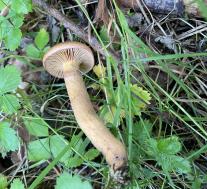
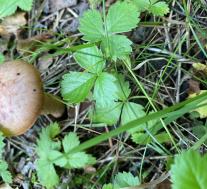
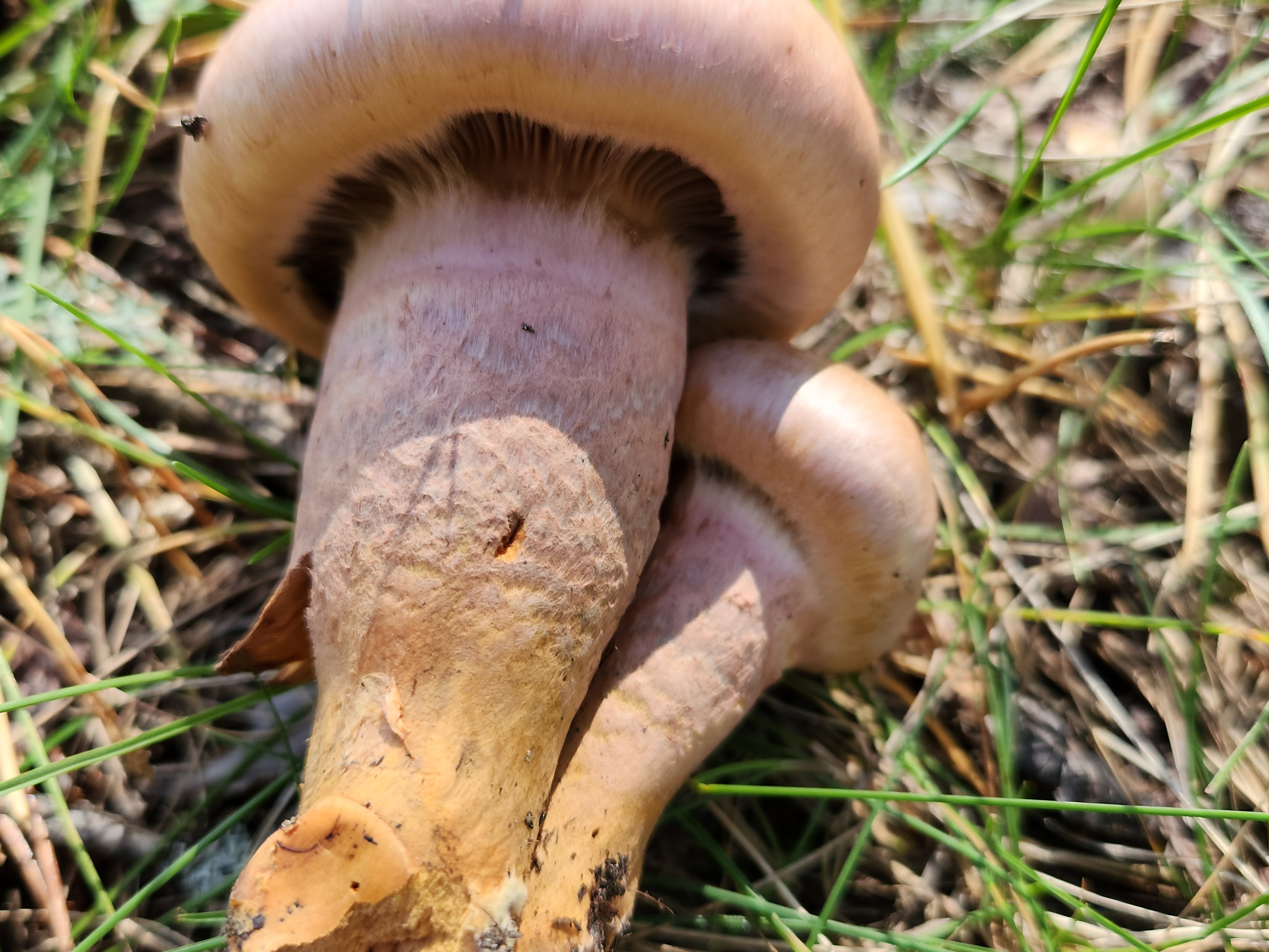
2.5–12 cm in diameter; initially conical-rounded, then slightly convex with an umbo and an incurved margin; surface smooth, sticky in wet weather, bare and glossy when dry. Coloration brownish-lilac, brick-orange, with a wine-red tint: in young specimens the central part is purple-toned, becoming more uniform with age.
In young mushrooms, the cap margin is connected to the stipe by a thin, cobwebby veil that quickly disappears as the mushroom grows, leaving a false ring on the stipe that also vanishes rapidly.
Hymenophore lamellate. Gills decurrent, ochre-pinkish or brownish at first, then purple-brown.
5–8 cm long, 0.5–2 cm in diameter, slightly tapering toward the base; stipe surface silky, with ring-like remnants of the partial veil that become less noticeable with age; surface pale, brownish-orange, concolorous with the cap, often with a coppery-red tint.
In the cap, pinkish; in the stipe, fibrous with a lilac tint; yellowish at the base of the stipe. Taste mild, unremarkable. Odor pleasant, mushroom-like.
Spore print dark brown, almost black. Spores fusiform (spindle-shaped).
Grows on soil in coniferous and mixed forests, usually near pines, often on elevated ground. Forms mycorrhiza with pine and birch. Particularly common in light, thinned pine forests and pine plantations together with Suillus granulatus and Suillus luteus. Prefers calcareous soils. Found singly or in small groups. Widespread in the northern temperate zone; within the Russian Federation, it occurs in the European part of Russia, the Caucasus, and Siberia.
Not listed in the Red Data Books of the Russian Federation or its regional Red Lists.
Purple Slimy-cap can be confused with the deadly poisonous Deadly Webcap (Cortinarius rubellus), also widespread in Northern Europe and likewise growing in coniferous and mixed forests. All species of slimy-caps (genera Gomphidius and Chroogomphus) share certain similarities.
Chroogomphus rutilus is a low-value edible mushroom. However, its collection and consumption are not recommended due to its certain similarity to poisonous or deadly species.
Add new comment