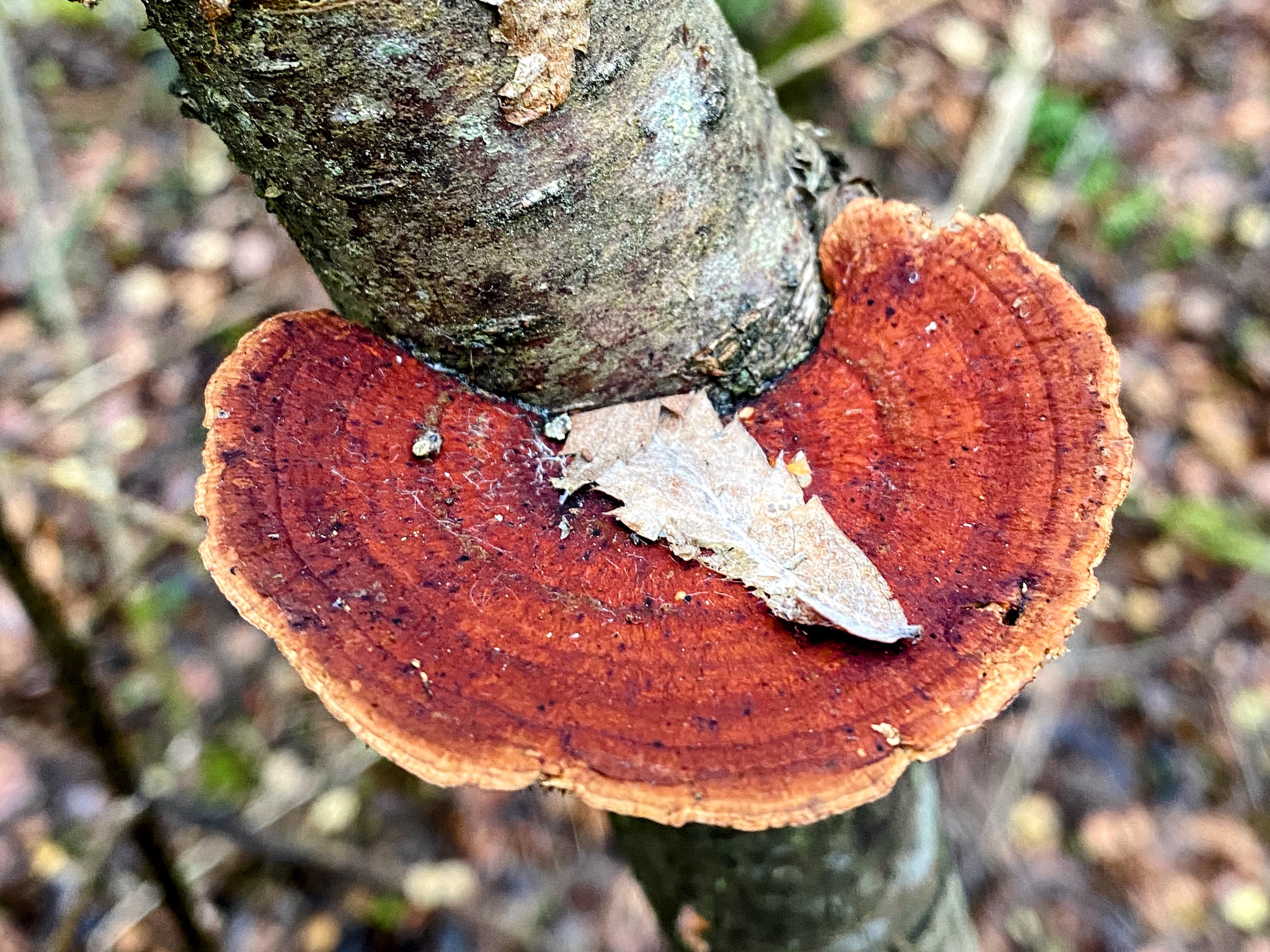
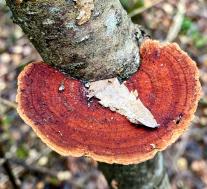
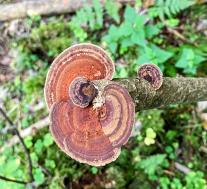
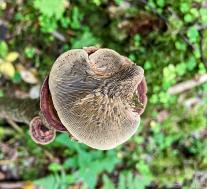
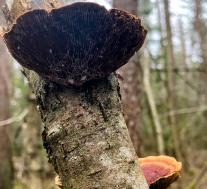
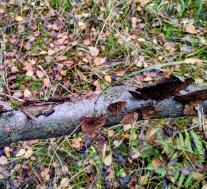
Three-colored Daedaleopsis (Daedaleopsis confragosa var. tricolor)

Дедалеопсис трёхцветный
Current name

Index Fungorum    Daedaleopsis tricolor (Bull.) Bondartsev & Singer
MycoBank    Daedaleopsis tricolor (Bull.) Bondartsev & Singer

Other names

Three-colored Polypore

Systematic position
Specific epithet etymology

Tricolor noun m. three-colored. From trēs, tria (three) + color, -ōris (color, coloration).

Synonyms

Daedaleopsis confragosa var. tricolor (Bull.) Bondartsev & Singer, The Polyporaceae of the European USSR and Caucasia: 571 (1953) 

Lenzites tricolor (Bull.) Fr., Epicrisis Systematis Mycologici: 406 (1838) 

Trametes tricolor (Bull.) Lloyd, Mycol. Writ. 6 (64): 998 (1920) 

Cellularia tricolor (Bull.) Kuntze, Revisio generum plantarum 3 (3): 452 (1898) 

Ischnoderma tricolor (Bull.) Zmitr., Mycena 1 (1): 92 (2001) 

Trametes rubescens var. tricolor (Bull.) Pilát, Bull. Trimestriel Soc. Mycol. France 48 (1): 20 (1932) 

Daedalea sepiaria var. tricolor (Bull.) Fr., Systema Mycologicum 3 (2): 82 (1832) 

Daedalea confragosa var. tricolor (Bull.) Domański, Orlos & Skirg., Fl. Polska, Grzyby (Mycota) 3: 250 (1967) 

Daedalea tricolor (Bull.) Fr., Mycol. eur.: 12 (1828) 

Daedalea sepiaria subsp. tricolor (Bull.) Pers., Mycologia Europaea 3: 12 (1828) 

Agaricus sepiarius var. tricolor (Bull.) Pers., Synopsis methodica fungorum: 487 (1801) 

General description

Many authors indicate that between D. tricolor (Bull.) Bondartsev & Singer and D. confragosa (Bolton) J. Schröter there are transitional forms with a porous hymenophore at the base of the fruit body, becoming lamellate towards the margin; they also note the impossibility of distinguishing these two species by microscopic characteristics. In 2014, phylogenetic studies conducted by Czech mycologists showed the identity of D. tricolor (Bull.) Bondartsev & Singer and D. confragosa (Bolton) J. Schröter. However, these data should be treated critically, as the authenticity of the studied specimens raises doubt.

Habit
Fruiting body
Sessile, bracket-shaped, hoof-shaped, or as an irregular crust/rosette
Hymenophore
Lamellate (gills present, including folded or rudimentary)
Fruiting period (list)
MayMay (21st–31st)JunJune (1st–10th)June (11th–20th)June (21st–30th)JulJuly (1st–10th)July (11th–20th)July (21st–31st)AugAugust (1st–10th)August (11th–20th)August (21st–31st)SepSeptember (1st–10th)September (11th–20th)September (21st–30th)OctOctober (1st–10th)October (11th–20th)October (21st–31st)NovNovember (1st–10th)
Fruit body

Fruit bodies 20–100 mm wide, 20–50 mm long from base to margin, 5–15 mm thick, annual, flat, thin, often with a tubercle at the base, imbricate, sometimes fused laterally along the substrate [3]. Shape and mode of attachment to the substrate vary: when growing on lateral surfaces—fan-shaped, semi-resupinate, attached laterally, sessile; on upper surfaces—rosette-like, rounded, attached centrally. Surface glabrous, radially wrinkled, concentrically zoned, brown, chestnut, purplish-brown, with a lighter margin.

Hymenophore lamellate, dichotomously branched, sometimes with anastomoses, initially light, yellowish-creamy, becoming light brown at maturity, darkening to dark brown with age, sometimes with a silvery sheen. In young fruit bodies, the gills turn slightly brown when damaged.

Flesh

Thin, tough, pale brown.

Odor

Pleasant, mushroom-like.

Microscopy

Microscopic characteristics match those of Daedaleopsis confragosa.

Spore print whitish. Spores 6.5–8.5 × 2–2.5 μm, allantoid, smooth, thin-walled, hyaline, sometimes with oil droplets.

Ecology and distribution

Grows singly or in groups on living and dead wood of deciduous trees. Causes white rot. A rare species in Central and Western Europe, absent in Fennoscandia and Denmark. In the Vologda region, it is most commonly found on willow (Salix) and birch (Betula).

Fruiting

Found throughout the year; the main growth period runs from early May to late autumn.

Nutritional properties
Inedible
Similar species

Northern Daedaleopsis (Daedaleopsis septentrionalis) — fruit bodies lighter in coloration, corky, yellowish-brown, with a pinkish tint.
Birch Lenzites (Lenzites betulina) — smaller, pubescent fruit bodies, light-colored hymenophore.
 

Link to this page for printed editions
Shipovalov A.G. Three-colored Daedaleopsis (Daedaleopsis confragosa var. tricolor) - Mushrooms of Vologda Region [Electronic resource] URL: https://xn----7sbancweblffgklubds60aja.xn--p1ai/en/three-colored-daedaleopsis-daedaleopsis-confragosa-var-tricolor (accessed: 13.04.2026).
Share link

Add new comment

One file only.
2 MB limit.
Allowed types: png jpeg jpg jpe gif webp svg.
Allowed types: png gif jpg jpeg webp svg.

Plain text

  • No HTML tags allowed.
  • Lines and paragraphs break automatically.
  • Web page addresses and email addresses turn into links automatically.
Add image
Maximum 8 files.
2 MB limit.
Allowed types: png jpeg jpg jpe gif webp svg.
Allowed types: png gif jpg jpeg webp.
January (1st–10th)
January (1st–10th)
January (11th–20th)
January (11th–20th)
January (21st–31st)
January (21st–31st)
February (1st–10th)
February (1st–10th)
February (11th–20th)
February (21st–28th/29th)
March (1st–10th)
March (1st–10th)
March (11th–20th)
March (11th–20th)
March (21st–31st)
March (21st–31st)
April (1st–10th)
April (1st–10th)
April (11th–20th)
April (11th–20th)
April (21st–30th)
April (21st–30th)
May (1st–10th)
May (1st–10th)
May (11th–20th)
May (11th–20th)
May (21st–31st)
May (21st–31st)
June (1st–10th)
June (1st–10th)
June (11th–20th)
June (11th–20th)
June (21st–30th)
June (21st–30th)
July (1st–10th)
July (1st–10th)
July (11th–20th)
July (11th–20th)
July (21st–31st)
July (21st–31st)
August (1st–10th)
August (1st–10th)
August (11th–20th)
August (11th–20th)
August (21st–31st)
August (21st–31st)
September (1st–10th)
September (11th–20th)
September (21st–30th)
October (1st–10th)
October (1st–10th)
October (11th–20th)
October (11th–20th)
October (21st–31st)
October (21st–31st)
November (1st–10th)
November (1st–10th)
November (11th–20th)
November (21st–30th)
December (1st–10th)
December (1st–10th)
December (11th–20th)
December (21st–31st)