Trainwrecker (Neolentinus lepideus)
Index Fungorum Neolentinus lepideus (Fr.) Redhead & Ginns
MycoBank Neolentinus lepideus (Fr.) Redhead & Ginns
Lentinus lepideus, scaly lentinus.
Lepideus, a, um, finely scaled. From lepis, idis (scale) + -eus, a, um (quality). Also lepidus, a, um, graceful.
Agaricus lepideus Fr., Observ. mycol. (Havniae) 1: 21 (1815)
Neolentinus lepideus f. lepideus (Fr.) Redhead & Ginns, Trans. Mycol. Soc. Japan 26(3): 357 (1985)
Panus lepideus (Fr.) Corner, Beih. Nova Hedwigia 69: 64 (1981)
Pocillaria lepidea (Fr.) Kuntze, Revis. gen. pl. (Leipzig) 2: 866 (1891)
Clitocybe lepidea (Fr.) P. Kumm., Führ. Pilzk. (Zerbst) : 123 (1871)
Lentinus lepideus (Fr.) Fr., Epicr. syst. mycol. (Upsaliae) : 390 (1838)
Lentinus lepideus var. lepideus (Fr.) Fr., Epicr. syst. mycol. (Upsaliae) : 390 (1838)
Lentinus lepideus f. lepideus (Fr.) Fr., Epicr. syst. mycol. (Upsaliae) : 390 (1838)
Agaricus lepideus Fr., Observ. mycol. (Havniae) 1: 21 (1815)
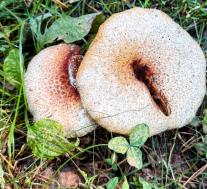
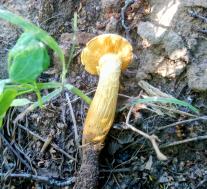
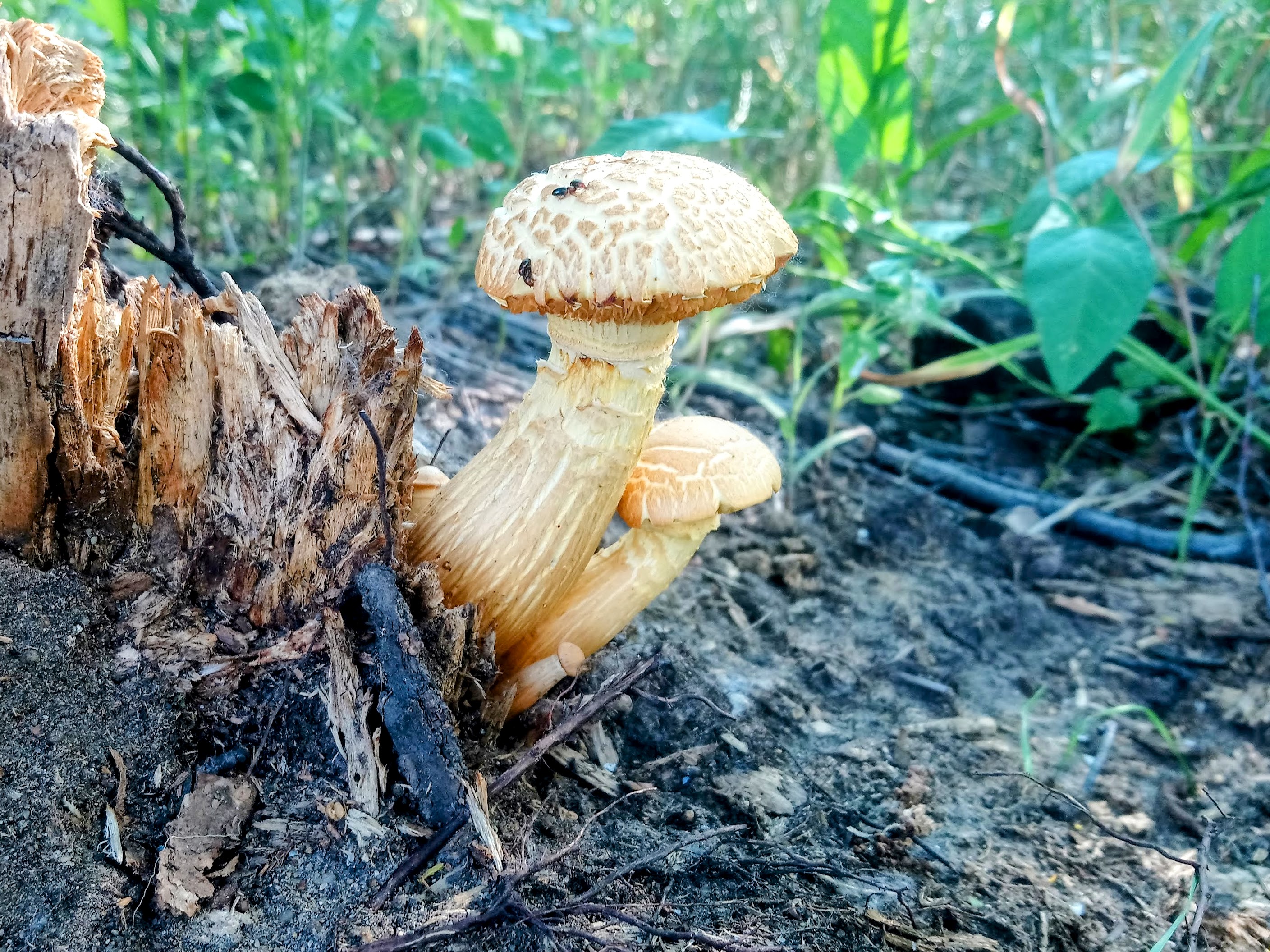
6–18 cm in diameter, initially convex, then funnel-shaped, almost prostrate; the surface is dry, dirty white or light brown, with brown or brown scales radiating outward, abundant in the center and sparse along the margin.
The gills are descending, dirty white or yellowish, with a serrated margin.
2–8 cm long, 1–2.5 cm thick, central or eccentric, cylindrical, narrowed at the bottom and sometimes root-like elongated, whitish with reddish-brownish scales, smooth, woody, solid near the plates.
White, hard, dries up after dying.
Weak, aniseed.
The spore powder is white. Spores are 8–13 × 3–5 µm, cylindrical, almond-shaped, with a noticeably elongated base, hyaline, smooth, thin-walled, non-amyloid.
It grows on fallen trees and stumps of coniferous and deciduous trees, on treated wood (telegraph poles, railroad ties, including those treated with creosote, on the walls of cellars and wells, etc.), usually sparsely and sparingly – singly or in small groups. It causes brown rot. It is widespread in Europe and North America; it is also found in the Caribbean, Asia, and Oceania; it has been introduced to Africa.
Lentinus tigrinus is confined to stumps and fallen trees of deciduous trees and is also smaller, has a funnel-shaped cap and usually grows in clusters.
Add new comment