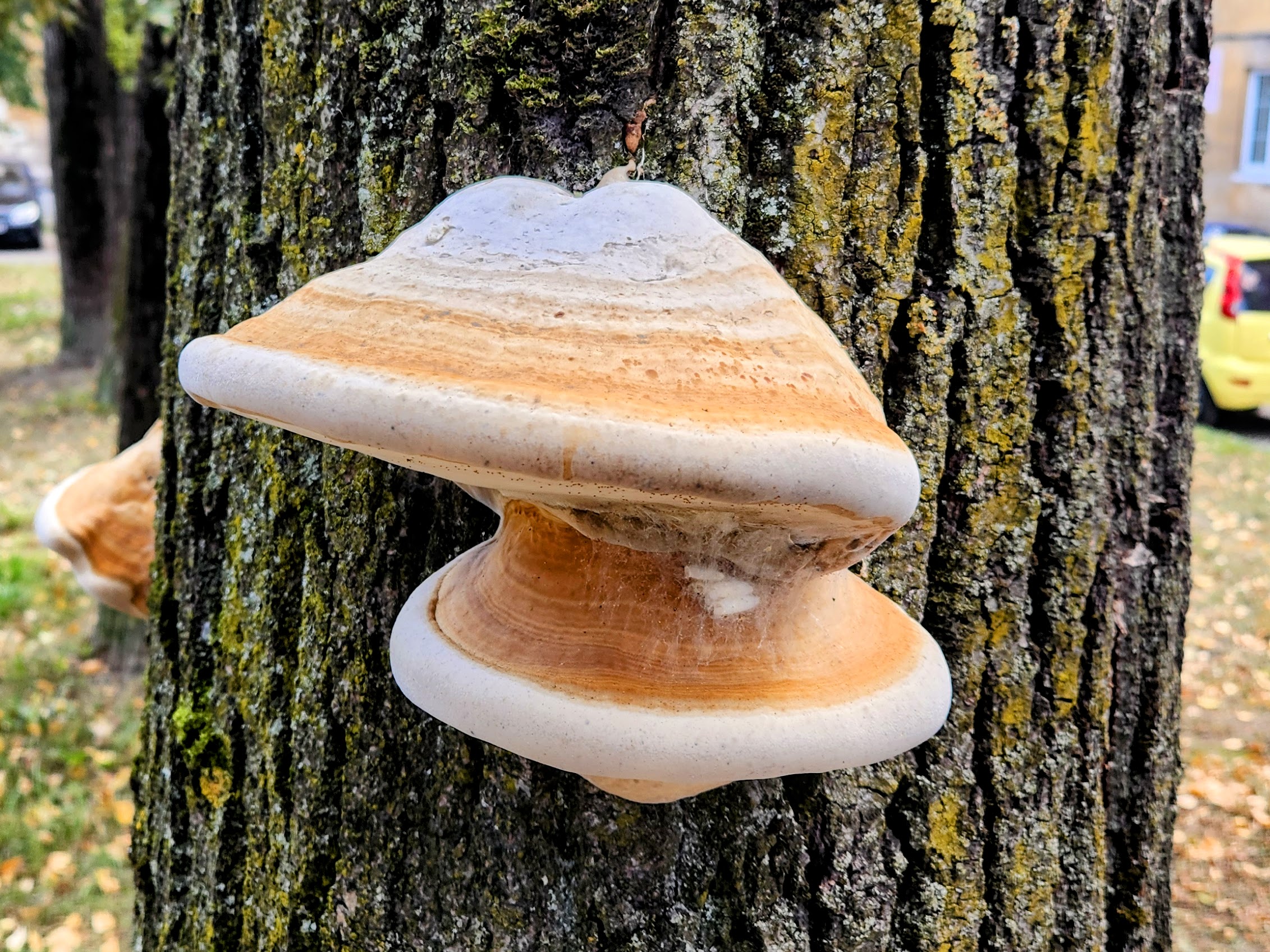
True Tinder Polypore, Hoof Fungus (Fomes fomentarius)

Трутовик настоящий
Current name

Index Fungorum    Fomes fomentarius (L.) Fr.

MycoBank   Fomes fomentarius (L.) Fr.

Other names

Blood Sponge, True Tinder Polypore

Systematic position
Specific epithet etymology

Fomentārius, a, um. Used as a dressing or combustible material, tinder. From *foveo, fōvī, fōtum, ere* — to warm, to heat.

Synonyms

Boletus fomentarius L., Sp. pl. 2: 1176 (1753)

Agaricus fomentarius (L.) Lam., Encycl. Méth. Bot. (Paris) 1(1): 50 (1783)

Polyporus fomentarius (L.) Fr., Syst. mycol. (Lundae) 1: 374 (1821)

Placodes fomentarius (L.) Quél., Enchir. fung. (Paris): 171 (1886)

Ochroporus fomentarius (L.) J. Schröt., in Cohn, Krypt.-Fl. Schlesien (Breslau) 3.1(25–32): 486 (1888)

Scindalma fomentarium (L.) Kuntze, Revis. gen. pl. (Leipzig) 3(2): 518 (1898)

Ungulina fomentaria (L.) Pat., Essai Tax. Hyménomyc. (Lons-le-Saunier): 102 (1900)

Elfvingia fomentaria (L.) Murrill, Bull. Torrey bot. Club 30(5): 298 (1903)

Elfvingiella fomentaria (L.) Murrill, North. Polyp. (1914)

Pyropolyporus fomentarius (L.) Teng, Chung-kuo Ti Chen-chun, [Fungi of China]: 763 (1963)

General description

Ötzi is the ice mummy of a man from the Copper Age. The age of the mummy, determined by radiocarbon dating, is approximately 5300 years.
Among Ötzi's belongings, bundles of two species of polypore mushrooms were found. One of them—the birch polypore (Fomitopsis betulina)—possesses antibacterial properties and was likely used for medicinal purposes. The other species—the true tinder polypore (Fomes fomentarius)—was part of a fire-starting kit. It is known that this mushroom was used as a fire starter in Hedeby, meaning that the Vikings also made use of the common tinder polypore. This points to a very ancient history of human use of mushrooms.
 

Habit
Fruiting body
Sessile, bracket-shaped, hoof-shaped, or as an irregular crust/rosette
Hymenophore
Tubulate, poroid
Fruiting period (list)
JanJanuary (1st–10th)January (11th–20th)January (21st–31st)FebFebruary (1st–10th)February (11th–20th)February (21st–28th/29th)MarMarch (1st–10th)March (11th–20th)March (21st–31st)AprApril (1st–10th)April (11th–20th)April (21st–30th)MayMay (1st–10th)May (11th–20th)May (21st–31st)JunJune (1st–10th)June (11th–20th)June (21st–30th)JulJuly (1st–10th)July (11th–20th)July (21st–31st)AugAugust (1st–10th)August (11th–20th)August (21st–31st)SepSeptember (1st–10th)September (11th–20th)September (21st–30th)OctOctober (1st–10th)October (11th–20th)October (21st–31st)NovNovember (1st–10th)November (11th–20th)November (21st–30th)DecDecember (1st–10th)December (11th–20th)December (21st–31st)
Fruit body

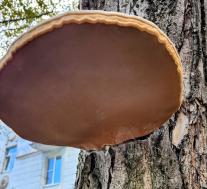
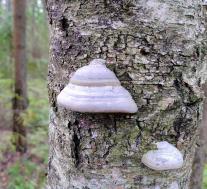
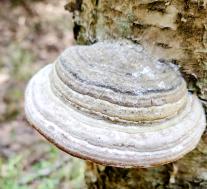
Perennial. Can persist for up to 30 years. Hoof-shaped, knob-like.

Fruit body: up to 20–40 cm wide, 5–15 (20) cm high, woody. Surface covered with a hard crust, shiny in cross-section, concentrically furrowed, gray to blackish, closer to the base leather-colored, brownish-yellowish, lighter toward the margin, slightly pubescent. Margin blunt.

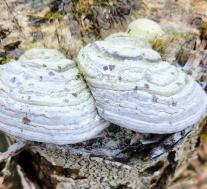
Hymenophore: tubular. Hymenophore surface light gray, pale brown, straight or slightly concave. Tubes form horizontal layers of light brown color, 2–6 mm thick: new layers develop during periods of active growth over several years, and more than one layer may form within a single year; layers indistinct, older ones merging with the tissue, old tubes filled with white mycelium.

Pores with entire, blunt, pubescent margins, 3–4 × 1 mm.

Flesh

Corky, composed of felt-like flakes of coarse fibers, indistinctly zoned, reddish or brown-rusty. Researchers from Finland, having collected samples of the mushroom in local forests, analyzed the structural and chemical composition, identifying three layers: a hard, thin outer crust covering a foamy layer beneath it, and stacks of hollow tubular structures in the core. In each layer, the mycelium exhibits a distinct microstructure with unique hyphal orientation.

Odor

Weak, mushroom-like.

Microscopy

Spore print pale lemon-yellow. Spores large, smooth, without a droplet, elongated, ellipsoidal, somewhat flattened on one side, 15–20 × 5–7 μm.

Ecology and distribution

Begins its life cycle as a parasite on damaged trees, then continues to grow as a saprophyte. Found mainly on deciduous trees: Betula, Fagus, Populus, Alnus, more rarely Fraxinus, Tilia, Quercus, Salix, and others. Forms multiple fruiting bodies on a single trunk. Causes initially a heart rot, light yellow, then white rot with black lines separating the decayed wood from healthy tissue. Wood in degraded areas becomes brittle and eventually splits into plates along the annual growth rings. Cosmopolitan distribution.

Fruiting

Found throughout the year; the main growth of fruiting bodies occurs from May to September.

Nutritional properties
Inedible

Inedible due to its tough flesh and poor taste qualities. At the same time, it possesses an impressive array of therapeutic and medicinal properties.

Similar species

Similar to other perennial polypores, but easily distinguished by its mode of attachment to the substrate—only by the upper part—its grayish coloration, and, in doubtful cases, by using an alkali (such as caustic potash): the upper surface of the fruiting body of *F. fomentarius* turns a dark blood-red color upon contact with KOH.

Notes

The mushroom has economic significance; it reduces the value of timber as the parasitic infection spreads.

In folk medicine, it is used in powdered form, as well as in water and alcohol-based tinctures.

Link to this page for printed editions
Shipovalov A.G. True Tinder Polypore, Hoof Fungus (Fomes fomentarius) - Mushrooms of Vologda Region [Electronic resource] URL: https://xn----7sbancweblffgklubds60aja.xn--p1ai/en/true-tinder-polypore-hoof-fungus-fomes-fomentarius (accessed: 13.04.2026).
Share link

Add new comment

One file only.
2 MB limit.
Allowed types: png jpeg jpg jpe gif webp svg.
Allowed types: png gif jpg jpeg webp svg.

Plain text

  • No HTML tags allowed.
  • Lines and paragraphs break automatically.
  • Web page addresses and email addresses turn into links automatically.
Add image
Maximum 8 files.
2 MB limit.
Allowed types: png jpeg jpg jpe gif webp svg.
Allowed types: png gif jpg jpeg webp.
January (1st–10th)
January (1st–10th)
January (11th–20th)
January (11th–20th)
January (21st–31st)
January (21st–31st)
February (1st–10th)
February (1st–10th)
February (11th–20th)
February (21st–28th/29th)
March (1st–10th)
March (1st–10th)
March (11th–20th)
March (11th–20th)
March (21st–31st)
March (21st–31st)
April (1st–10th)
April (1st–10th)
April (11th–20th)
April (11th–20th)
April (21st–30th)
April (21st–30th)
May (1st–10th)
May (1st–10th)
May (11th–20th)
May (11th–20th)
May (21st–31st)
May (21st–31st)
June (1st–10th)
June (1st–10th)
June (11th–20th)
June (11th–20th)
June (21st–30th)
June (21st–30th)
July (1st–10th)
July (1st–10th)
July (11th–20th)
July (11th–20th)
July (21st–31st)
July (21st–31st)
August (1st–10th)
August (1st–10th)
August (11th–20th)
August (11th–20th)
August (21st–31st)
August (21st–31st)
September (1st–10th)
September (11th–20th)
September (21st–30th)
October (1st–10th)
October (1st–10th)
October (11th–20th)
October (11th–20th)
October (21st–31st)
October (21st–31st)
November (1st–10th)
November (1st–10th)
November (11th–20th)
November (21st–30th)
December (1st–10th)
December (1st–10th)
December (11th–20th)
December (21st–31st)