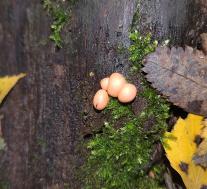
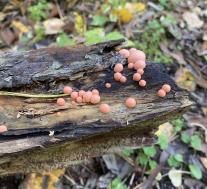
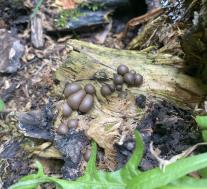
Wolf's Milk Slime Mold (Lycogala epidendrum)

Ликогала древесинная
Current name

Index Fungorum    Lycogala epidendrum (J.C. Buxb. ex L.) Fr.
MycoBank    Lycogala epidendrum (L.) Fr.

Other names

Wolf's milk, wolf's udder

Systematic position
Specific epithet etymology

epidendrus, a, um — growing on a tree, epidendrous. From epi- (upon, on, ἐπί) + dendrus (tree).

Synonyms

Galeperdon epidendron (L.) Weber ex F.H. Wigg., Primitiae Florae Holsaticae: 108 (1780) 

Lycoperdon epidendron Bull., Histoire des champignons de la France. I: 145, t. 503 (1791) 
 

General description

Based on purely external similarity, this slime mold, described in the 17th century, was classified as a fungus, among which this and other slime mold species remained until the middle of the last century.

Habit
Fruiting body
Rounded, star-shaped, phalloid, nidularioid (gasteroid)
Gelatinous, jelly-like
Hymenophore
Absent or difficult to classify
Fruiting period (list)
MayMay (1st–10th)May (11th–20th)May (21st–31st)JunJune (1st–10th)June (11th–20th)June (21st–30th)JulJuly (1st–10th)July (11th–20th)July (21st–31st)AugAugust (1st–10th)August (11th–20th)August (21st–31st)SepSeptember (1st–10th)September (11th–20th)September (21st–30th)OctOctober (1st–10th)
Fruit body

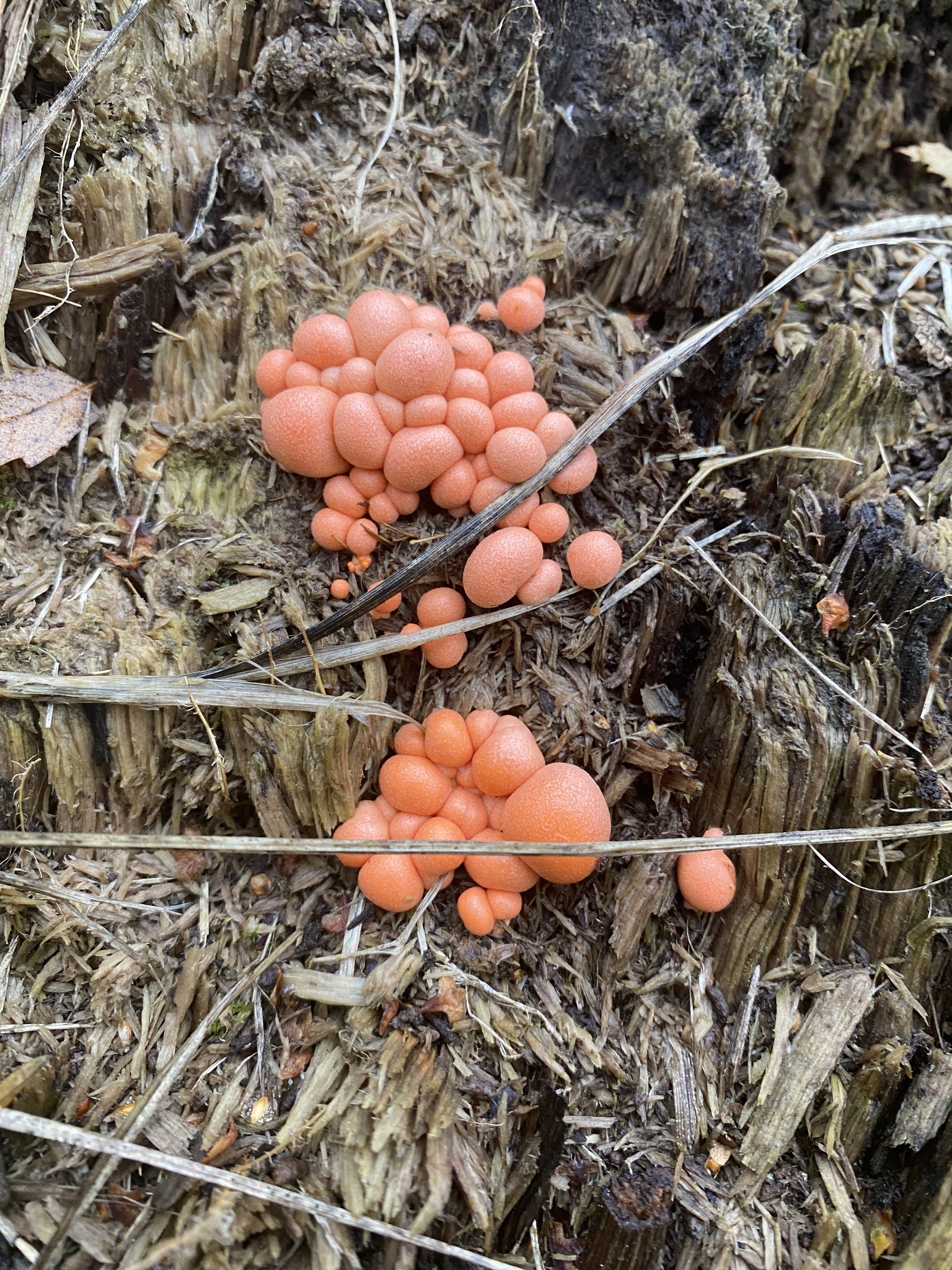
Plasmodium. Pink-coral in color. Inhabits shaded places. Macroscopically distinguishable but generally difficult to observe. After the period of vegetative growth, the plasmodium crawls to the surface and forms sporulations.

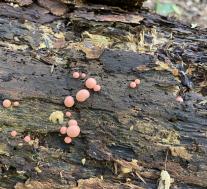
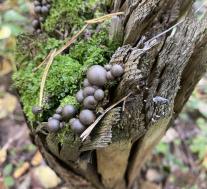
Aethalium. Spherical, cushion-like, 0.5–1.5 cm in diameter. Coloration in young stage pink or reddish; later fades to gray-brown. Surface rough. Occurring singly or clustered together but not completely fused. After spore maturation, the aethalium ruptures at the top, releasing the spore mass.

Flesh

In young stage tender, pink, "paste-like". After maturity brittle.

Odor

Absent

Microscopy

Spore print pinkish-gray in mass. Spores 6–8 µm, rounded, ornamented, colorless. Pseudocapillitium in the form of a system of flat, branching tubes with transverse folds on the surface.

Ecology and distribution

Occurs worldwide. On decaying wood.

Fruiting

May–September

Nutritional properties
Edibility unknown

Obviously, it has no food value.

Similar species

The sporulations resemble those of the slime mold Ground Wolf's Milk (Lycogala terrestre), whose aethalia are colored orange or apricot.

Notes

There is a great deal of information online claiming that the spores of Lycogala can germinate inside the human body, cause cancer, deep mycoses, and other diseases, leading to the conclusion that one should not even approach them. And the names bestowed upon this harmless slime mold—nothing less than "killer mushroom." Of course, it is impossible to take such claims seriously.

Link to this page for printed editions
Shipovalov A.G. Wolf's Milk Slime Mold (Lycogala epidendrum) - Mushrooms of Vologda Region [Electronic resource] URL: https://xn----7sbancweblffgklubds60aja.xn--p1ai/en/wolfs-milk-slime-mold-lycogala-epidendrum (accessed: 13.04.2026).
Share link

Add new comment

One file only.
2 MB limit.
Allowed types: png jpeg jpg jpe gif webp svg.
Allowed types: png gif jpg jpeg webp svg.

Plain text

  • No HTML tags allowed.
  • Lines and paragraphs break automatically.
  • Web page addresses and email addresses turn into links automatically.
Add image
Maximum 8 files.
2 MB limit.
Allowed types: png jpeg jpg jpe gif webp svg.
Allowed types: png gif jpg jpeg webp.
January (1st–10th)
January (1st–10th)
January (11th–20th)
January (11th–20th)
January (21st–31st)
January (21st–31st)
February (1st–10th)
February (1st–10th)
February (11th–20th)
February (21st–28th/29th)
March (1st–10th)
March (1st–10th)
March (11th–20th)
March (11th–20th)
March (21st–31st)
March (21st–31st)
April (1st–10th)
April (1st–10th)
April (11th–20th)
April (11th–20th)
April (21st–30th)
April (21st–30th)
May (1st–10th)
May (1st–10th)
May (11th–20th)
May (11th–20th)
May (21st–31st)
May (21st–31st)
June (1st–10th)
June (1st–10th)
June (11th–20th)
June (11th–20th)
June (21st–30th)
June (21st–30th)
July (1st–10th)
July (1st–10th)
July (11th–20th)
July (11th–20th)
July (21st–31st)
July (21st–31st)
August (1st–10th)
August (1st–10th)
August (11th–20th)
August (11th–20th)
August (21st–31st)
August (21st–31st)
September (1st–10th)
September (11th–20th)
September (21st–30th)
October (1st–10th)
October (1st–10th)
October (11th–20th)
October (11th–20th)
October (21st–31st)
October (21st–31st)
November (1st–10th)
November (1st–10th)
November (11th–20th)
November (21st–30th)
December (1st–10th)
December (1st–10th)
December (11th–20th)
December (21st–31st)