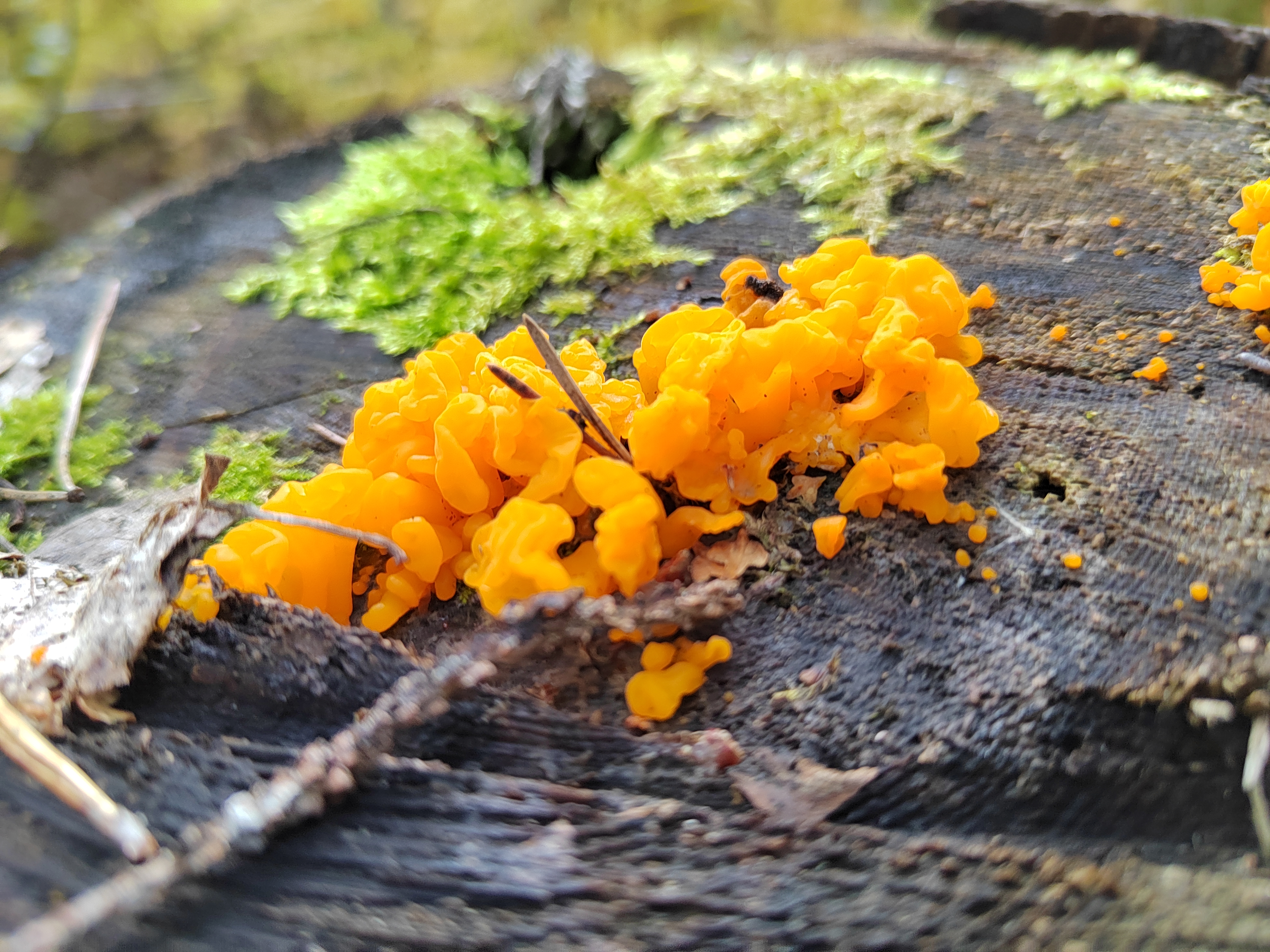
Typically 2–5 cm across, sessile. It consists of tightly packed, convoluted folds and rounded or flattened lobes. Young fruit bodies are more compact and brain-like; as they develop, the lobes expand and their edges become wavy.
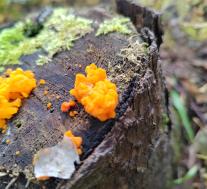
The surface is smooth, glabrous, and shiny when moist. The color is yellow, golden-yellow, or orange-yellow; it may fade with age or prolonged exposure to moisture. Upon drying, the fruit body shrinks significantly, turning into a thin, orange-yellow crust.
The hymenophore is smooth and located on the surface of the lobes.
Flesh
Gelatinous, firm, yellow; translucent in thinner areas. Taste indistinct.
Odor
No distinct odor.
Microscopy
Spore print white. Spores 10–13(14) × 7–9 µm, broadly ellipsoid to ovoid, hyaline, thin-walled, with a droplet of contents and a distinct apiculus.
Ecology and distribution
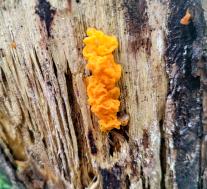
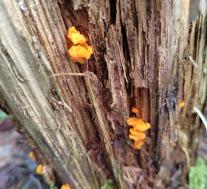
A mycoparasite that develops on the fruiting bodies (or mycelium) of xylotrophic fungi of the genus *Peniophora*. Its fruiting bodies appear on dead branches and other wood of deciduous trees, often on wood that still retains its bark. It occurs singly or in small clusters.
A widely distributed species; it has been recorded in Russia, Europe, North America, Africa, and Asia.
Similar species
Дрожалка золотистая (Naematelia aurantia) внешне очень похожа: образует жёлтые или оранжево-жёлтые студенистые складчатые плодовые тела. Связана со стереумом жёстковолосистым (Stereum hirsutum). У N. aurantia базидии и базидиоспоры в целом мельче.
Notes
Malysheva V. F., Malysheva E. F., Bulakh E. M. The genus Tremella (Tremellales, Basidiomycota) in Russia with description of two new species and proposal of one nomenclatural combination // Phytotaxa. — 2015. — Vol. 238, no. 1. — P. 40–70.
Kuo M. Tremella mesenterica // MushroomExpert.Com. — 2018. — October.
Roberts P. British Tremella species I: Tremella aurantia & T. mesenterica // Mycologist. — 1995. — Vol. 9, no. 3. — P. 110–114.
Towards an integrated phylogenetic classification of the Tremellomycetes / X.-Z. Liu, Q.-M. Wang, M. Göker [et al.] // Studies in Mycology. — 2015. — Vol. 81. — P. 85–147.
Add new comment