Birch Polypore (Fomitopsis betulina)

Березовая губка
Current name

Index Fungorum   Fomitopsis betulina (Bull.) B.K. Cui, M.L. Han & Y.C. Dai

MycoBank   Fomitopsis betulina (Bull.) B.K. Cui, M.L. Han & Y.C. Dai

Other names

Birch Sponge

Systematic position
Specific epithet etymology

Betulinus, a, um, mycol. pertaining to birch. From bētula, ae, birch + -inus, a, um, suffix denoting relation or belonging.

Synonyms

Piptoporus betulinus (Bull.) P. Karst., Meddeland. Soc. Fauna Fl. Fenn. 6: 9 (1881) 

Polyporus betulinus (Bull.) Fr., Utkast til en Svensk Flora. Ed. 3: 660 (1816) 

Ungulina betulina (Bull.) Pat., Essai taxonomique sur les familles et les genres des Hyménomycètes: 103 (1900) 

Placodes betulinus (Bull.) Quél., Enchiridion Fungorum in Europa media et praesertim in Gallia Vigentium: 170 (1886) 

Ungularia betulina (Bull.) Lázaro Ibiza, Revista Real Acad. Ci. Madrid 14: 668 (1916) 

Fomes betulinus (Bull.) Gillot & Lucand, Bull. Soc. Hist. nat. Autun: 165 (1890) 

General description

Phylogenetic studies published in 2016 revealed a close relationship between Piptoporus betulinus and representatives of the genus Fomitopsis. Consequently, it was decided to transfer the birch polypore to this genus. Since P. betulinus was the type species for the genus Piptoporus, the loss of this type species led to the dissolution of that genus.

Habit
Fruiting body
Sessile, bracket-shaped, hoof-shaped, or as an irregular crust/rosette
Hymenophore
Tubulate, poroid
Fruiting period (list)
JunJune (1st–10th)June (11th–20th)June (21st–30th)JulJuly (1st–10th)July (11th–20th)July (21st–31st)AugAugust (1st–10th)August (11th–20th)August (21st–31st)SepSeptember (1st–10th)September (11th–20th)September (21st–30th)
Fruit body

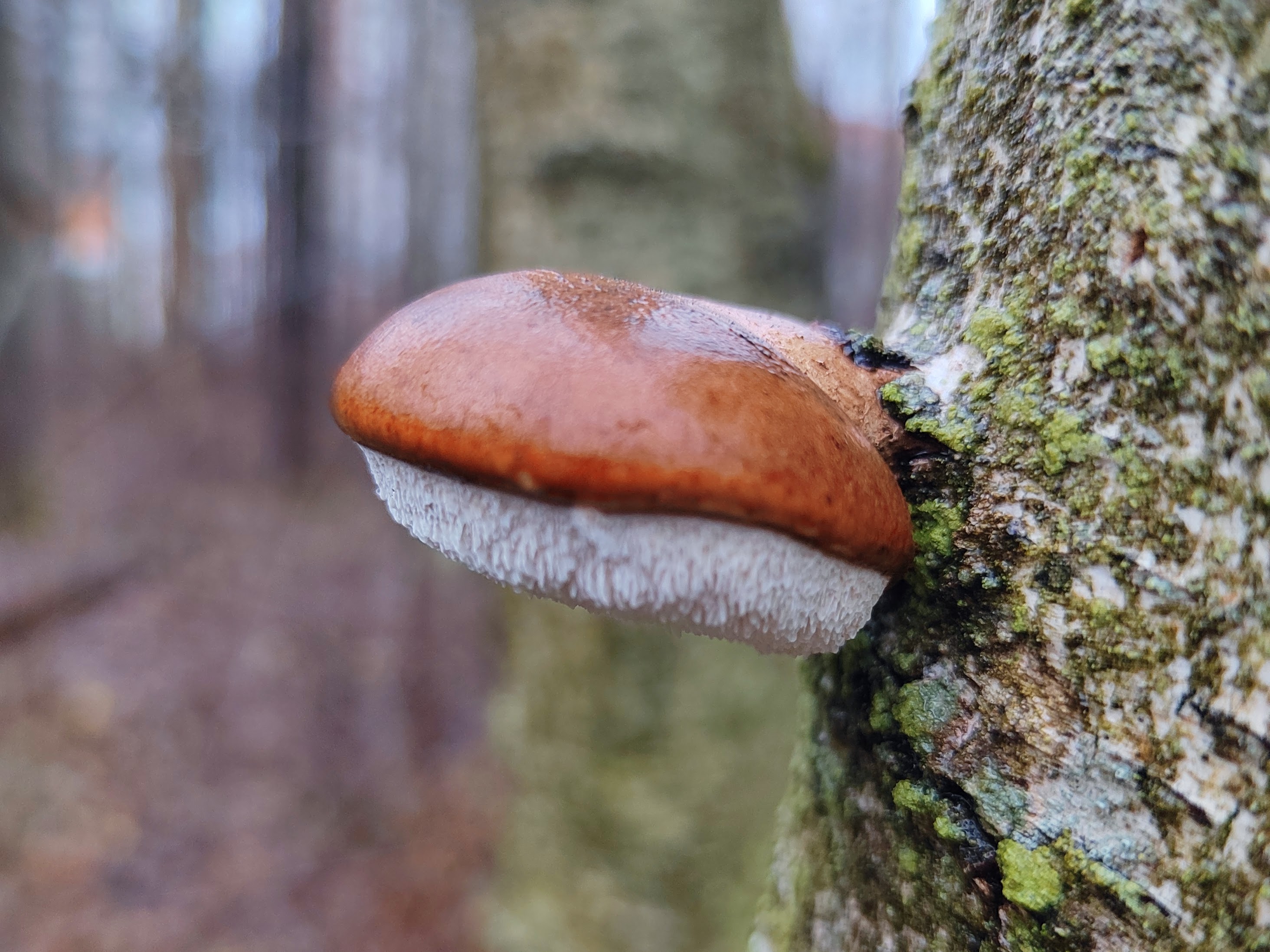
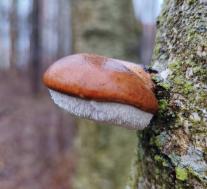
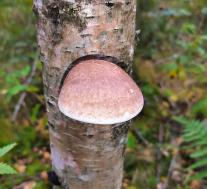
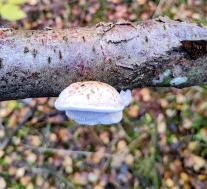
5–20 cm in diameter, 2–6 cm thick, sometimes larger. Semi-circular, attached to the substrate at a single point, semicircular to fully rounded, sessile, with a rudimentary stipe or with a narrowed base resembling a stipe, sometimes almost pendant, convex or flat.

Cap surface smooth, white, soon becoming yellowish, grayish, grayish-brownish, eventually fading, non-zoned, covered with a thin crust that sometimes cracks and peels with age. Margin blunt, rounded, slightly incurved, framing the hymenophore, concolorous with the cap surface or paler.

Hymenophore tubular. Hymenophore surface white, becoming brownish with age. Tubes concolorous with the flesh, 2–8 mm long, single-layered. Pores with entire margins, round, initially with thick walls that thin with age, 3–4 × 1 mm, becoming toothed and split in old fruiting bodies.

Flesh

In cross-section, the flesh is white, softly corky, later slightly fibrous.

Odor

Strong, mushroom-like.

Microscopy

Spore print white. Spores cylindrical, curved and slightly obliquely tapered at the base, hyaline.

Ecology and distribution

One of the most widespread polypores. Causes brown rot. Grows on dead, very rarely on living birches (Betula). Solitary or in groups. Causes brown rot.

The mushroom can serve as a habitat for a large number of insect species that depend on it as a food source and breeding site. In a large-scale study of more than 2600 fruiting bodies collected in eastern Canada, 257 arthropod species were recorded, including 172 insects and 59 mites. The fungus is consumed by caterpillars of the birch fungus moth Nemaxera betulinella.

Fruiting

June–September.

Nutritional properties
Inedible

Inedible due to its tough flesh and poor taste qualities. At the same time, it possesses an impressive array of therapeutic and medicinal properties. There are reports of the mushroom being consumed at a very young age, but there are also accounts of its bitterness.

Similar species

No similar species occur under our local conditions.

Notes

In mature fruiting bodies of F. betulina, the flesh is specifically dense and elastic, resembling soft leather, which is why the mushroom was used for sharpening razors, as well as a pincushion or a mounting board for insect specimens. One of its colloquial English names is Razor strop conk (conk = polypore, razor strop = the leather strap barbers used for sharpening razors).

Link to this page for printed editions
Shipovalov A.G. Birch Polypore (Fomitopsis betulina) - Mushrooms of Vologda Region [Electronic resource] URL: https://xn----7sbancweblffgklubds60aja.xn--p1ai/en/birch-polypore-fomitopsis-betulina (accessed: 13.04.2026).
Share link

Add new comment

One file only.
2 MB limit.
Allowed types: png jpeg jpg jpe gif webp svg.
Allowed types: png gif jpg jpeg webp svg.

Plain text

  • No HTML tags allowed.
  • Lines and paragraphs break automatically.
  • Web page addresses and email addresses turn into links automatically.
Add image
Maximum 8 files.
2 MB limit.
Allowed types: png jpeg jpg jpe gif webp svg.
Allowed types: png gif jpg jpeg webp.
January (1st–10th)
January (1st–10th)
January (11th–20th)
January (11th–20th)
January (21st–31st)
January (21st–31st)
February (1st–10th)
February (1st–10th)
February (11th–20th)
February (21st–28th/29th)
March (1st–10th)
March (1st–10th)
March (11th–20th)
March (11th–20th)
March (21st–31st)
March (21st–31st)
April (1st–10th)
April (1st–10th)
April (11th–20th)
April (11th–20th)
April (21st–30th)
April (21st–30th)
May (1st–10th)
May (1st–10th)
May (11th–20th)
May (11th–20th)
May (21st–31st)
May (21st–31st)
June (1st–10th)
June (1st–10th)
June (11th–20th)
June (11th–20th)
June (21st–30th)
June (21st–30th)
July (1st–10th)
July (1st–10th)
July (11th–20th)
July (11th–20th)
July (21st–31st)
July (21st–31st)
August (1st–10th)
August (1st–10th)
August (11th–20th)
August (11th–20th)
August (21st–31st)
August (21st–31st)
September (1st–10th)
September (11th–20th)
September (21st–30th)
October (1st–10th)
October (1st–10th)
October (11th–20th)
October (11th–20th)
October (21st–31st)
October (21st–31st)
November (1st–10th)
November (1st–10th)
November (11th–20th)
November (21st–30th)
December (1st–10th)
December (1st–10th)
December (11th–20th)
December (21st–31st)