Boletus sanguineus Lilj., Utkast til en Svensk Flora. Ed. 2: 453 (1798)
General description
The Red-belted Conk successfully grows on fallen and dead wood of both coniferous and deciduous trees, as well as on stumps. If a living tree is weakened, the fungus can infect it as well, beginning its life as a parasite and later becoming a saprotroph.
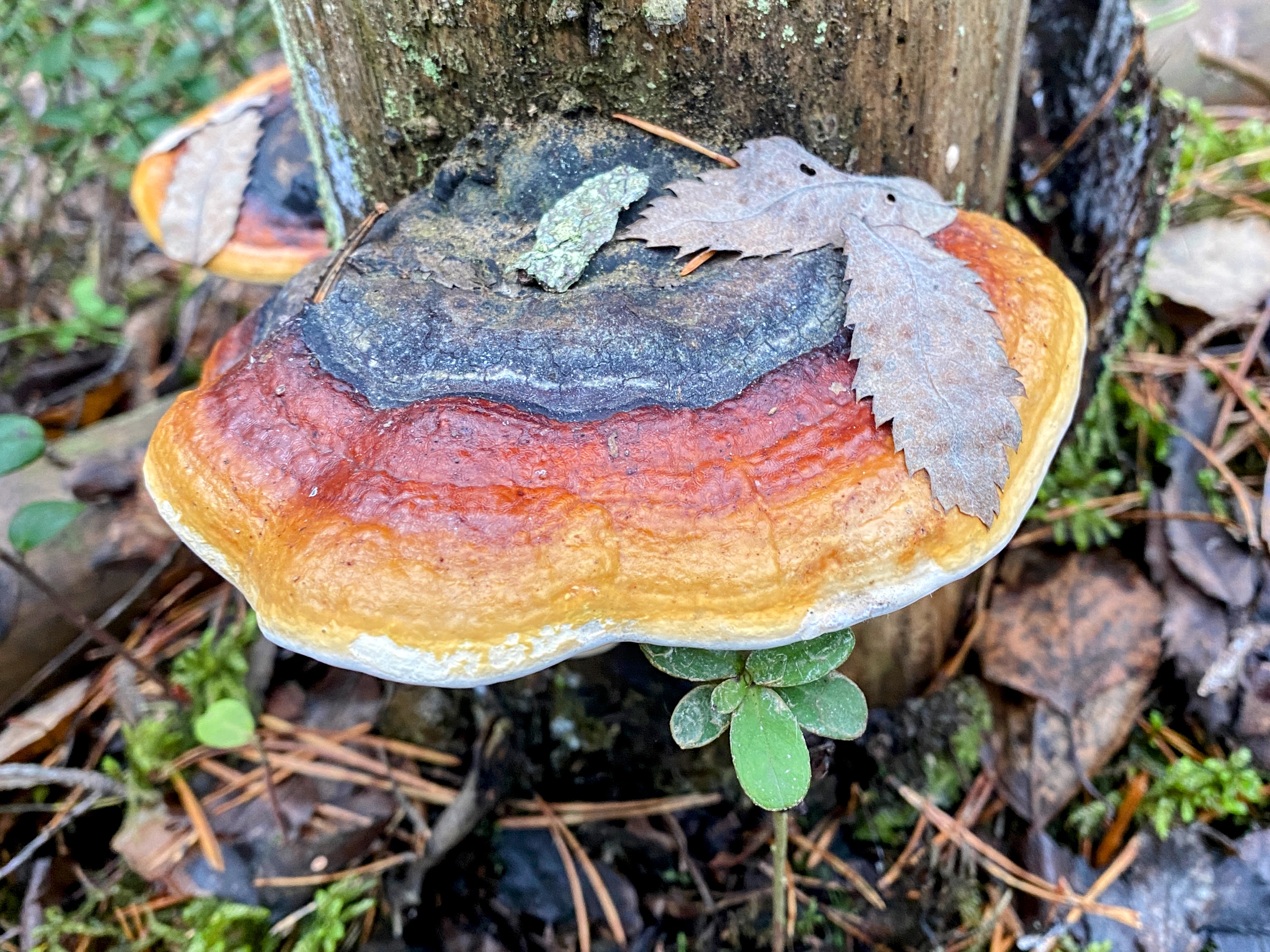
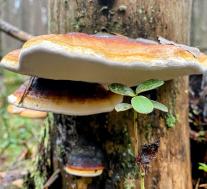
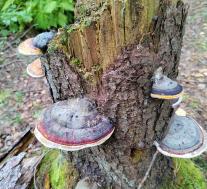
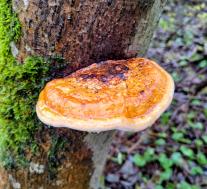
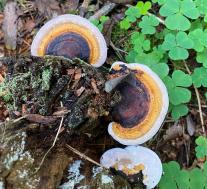
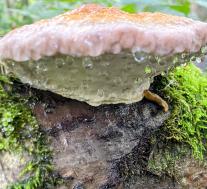
Perennial, with a sharp margin, usually sessile, less often effused-reflexed or resupinate, woody, flattened or hoof-shaped, up to 38 cm wide, 20 cm long from base to margin, and up to 15 cm thick. The color of the upper surface changes from white to yellow, orange, wine-red, gray, and black depending on the age of the fruiting body and its growth rate; in large caps, all colors are represented as concentric zones. The surface is covered with a glossy layer that shines on young zones and becomes sticky when warmed.
First-year fruiting bodies and the growing margin of older ones exude drops of clear liquid during active growth—a phenomenon known as guttation.
Hymenophore: tubular. The pore surface is cream-colored and darkens when pressed; pores are round, 5–6 per 1 mm.
Flesh
Of corky or woody consistency, elastic, dense.
Odor
Strong, mushroom-like.
Microscopy
Spore print cream-colored, pinkish. Spores hyaline, ellipsoidal to elongate-ovoid, slightly flattened and somewhat curved on one side, tapered at the base.
Ecology and distribution
Found on both deciduous and coniferous trees: Betula, Picea, Pinus. The Red-belted Conk is among the most common wood-decaying fungi, causing very active decomposition of wood. It induces mixed rot in the trunks of both coniferous and deciduous species. Decay begins in the sapwood; subsequently, the rot penetrates into the heartwood and develops as a mixed type. The rot is brown and destructive, with numerous cracks in which accumulations of white, fluffy mycelium can be observed. In the final stage of decomposition, the wood breaks down into small prismatic pieces. Fruiting bodies on living trees typically develop in the lower part, whereas on dead trees, their arrangement along the trunk is irregular.
Similar species
Similar to other perennial polypores, but easily distinguished by its characteristic coloration.
Notes
The Red-belted Conk is a fairly well-studied fungus that has been the subject of numerous scientific investigations across various fields, including research conducted at the Federal Budgetary Institution of Science "State Research Center of Virology and Biotechnology 'Vector'".
The main therapeutic properties of the Red-belted Conk identified through research are as follows:
- Exhibits antibacterial activity - Acts as an immunostimulant - Acts as an immunomodulator - Possesses hemostatic properties - Has anti-inflammatory effects (including against abscesses and furunculosis) - Demonstrates anticancer activity (slows the growth of sarcoma 180 tumors by 51%) - Has a tonic effect
In folk medicine, it is used in the form of powders, water infusions, and alcoholic tinctures.
Add new comment