Blushing White Dung-mushroom (Leucocoprinus leucothites)
Index Fungorum Leucocoprinus leucothites (Vittad.) Redhead
MycoBank Leucocoprinus leucothites (Vittad.) Redhead
Белошампиньон румянящийся.
Leucothites, mycol. white-flowered, white-colored. From Greek leukotēs (λευκότης) "whiteness, brightness" + -ētēs (ητος), a suffix forming adjectives or nouns.
Leucoagaricus leucothites (Vittad.) Wasser, Ukrayins'k. Bot. Zhurn. 34 (3): 308 (1977)
Lepiota naucina var. leucothites (Vittad.) Sacc., Syll. Fung. 5: 43 (1887)
Lepiota leucothites (Vittad.) P.D. Orton, Trans. Brit. Mycol. Soc. 43 (2): 177 (1960)
Leucoagaricus carneifolius var. leucothites (Vittad.) Bon, Doc. Mycol. 7 (27-28): 21 (1977)
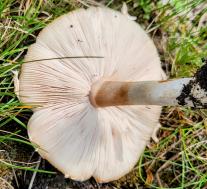
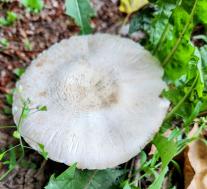
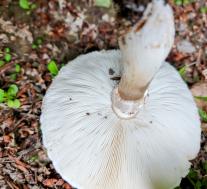
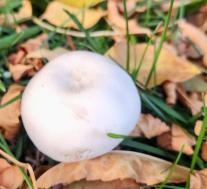
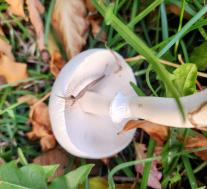
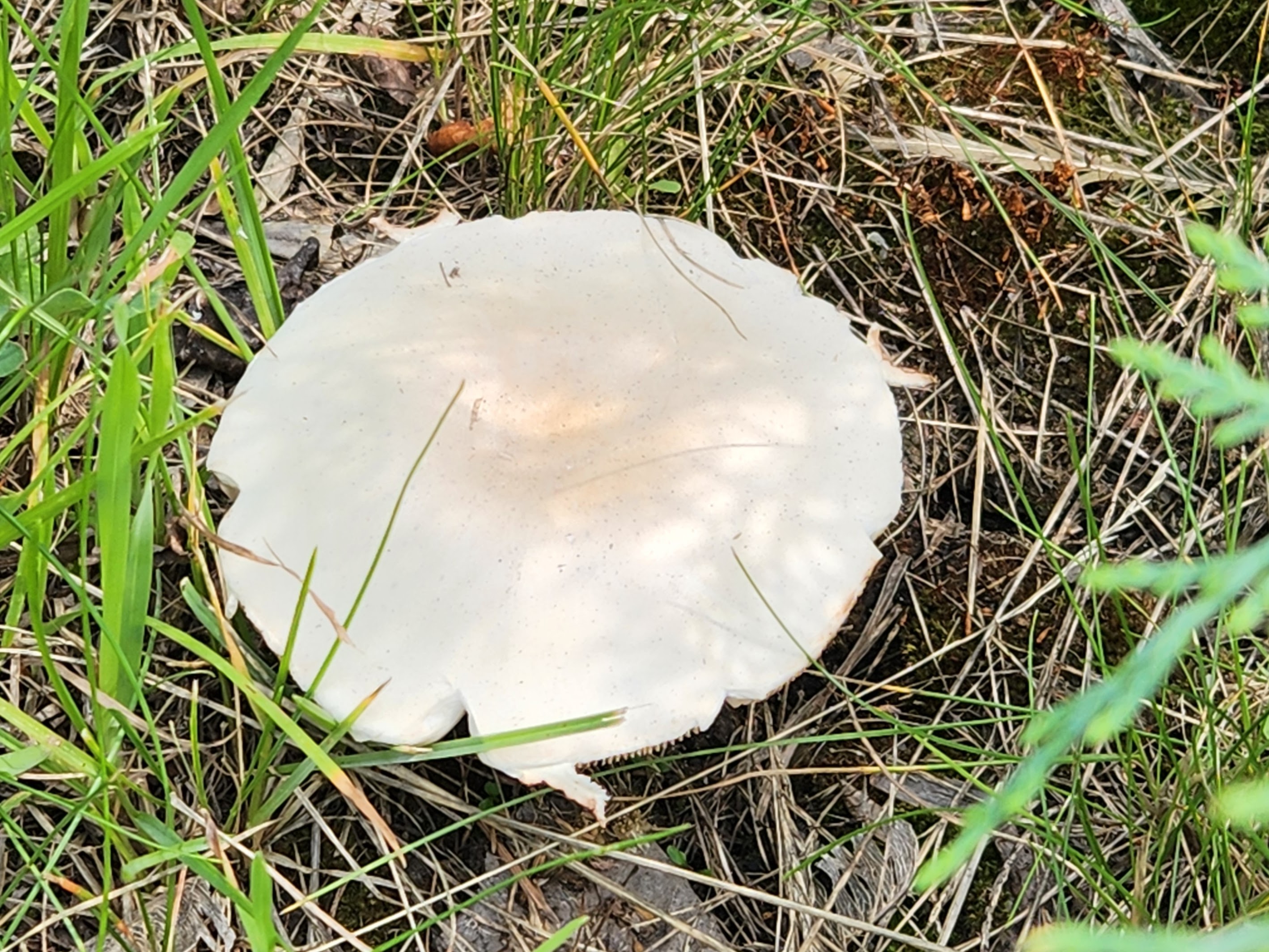
Due to the external similarity among species of Leucocoprinus, Leucoagaricus, and Lepiota, they have frequently been reclassified. Leucocoprinus leucothites has been assigned to these different genera over the years. It has the most "button-mushroom-like" habitus, but differs in having light-colored gills.
6–10 cm wide when fully expanded. In youth, spherical or oval, with margins enclosing the stipe; gradually expands to bell-shaped, then convex-spread, cushion-like, and finally becoming completely flat. The cap coloration is generally white, sometimes with grayish or yellowish speckles; the cuticle, especially in the central area, may crack, giving the mushroom a more or less scaly appearance.
Gills free, crowded, broad, interspersed with shorter gills; in young specimens purely white, becoming light pink or creamy as spores mature. In young mushrooms, covered by a dense white veil.
5–8 cm tall, 1–1.5 cm in diameter, cylindrical with a clavate thickening at the base, with a small hollow cavity. Coloration white; surface smooth, often yellowing upon contact; fragments of the partial veil remain on the stipe as a relatively thin, movable ring.
Thick, dense, white. Sometimes turns yellowish when damaged.
Weak, indistinct. According to other sources, pleasant, with fruity notes.
Spore print white to pale pink. Spores 6.5–8 × 4.5–5.5 μm, broadly elliptical, smooth, thin-walled, dextrinoid, with an apical pore.
Leucocoprinus leucothites is originally a tropical species that has achieved cosmopolitan distribution. A litter saprotroph. Common on disturbed soil areas: path edges, parks, gardens, greenhouses, and compost heaps.
Amateur mushroom foragers should avoid collecting this mushroom due to its similarity to poisonous members of the family Amanitaceae. For example, Destroying Angel or white death cap (Amanita virosa). These can be distinguished by the presence of a sac-like volva and a membranous, immobile ring.
Add new comment