Brown Roll-rim, Common Roll-rim, Poison Pax (Paxillus involutus)
Index Fungorum Paxillus involutus (Batsch) Fr.
MycoBank Paxillus involutus (Batsch) Fr.
Korovnik ("cow mushroom"), Matryoshka ("little Matryona" / nesting doll), Kobyłka ("little mare"), Dun'ka (diminutive of the female name Dunya), Svinukha ("little pig"), Korov'ya guba ("cow's lip"), Dunya.
Involutus, a, um — rolled inward, coiled, spiral. Perfect passive participle of involvo, volvi, volutum, ere — to roll in, wrap up, enfold, cover, envelop.
Agaricus adscendibus Bolton [as 'adscendentibus'], Hist. fung. Halifax (Huddersfield) 2: 55 (1788)
Agaricus contiguus Bull., Herb. Fr. (Paris) 5: pl. 240 (1785)
Agaricus contiguus Bull., Hist. Champ. Fr. (Paris) 2(1): 518 (1792)
Agaricus involutus Batsch, Elench. fung. (Halle): 39 (1783)
Agaricus involutus var. stillans Pers., Mycol. eur. (Erlanga) 3: 63 (1828)
Agaricus involutus var. terrestris Alb. & Schwein., Consp. fung. (Leipzig): 216 (1805)
Agaricus involutus var. truncigenus Alb. & Schwein., Consp. fung. (Leipzig): 216 (1805)
Agaricus involutus ß truncigenus Pers., Syn. meth. fung. (Göttingen) 2: 448 (1801)
Omphalia involuta (Batsch) Gray, Nat. Arr. Brit. Pl. (London) 1: 611 (1821)
Omphalia involuta var. truncigena (Pers.) Gray, Nat. Arr. Brit. Pl. (London) 1: 611 (1821)
Paxillus involutus f. eburneus Gelardi, Segneri & Vizzini, in Gelardi, Segneri, Ercole & Vizzini, Mycosphere 2(5): 548 (2011)
Paxillus involutus f. subrubicundulus Bon, in Bon & Van Haluwyn, Docums Mycol. 11(no. 44): 32 (1981)
Paxillus involutus var. leptopus (Fr.) Quél., Enchir. fung. (Paris): 93 (1886)
Paxillus involutus var. simplex Peck, Ann. Rep. Reg. N.Y. St. Mus. 53: 857 (1901) [1900]
Paxillus leptopus Fr., Monogr. Hymenomyc. Suec. (Upsaliae) 2(2): 311 (1857)
Rhymovis involuta (Batsch) Rabenh., Deutschl. Krypt.-Fl. (Leipzig) 1: 453 (1844)
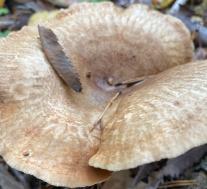
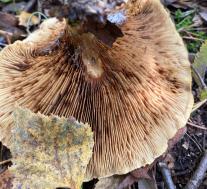
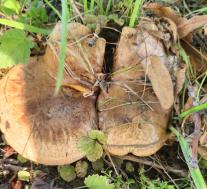
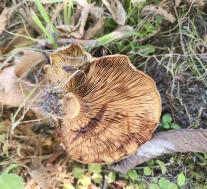
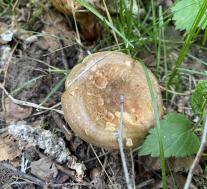
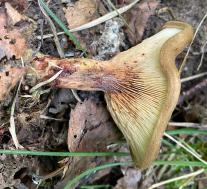
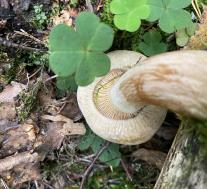
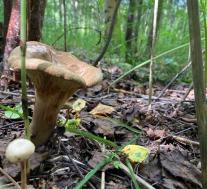
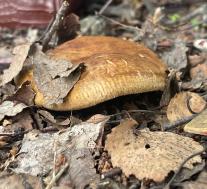
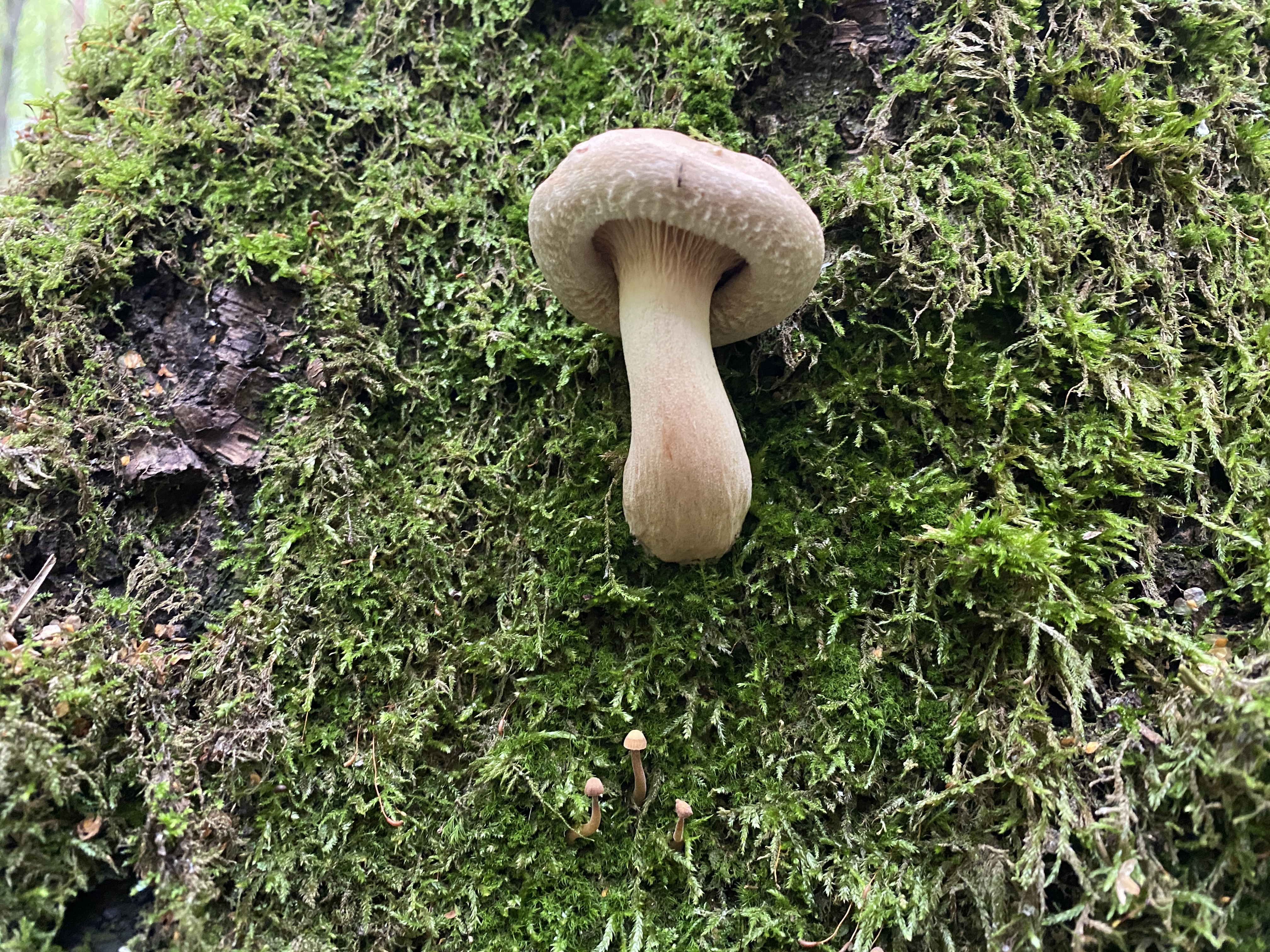
Cap 3–12 cm in diameter, sometimes larger, fleshy; initially convex with an inrolled margin, later becoming flat with a depressed center and a straight or upturned edge, rarely funnel-shaped. The cap surface is smooth, rarely with small bumps, finely pubescent. The margin is pubescent. In young specimens, the cap is light olive with brownish tones, later becoming brown, dark brown, with a rusty or reddish-brown hue. The cap surface is dry, becoming sticky in wet weather. The hymenophore is decurrent and folded; it is sometimes described as gilled, but this is only a visual resemblance. The folds run down the stipe. The folds are yellowish or olive-colored and often forked. With age, they acquire a brick-reddish tint.
3–10 cm long, 1–3 cm in diameter, solid, sometimes curved, central or slightly eccentric. Lighter in color than the cap. Brownish-yellow in the upper part, becoming dark brown toward the base. Smooth.
Yellowish, loose, darkening when broken. Odor strong, mushroom-like, sometimes with slight fruity notes.
Spore print brown. Spores ellipsoid, smooth.
Grows in groups, on soil in mixed and deciduous forests. Forms mycorrhiza with many tree species, for example Betula, Populus tremula and Pinus sylvestris. Shows a preference for anthropogenically disturbed and ruderal habitats. Can exhibit substrate lability and colonize decaying wood.
It has no true look-alikes, but is difficult to distinguish from other species of Paxillus: the Copper Roll-rim (Paxillus cuprinus), the Dark-spored Roll-rim (Paxillus obscurisporus), and the Alder Roll-rim (Paxillus filamentosus).
Paxillus involutus is a species complex that cannot be distinguished under field conditions. Laboratory crossing experiments and molecular studies are used to determine species affiliation.
Add new comment