Bulbous Webcap (Leucocortinarius bulbiger)
Index Fungorum Leucocortinarius bulbiger (Alb. & Schwein.) Singer
MycoBank Leucocortinarius bulbiger (Albertini & Schweinitz) Singer
Bulbous White Webcap.
Bulbiger, having a bulb or tuber, bulbous. From bulbus, i m bulb, tuber + gero, gessi, gestum, ere to bear, to carry.
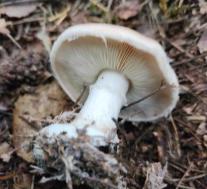
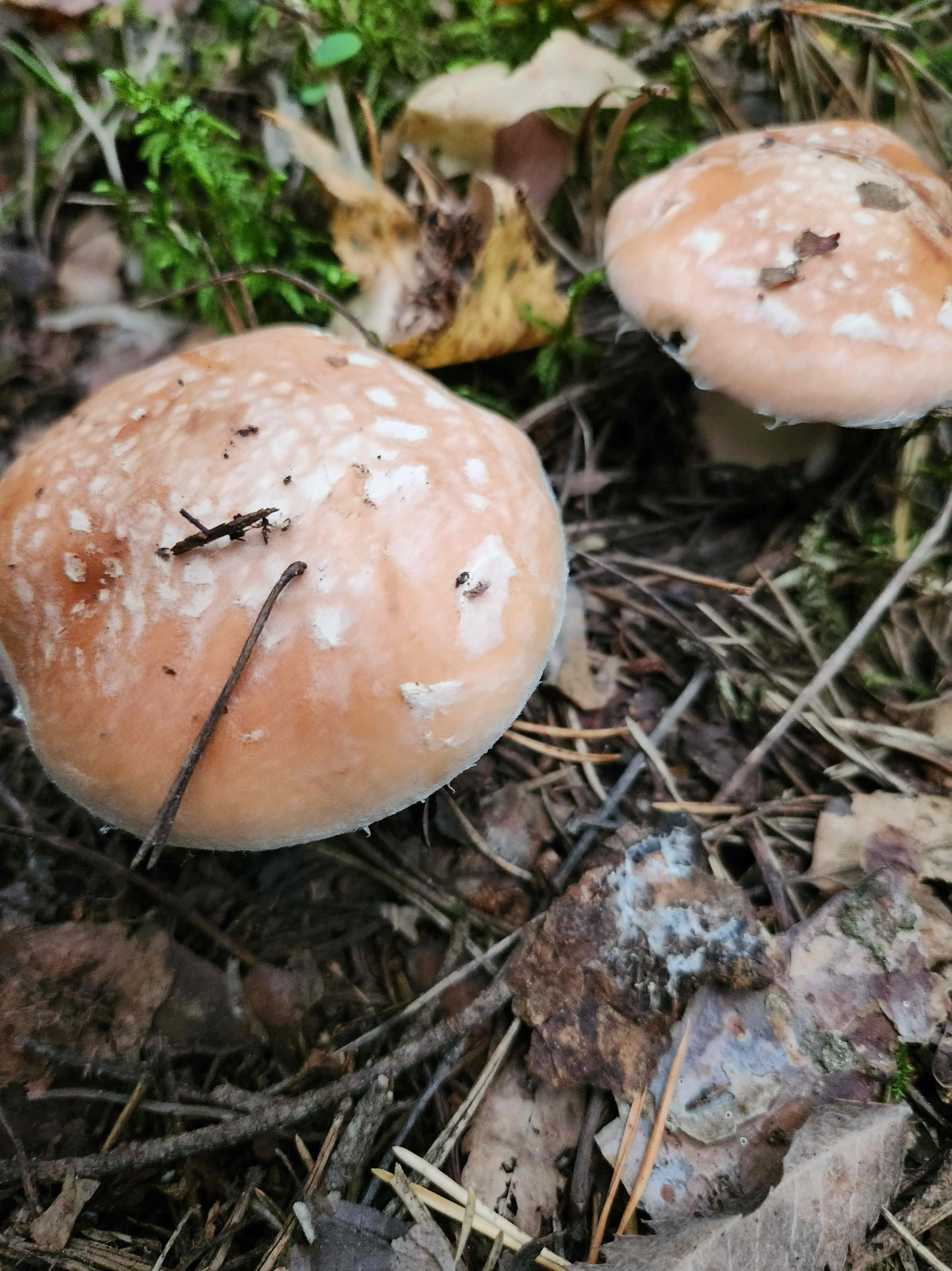
It is the only species in its genus *Leucocortinarius*, meaning the genus is monotypic, with a single representative.
4–8 cm in diameter, initially convex, obtusely bell-shaped with an inrolled, whitish margin due to the cobwebby veil; later convex with a broad umbo, then expanded with a wavy margin; dry, fleshy, with pale whitish cobwebby veil remnants (cortina fragments) closer to the margin (a characteristic feature); dirty-creamy, pale orange, dirty-rusty, brownish-orange, fading in dry weather.
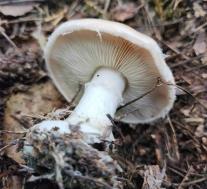
5–7 cm long and about 1 cm in diameter, cylindrical, with a sharply defined large bulb at the base (a characteristic feature); solid; smooth above the ring, fibrous-tomentose and silky below; white, with a detached white cobwebby, needle-like ring.
Fleshy, soft, whitish; in the stipe fibrous, grayish, watery.
Weak, slightly reminiscent of celery.
Spore print white. Spores ellipsoid, smooth, hyaline, thick-walled.
A cosmopolitan species, widely distributed throughout the Northern Hemisphere, preferring mixed birch–aspen–pine forests and sub-boreal woodlands with rich soils, but also occurring in pure, steppe-like pine forests and mixed dark-coniferous forests dominated by cedar and spruce. Based on scattered mentions in the literature, it is considered one of the mycorrhiza-forming partners of pine, but apparently can also form mycorrhiza with other tree species.
Status 3 — Rare species
Status 3 — Rare species
Status 3 — Rare species
Status 3 — Rare species
As the name suggests, the Bulbous White Webcap closely resembles many webcaps (Cortinarius), especially species of the subgenus Phlegmacium with similar habit, which also often have a bulbous thickening at the stipe base. In the field, Leucocortinarius is distinguished primarily by its lighter spores and, consequently, the colour of the gills, as well as by its floccose-fibrous (rather than cobwebby) velum (though exceptions exist, see below).
Light-coloured Webcap (Cortinarius claricolor) — one of the typical webcaps of pure pine forests. It resembles the Bulbous White Webcap in size, brownish cap colour, and abundant floccose veil remnants on the cap (which is generally atypical for webcaps). It differs by the absence of a pronounced bulb at the stipe base and a warmer, yellowish tint in the cap colouration; it is generally found in poorer, haircap-moss patches of pine forests on sandy soils.
Mustard Dune Cap (Hebeloma sinapizans) and other large Hebeloma species differ from the Bulbous White Webcap in the field by a more uniform colouration of the entire fruiting body, darker spores that often settle as tiny droplets on the gills, staining them brown, and usually by a more or less pronounced radish-like odour of the flesh.
Resemblance to the poisonous Fly Agaric (Amanita muscaria), when faded and pale, from which it differs by a thick, bulbous stipe without a volva and a pointed, cobwebby ring. Caution is required: in dry weather, the stipe can sometimes become elongated and thin, and the ring may be barely noticeable.
A specialized species of biologically valuable forests.
Limiting factors: demanding soil composition requirements, logging in old-growth spruce and mixed forests.
Add new comment