Chaga (Inonotus obliquus)

Чага
Current name

Index Fungorum  Inonotus obliquus (Fr.) Pilát

MycoBank  Inonotus obliquus (Fr.) Pilát

Other names

Birch mushroom, Clinker polypore, Sterile conk of Inonotus obliquus

Systematic position
Specific epithet etymology

**Oblīquus, -a, -um** — directed sideways, slanting, oblique, skewed. From *oblīquo* ("to slant, to bend aside").

Synonyms

Polyporus obliquus Fr., Systema Mycologicum 1: 378 (1821) - Basionym

Poria obliquua (Fr.) P. Karst. (1881) 

Fuscoporia obliqua (Fr.) Aoshima, Bull. Tokyo Univ. Forests: 200 (1951) 

Xanthochrous obliquus (Fr.) Bourdot & Galzin, Hyménomycètes de France: 642 (1928)

Phellinus obliquus (Fr.) Pat., Essai taxonomique sur les familles et les genres des Hyménomycètes: 97 (1900) 

Boletus obliquus Ach., Synopsis methodica fungorum: 548 (1801) 

Scindalma obliquum (Fr.) Kuntze, Revisio generum plantarum 3 (3): 519 (1898) 

Phaeoporus obliquus (Fr.) J. Schröt., Kryptogamen-Flora von Schlesien 3.1 (4): 489 (1888)

Fomes obliquus (Fr.) Cooke, Grevillea 14 (69): 21 (1885) 

Physisporus obliquus (Fr.) Chevall., Flore Générale des Environs de Paris 1: 261 (1826) 

Mucronoporus obliquus (Fr.) Ellis & Everh. (1889) 

Mucronoporus obliqua (Fr.) Ellis & Everh., J. Mycol. 5 (2): 91 (1889)

Poria obliqua (Fr.) P. Karst., Rev. Mycol. (Toulouse) 3 (9): 19 (1881)

Habit
Fruiting body
Sessile, bracket-shaped, hoof-shaped, or as an irregular crust/rosette
Hymenophore
Tubulate, poroid
Fruiting period (list)
MayMay (1st–10th)May (11th–20th)May (21st–31st)JunJune (1st–10th)June (11th–20th)June (21st–30th)JulJuly (1st–10th)July (11th–20th)July (21st–31st)AugAugust (1st–10th)August (11th–20th)August (21st–31st)SepSeptember (1st–10th)September (11th–20th)September (21st–30th)
Fruit body

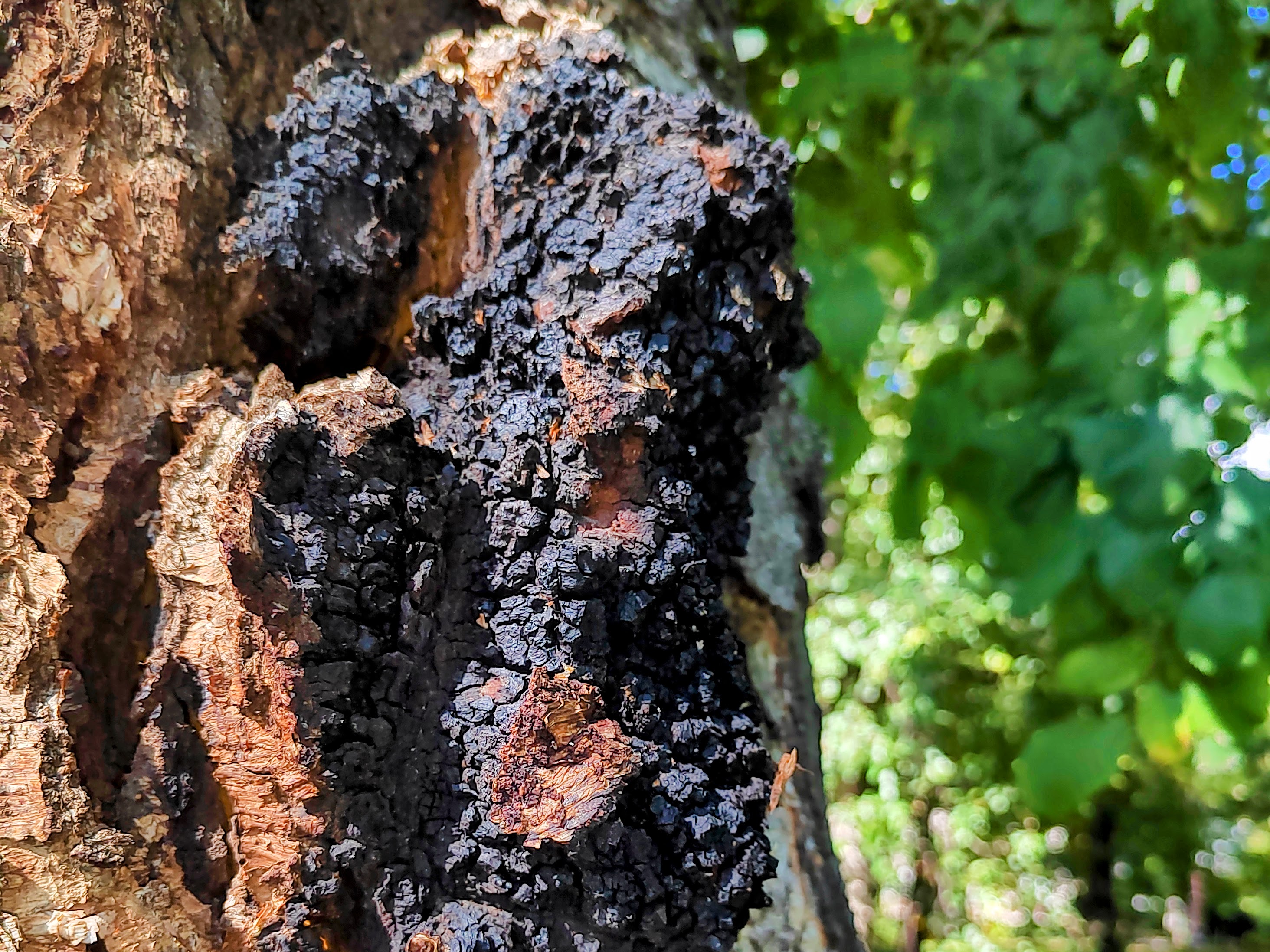
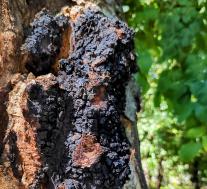
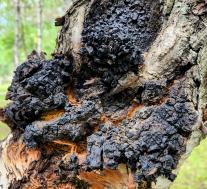
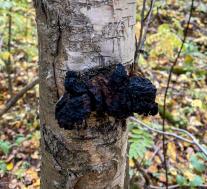
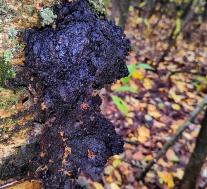
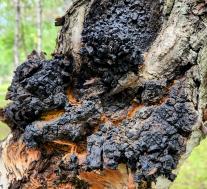
**Chaga** refers to the sterile stage of the Clinker polypore (*Inonotus obliquus*) — large growths formed by this fungus on the trunks of living birch trees. These growths consist of a mass of fungal mycelium and host tree tissues that have proliferated under the influence of hormones and active compounds secreted by the fungus. These growths are not fruiting bodies in the strict sense, i.e., they are not specialised organs of sexual reproduction and do not produce sexual spores. In taxonomic nomenclature, the asexual stage is designated *Inonotus obliquus* f. *sterilis*, which can be somewhat misleading: the surface of these growths actively produces asexual spores — chlamydospores — which give chaga its characteristic black or dark brown colour.

The growths can reach up to 50 cm in diameter and protrude 50–100 mm from the trunk. Beneath the hard, cracked blackish-brown outer layer lies a softer, looser mass of cork-like consistency, ochre in colour with yellowish veins. Chaga can persist for many years; growths aged twenty years or more have been recorded.

The sexual stage of the fungus typically develops when the host tree begins to die. Beneath the bark of the infected tree, a new structure appears as a thin dark-brown layer of tubular hymenophore, 3–15 mm thick, often extending along the trunk for considerable distances — up to 1–2 (4) m. The tubes are single-layered, up to 10 mm long, and oriented at an angle of 20–30° to the trunk, which gave the species its scientific name (*obliquus*). Pores are 0.2–0.3 mm in diameter: rounded to oblong in young specimens (3–5 per mm), becoming angular and toothed with age. When fresh, the tissue is leathery-fleshy; when dry, it becomes hard and brittle.

The sexual stage of chaga is a rare find — one that not every mycologist can claim to have encountered — primarily because it is often completely hidden beneath the bark. Most often, overmature or dried specimens are discovered after the bark has already fallen away. The process by which the fungus emerges from beneath the bark is quite interesting: so-called "lever" plates grow along the edge of the hymenophore; as they expand, they lift the bark away from the wood, thereby creating space for effective sporulation.

Flesh

Жесткая, деревянистая, крошащаяся.

Odor

Weak, indistinct

Microscopy

Chlamydospores7–10 × 3.5–5.5 μm, ellipsoid, 1–2(4)-celled, smooth, olive-brown, often borne on conidiophores.

Basidiospores 8–10 × 5–7.5 μm, ellipsoid, hyaline, with oil droplets.

Ecology and distribution

Xylotroph. In the Vologda Region, it grows primarily on birch (Betula) and poplar (Populus), occasionally occurring on aspen (Populus tremula). It infects only living trees and may occur at considerable height. It typically develops at sites of mechanical bark damage (broken branches, frost cracks, insect activity, etc.). Also recorded on alder (Alnus), elm (Ulmus), beech (Fagus), maple (Acer), broom (Genista), and oak (Quercus). The distribution range of chaga coincides with that of birch. Causes white rot.

Fruiting

Occurs throughout the year; main growth of fruiting bodies takes place from May to September.

Nutritional properties
Inedible

Inedible due to tough flesh and poor culinary qualities. However, it possesses a substantial range of therapeutic and medicinal properties.

Similar species

Chaga is often mistakenly used to refer to fruiting bodies of other polypores, primarily the Tinder fungus (Fomes fomentarius). Sometimes chaga is confused with trunk abnormalities: burl and wood knot.

Notes

Over more than a century of study of I. obliquus, a significant body of research has accumulated demonstrating the remarkable benefits of this fungus. These studies have noted antitoxic effects, radioprotective properties, antioxidant activity, immunomodulatory effects, anti-inflammatory properties, positive effects on the digestive system, and general strengthening and tonic effects on the body. It is used as an adjunctive treatment for various oncological diseases.

It is used as a medicinal agent in traditional medicine. Various dietary supplements, such as Befungin, are produced from chaga extracts.

The tonic effect of chaga decoction is sometimes compared to that of Eleutherococcus or coffee.

In the Vologda Region, with its vast birch forests, chaga is an important commercial fungus. The market price of chaga is comparable to that of dried king bolete.

Link to this page for printed editions
Shipovalov A.G. Chaga (Inonotus obliquus) - Mushrooms of Vologda Region [Electronic resource] URL: https://xn----7sbancweblffgklubds60aja.xn--p1ai/en/chaga-inonotus-obliquus (accessed: 13.04.2026).
Share link

Add new comment

One file only.
2 MB limit.
Allowed types: png jpeg jpg jpe gif webp svg.
Allowed types: png gif jpg jpeg webp svg.

Plain text

  • No HTML tags allowed.
  • Lines and paragraphs break automatically.
  • Web page addresses and email addresses turn into links automatically.
Add image
Maximum 8 files.
2 MB limit.
Allowed types: png jpeg jpg jpe gif webp svg.
Allowed types: png gif jpg jpeg webp.
January (1st–10th)
January (1st–10th)
January (11th–20th)
January (11th–20th)
January (21st–31st)
January (21st–31st)
February (1st–10th)
February (1st–10th)
February (11th–20th)
February (21st–28th/29th)
March (1st–10th)
March (1st–10th)
March (11th–20th)
March (11th–20th)
March (21st–31st)
March (21st–31st)
April (1st–10th)
April (1st–10th)
April (11th–20th)
April (11th–20th)
April (21st–30th)
April (21st–30th)
May (1st–10th)
May (1st–10th)
May (11th–20th)
May (11th–20th)
May (21st–31st)
May (21st–31st)
June (1st–10th)
June (1st–10th)
June (11th–20th)
June (11th–20th)
June (21st–30th)
June (21st–30th)
July (1st–10th)
July (1st–10th)
July (11th–20th)
July (11th–20th)
July (21st–31st)
July (21st–31st)
August (1st–10th)
August (1st–10th)
August (11th–20th)
August (11th–20th)
August (21st–31st)
August (21st–31st)
September (1st–10th)
September (11th–20th)
September (21st–30th)
October (1st–10th)
October (1st–10th)
October (11th–20th)
October (11th–20th)
October (21st–31st)
October (21st–31st)
November (1st–10th)
November (1st–10th)
November (11th–20th)
November (21st–30th)
December (1st–10th)
December (1st–10th)
December (11th–20th)
December (21st–31st)