Chanterelle (Cantharellus cibarius)
Index Fungorum Cantharellus cibarius Fr
MycoBank Cantharellus cibarius Fr
True chanterelle, yellow chanterelle, rooster.
Distinctive feature of common chanterelle is practically complete absence of wormholes and insect larvae in flesh. Chitinmannose is present in spores and flesh of common chanterelle, which acts lethally on arthropods and helminths of all species. This polysaccharide can penetrate through worm's outer cover, enter nerve ganglion and cause blockage of its nervous system function. Broken nervous system function of worm leads to death of parasite. Once the author was objected to this that once a wireworm larva was found in fruit body of chanterelle, so a slight clarification, besides truly omnivorous insect species, others still avoid feeding on common chanterelle.
From Latin cibus, i, m – food, nourishment, feed; nutritive juices and substances
Agaricus alectorolophoides Schaeff., Fung. bavar. palat. nasc. (Ratisbonae) 4: 46 (1774)
Agaricus chantarellus L., Sp. pl. 2: 1171 (1753)
Agaricus chantarellus Bolton, Hist. fung. Halifax (Huddersfield) 2: 62 (1788)
Alectorolophoides cibarius (Fr.) Earle, Bull. New York Bot. Gard. 5: 407 (1909)
Cantharellus carneoalbus R. Heim, Revue Mycol., Paris 25(3-4): 225 (1960)
Cantharellus cibarius f. neglectus M. Souché, Bull. Soc. mycol. Fr. 20: 39 (1904)
Cantharellus cibarius var. rufescens Cetto, I Funghi dal Vero, Vol. 6. Edn. 2 (Trento): 487 (1991)
Cantharellus cibarius var. rufipes (Gillet) Cooke, Handb. Brit. Fungi, 2nd Edn: 339 (1883)
Cantharellus cibarius var. salmoneus L. Corb., Mém. Soc. natn. Sci. nat. Cherbourg 40(2): 123 (1929)
Chanterel chantarellus (L.) Murrill, N. Amer. Fl. (New York) 9(3): 169 (1910)
Craterellus cibarius (Fr.) Quél., Fl. mycol. France (Paris): 37 (1888)
Hyponevris cantharella (L.) Paulet [as 'cantharella'], Traité champ. (Paris) 2: 128, tab. 36, fig. 1-5 (1808) [1793]
Merulius alectorolophoides (Schaeff.) J.F. Gmel., Syst. Nat., Edn 13 2(2): 1430 (1792)
Merulius chantarellus (L.) Scop., Fl. carniol., Edn 2 (Wien) 2: 461 (1772)
Merulius cibarius (Fr.) Westend., Herb. crypt. Belg.: no. 340 (1849)
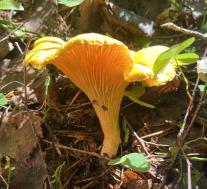
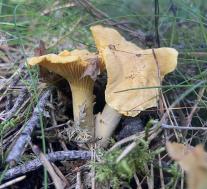
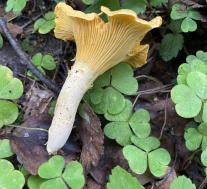
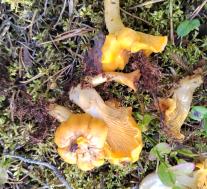
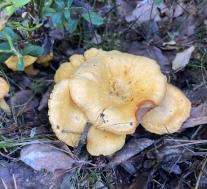
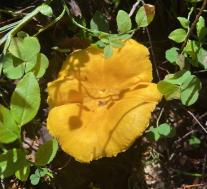
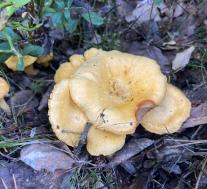
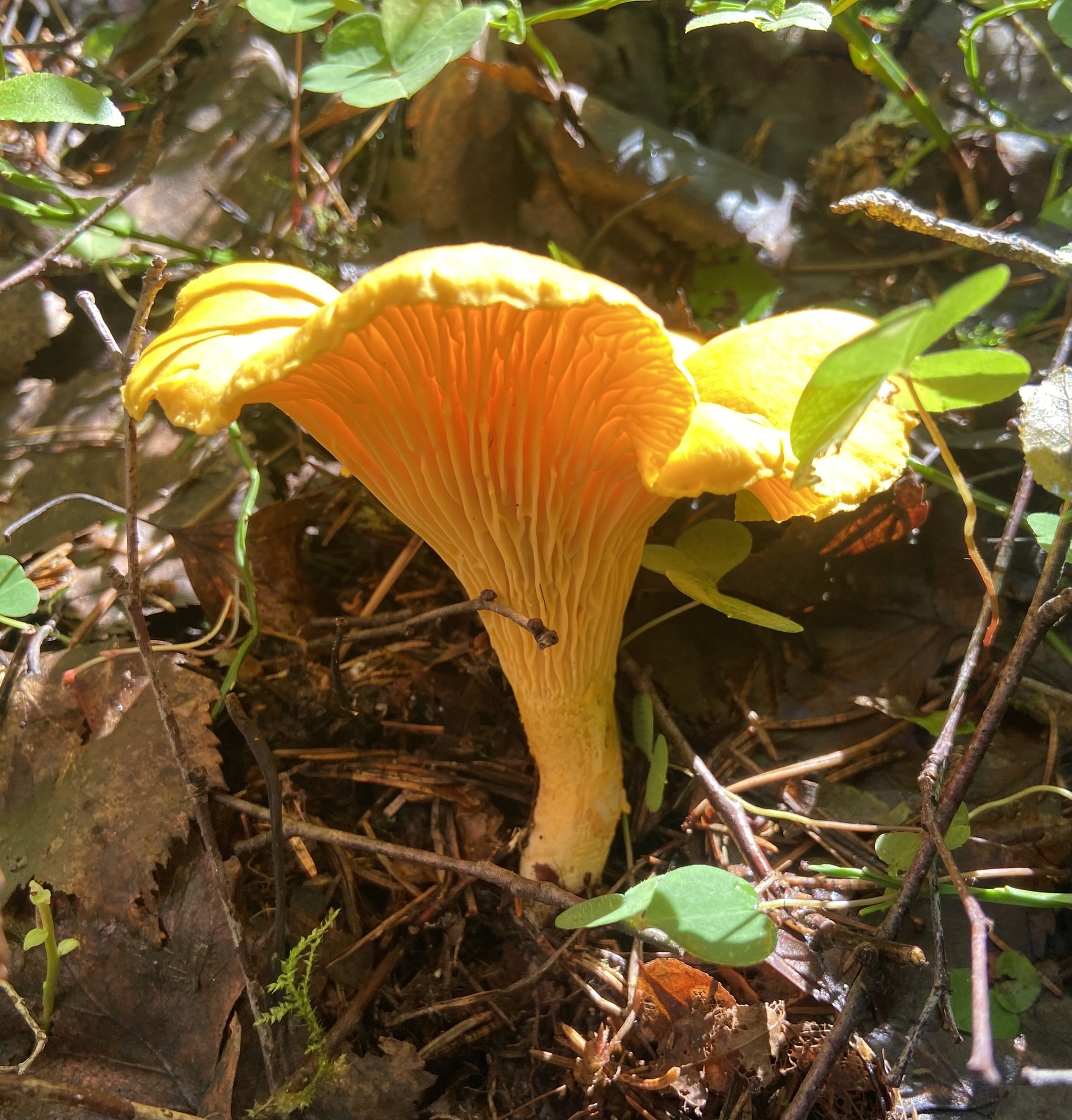
3 – 15 cm in diameter, fleshy, initially convex with rolled-in margin, then almost flat, later funnel-shaped with irregular wavy edge. Surface pale-yellow, yellow, orange-yellow, sometimes with brownish spots, smooth, sometimes wrinkled.
Hymenophore: folded, strongly decurrent, same color as cap surface, with numerous anastomoses.
3 – 10 cm long, 0.8 – 3 cm in diameter, typically short, more or less cylindrical, narrowing toward base, at top directly transitions into cap, yellow, toward bottom often colored in lighter shades, up to almost white.
Dense, fibrous, elastic, same color as cap or lighter, with slightly sharp taste.
Smell: pleasant, with fruity notes.
Spore print pale-yellow. Spores ellipsoid, transparent, thin-walled.
Grows singly and in large groups in coniferous and mixed forests, in wet moss, among grass or under litter.
14 genera of trees are mentioned with which C. cibarius forms mycorrhiza: fir (Abies), birch (Betula), hornbeam (Carpinus), chestnut (Castanea), hazel (Corylus), eucalyptus (Eucalyptus), beech (Fagus), spruce (Picea), pine (Pinus), poplar (Populus), Douglas fir (Pseudotsuga), oak (Quercus), Shorea (Shorea), hemlock (Tsuga).
Not listed in Red Data Books of RF and regions.
False chanterelle (Hygrophoropsis aurantiaca) — has reddish-orange coloration, more round shape of cap, hollow stem, often blackening toward bottom with age. Gills characteristically fork-branched toward cap margin. This mushroom is often collected by mistake together with true chanterelle. Substrate indiscriminateness of false chanterelle should also be noted, it occupies soil litter, rotten wood and even anthills.
Yellow hedgehog (Hydnum repandum) — this mushroom, just like orange hedgehog (Hydnum rufescens), can be confused with chanterelle only for a few seconds and only when viewed from above because hymenophore of hedgehogs is spiny.
Previously it was thought that chanterelles can remove radionuclides from the body, but now it is established that this is not so. On the contrary, chanterelles are capable of accumulating and containing radionuclides, especially cesium-137.
Constant consumption of chanterelles in food can prevent vision disorders, inflammation of the eye mucous membrane, night blindness (nyctalopia). Chinese specialists recommend including chanterelles in the diet for those working constantly at computers.
Add new comment