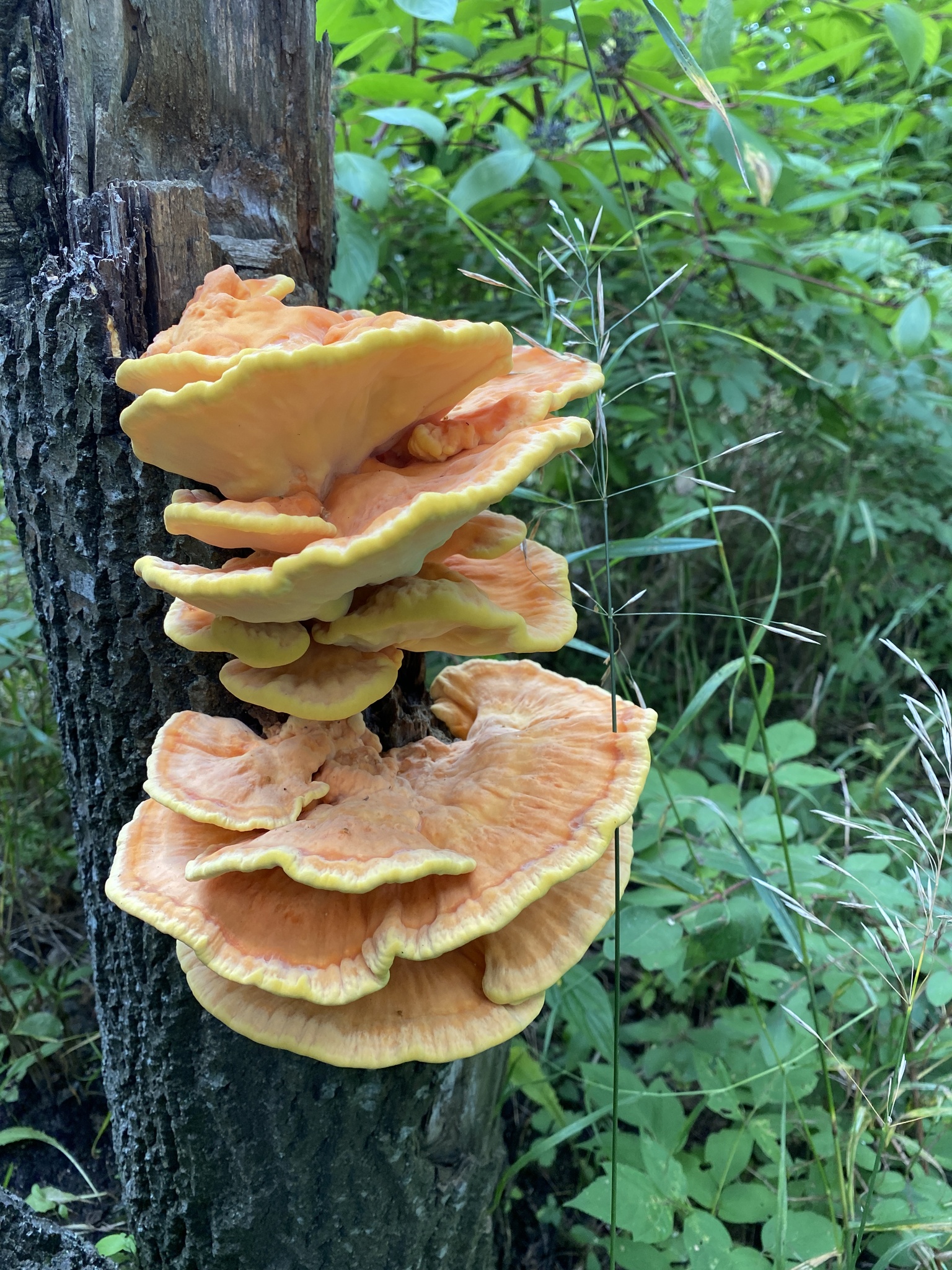
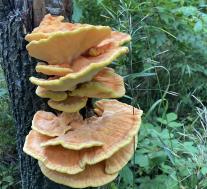
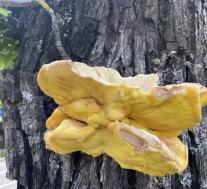
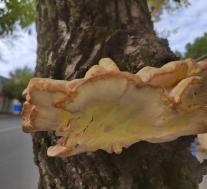
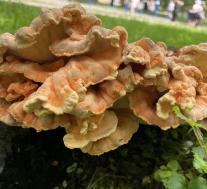
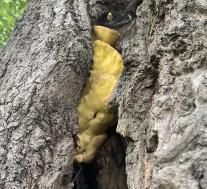
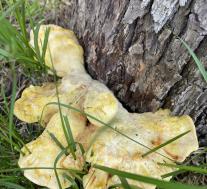
Chicken of the Woods, Sulphur Shelf (Laetiporus sulphureus)

Laetiporus sulphureus
Current name

Index Fungorum    Laetiporus sulphureus (Bull.) Murrill

MycoBank    Laetiporus sulphureus (Bull.) Murrill
 

Other names

Chicken mushroom, Witch's sulfur.

Systematic position
Specific epithet etymology

Sulphureus, a, um — sulfur-yellow, sulfurous. From sulphurāns (Latin: sulfurous).

Synonyms

Polyporus sulphureus (Bull.) Fr., Systema Mycologicum 1: 357 (1821) 

Grifola sulphurea (Bull.) Pilát, Beih. Bot. Zentbl.: 39 (1934) 

Cladoporus sulphureus (Bull.) Teixeira, Revista Brasileira de Botânica 9 (1): 43 (1986)

Tyromyces sulphureus (Bull.) Donk, Mededelingen van het botanisch Museum en Herbarium van de Rijksuniversiteit Utrecht 9: 145 (1933) 

Leptoporus sulphureus (Bull.) Quél., Flore mycologique de la France et des pays limitrophes: 386 (1888) 

Sistotrema sulphureum (Bull.) Rebent., Prodromus Flora Neomarchicae: 376 (1804) 

Merisma sulphureus (Bull.) Gillet, Les Hyménomycètes ou Description de tous les Champignons (Fungi) qui Croissent en France avec l'indication de leurs propriétés utiles ou vénéneuses 1: 691 (1878) 

Polypilus sulphureus (Bull.) P. Karst., Acta Societatis pro Fauna et Flora Fennica 2 (1): 29 (1881) 

Cladomeris sulphurea (Bull.) Quél., Enchiridion Fungorum in Europa media et praesertim in Gallia Vigentium: 168 (1886) 

Merisma sulphureum (Bull.) Gillet, Les Hyménomycètes ou Description de tous les Champignons qui Croissent en France: 691 (1878)

General description

In Germany and some regions of North America, dishes made from the Sulphur Shelf are considered delicacies, and the mushroom is called "wood chicken" or "forest chicken" (English: chicken of the woods, chicken mushroom). As a substitute for chicken meat, it can be used in vegetarian cuisine.

Habit
Fruiting body
Sessile, bracket-shaped, hoof-shaped, or as an irregular crust/rosette
Hymenophore
Tubulate, poroid
Fruiting period (list)
MayMay (1st–10th)May (11th–20th)May (21st–31st)JunJune (1st–10th)June (11th–20th)June (21st–30th)JulJuly (1st–10th)July (11th–20th)July (21st–31st)AugAugust (1st–10th)August (11th–20th)August (21st–31st)SepSeptember (1st–10th)
Fruit body

Fruiting bodies with a lateral pseudostipe or sessile, solitary or clustered in large imbricate groups. At the initial growth stage, caps amorphous, drop-shaped or bladder-like, fleshy — the so-called "effused-reflexed form". With age, they develop into consolate (bracket-shaped) structures. Size ranging from 5 to 40 cm. Cap surface lemon-yellow or orange, becoming pale brownish with age, slightly pubescent or smooth, radially wrinkled. Margin similarly colored, often wavy, rounded. Hymenophore tubular, layer up to 4 mm thick, sulphur-yellow, pores angular, 3–4 per 1 mm.

Flesh

Soft and juicy, quite brittle, white in color. When dried, it becomes brittle, fibrous, and very light. Taste with a light pleasant acidity.

Odor

Pleasant, mushroom-like with lemon notes. With age and upon drying, it acquires an unpleasant odor.

Microscopy

Spore print in mass white-creamy. Spores ellipsoid, smooth, transparent.

Ecology and distribution

Xylotroph. A wood-decaying parasitic fungus that affects hardwood tree species. Causes red-brown destructive trunk rot, red-brown prismatic heart rot. Primarily affects the heartwood of the tree trunk, less frequently the sapwood. Capable of continuing its development for several years on dead trees. In the Vologda Region, recorded on poplar, oak, and willow.

Fruiting

May–September

Nutritional properties
Edible

In its young stage, the mushroom is edible. It has a pleasant mushroom aroma and a slightly sour taste. Young, tender, and firm specimens are used in salads, fried, salted, or pickled. Minced fried Sulphur Shelf can be used as a filling for pies or egg casseroles. Some sources mention poisonous properties of this mushroom, in particular a mild laxative effect; it can sometimes cause contact edema, nausea, vomiting, and dizziness. Cases of allergic reactions upon consumption, as well as ataxia and visual hallucinations in children, have been reported. To avoid poisoning, only young mushrooms growing on hardwood trees far outside urban areas should be collected.

Conservation status
Red Data Book of Arkhangelsk Oblast.

Category 4. Species of uncertain status.

Similar species

Mountain Laetiporus (Laetiporus montanus) inhabits coniferous tree species.
Beige-pored Laetiporus (Laetiporus cremeiporus) — hymenial layer white or beige with a yellowish tint.
Variable-spored Laetiporus (Laetiporus versisporus) is paler, not as bright as L. sulphureus, and on average has smaller spores.

Notes

Causes red-brown destructive trunk rot and red-brown prismatic heart rot. Primarily affects the heartwood of the tree trunk, less frequently the sapwood.

For the Sulphur Shelf, an anamorphic stage is known: *Sporotrichum versisporum* (Lloyd) Stalpers, Stud. Mycol. 24: 25 (1984).

The fungus is promising as a biotechnological object due to its ability to rapidly accumulate mycelial biomass, making it a potential candidate for cultivation as animal feed.

Link to this page for printed editions
Shipovalov A.G. Chicken of the Woods, Sulphur Shelf (Laetiporus sulphureus) - Mushrooms of Vologda Region [Electronic resource] URL: https://xn----7sbancweblffgklubds60aja.xn--p1ai/en/chicken-woods-sulphur-shelf-laetiporus-sulphureus (accessed: 13.04.2026).
Share link

Add new comment

One file only.
2 MB limit.
Allowed types: png jpeg jpg jpe gif webp svg.
Allowed types: png gif jpg jpeg webp svg.

Plain text

  • No HTML tags allowed.
  • Lines and paragraphs break automatically.
  • Web page addresses and email addresses turn into links automatically.
Add image
Maximum 8 files.
2 MB limit.
Allowed types: png jpeg jpg jpe gif webp svg.
Allowed types: png gif jpg jpeg webp.
January (1st–10th)
January (1st–10th)
January (11th–20th)
January (11th–20th)
January (21st–31st)
January (21st–31st)
February (1st–10th)
February (1st–10th)
February (11th–20th)
February (21st–28th/29th)
March (1st–10th)
March (1st–10th)
March (11th–20th)
March (11th–20th)
March (21st–31st)
March (21st–31st)
April (1st–10th)
April (1st–10th)
April (11th–20th)
April (11th–20th)
April (21st–30th)
April (21st–30th)
May (1st–10th)
May (1st–10th)
May (11th–20th)
May (11th–20th)
May (21st–31st)
May (21st–31st)
June (1st–10th)
June (1st–10th)
June (11th–20th)
June (11th–20th)
June (21st–30th)
June (21st–30th)
July (1st–10th)
July (1st–10th)
July (11th–20th)
July (11th–20th)
July (21st–31st)
July (21st–31st)
August (1st–10th)
August (1st–10th)
August (11th–20th)
August (11th–20th)
August (21st–31st)
August (21st–31st)
September (1st–10th)
September (11th–20th)
September (21st–30th)
October (1st–10th)
October (1st–10th)
October (11th–20th)
October (11th–20th)
October (21st–31st)
October (21st–31st)
November (1st–10th)
November (1st–10th)
November (11th–20th)
November (21st–30th)
December (1st–10th)
December (1st–10th)
December (11th–20th)
December (21st–31st)