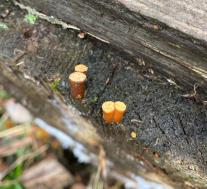
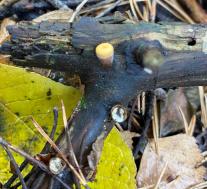
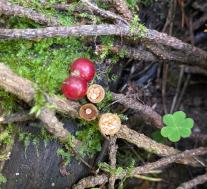
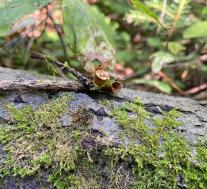
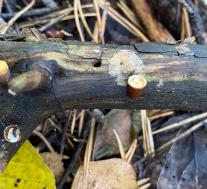
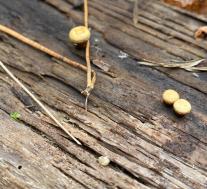
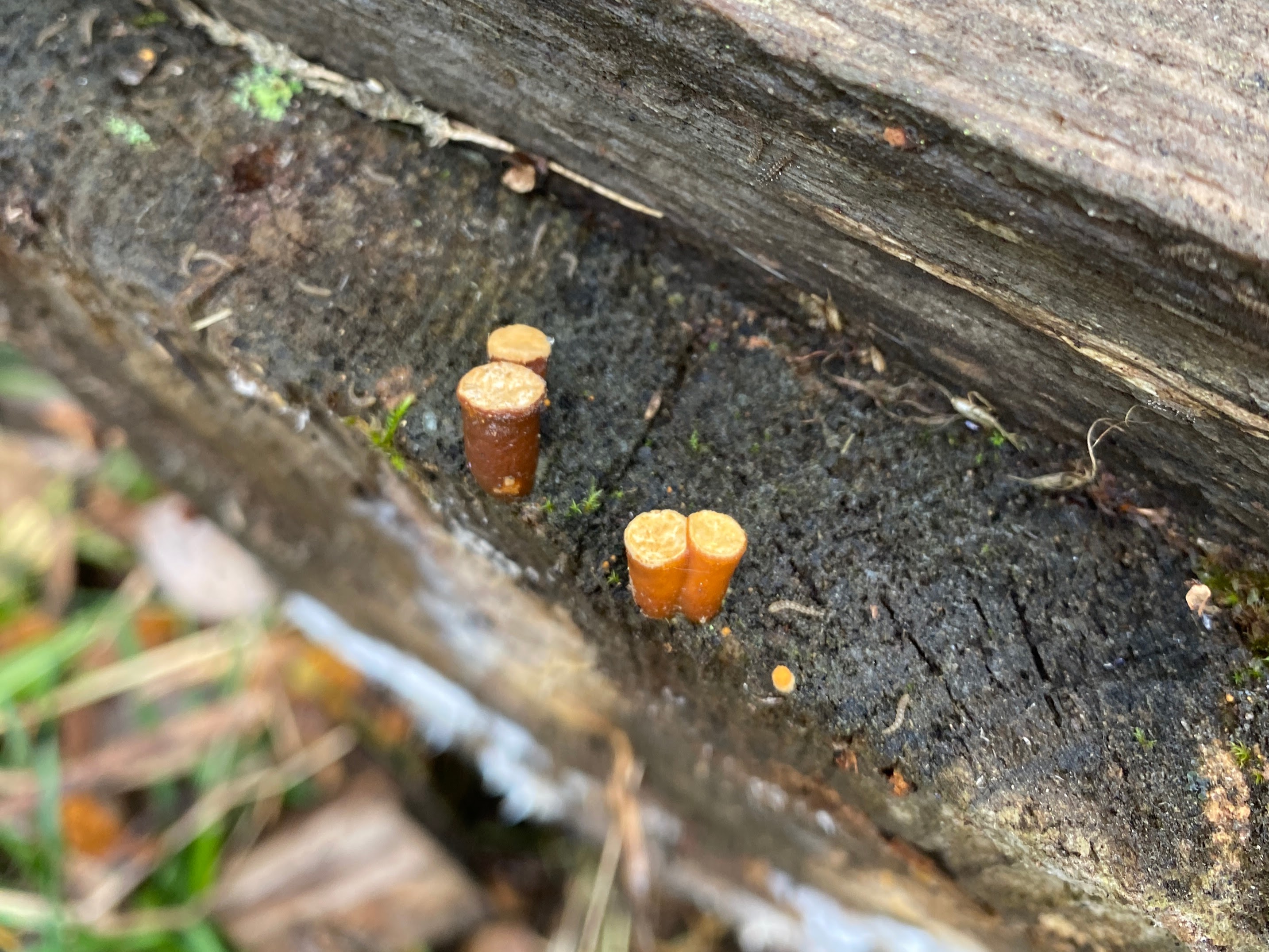
Spherical when young, then gradually acquiring a goblet-shaped or cup-shaped form, quite modest in size—no more than 1 cm in height and 0.8 cm in width; initially covered with a loose "plug," a reddish-brown membrane protecting the contents. The outer surface of the mushroom is dull yellowish, woolly-velvety. As it grows, the membrane thins and tears, disappearing almost without a trace, and whitish "eggs" measuring two to three millimeters are discovered in the "basket," representing sac-like structures in which spores mature. Each sac is attached to the base of the basket by means of a special thread, quite strong in early developmental stages. This thread ("funiculus" in mycological terms) does not simply fix the "eggs" in place—when raindrops knock them out of the basket, it stretches to its limit, bursts, and releases a sticky liquid by means of which the egg attaches to various kinds of forest debris—leaves, twigs, and the like—where it then releases its spores.
Common Bird's Nest (Crucibulum laeve)
Index Fungorum Crucibulum laeve (Huds.) Kambly
MycoBank Crucibulum laeve (Huds.) Kambly
Common Bird's Nest (Crucibulum laeve)
Russian mushroom names can be misleading again: "бокальчик гладкий" (smooth cup) and "бокальчик полосатый" (striped cup) are not just different species—they belong to different genera. The smooth cup belongs to the genus Crucibulum, while the striped cup belongs to the genus Cyathus. And temporarily, both these species reside in the family Agaricaceae (mushroom family).
The interesting shape of the mushroom is related to its reproductive features. The kinetic energy of raindrops falling from a height, when they hit the cup of the bird's nest, splashes the "eggs" (peridioles) out of the "nest" onto the grass. By the way, in English the mushroom is often called exactly that—bird's nest—and the angle of the cup walls is perfectly calibrated to ensure the maximum splash radius.
Laevis (= lēvis), e — smooth, even; shining, glossy.
Cyathus crucibulum Pers., Synopsis methodica fungorum: 238 (1801)
Cyathus crucibuliformis (Scop.) Hoffm., Vegetabilia Cryptogama 2: 29, t. 8:1 (1790)
Cyathus cylindricus Willd., Florae Berolinensis Prodromus: 399 (1787)
Peziza pyxis Batsch, Elenchus fungorum: 129 (1783)
Nidularia laevis Bull., Herbier de la France 11 (121-132): pl. 488 fig. 2 (1790)
Peziza laevis Huds., Flora anglica: 634 (1778)
Firm, woody.
Pleasant, mushroom-like.
Spore print white. Spores ellipsoid, smooth.
Xylotroph. Cosmopolitan. Grows in groups on small to medium-sized decaying wood fragments, dried plant stems, and dung. Does not occur on soil or large fallen logs. When coniferous debris is present, it shows a preference for it.
Not listed in the Red Data Book of the Russian Federation or regional Red Lists.
All representatives of the genus Crucibulum are very similar to each other.
The liquid mycelial culture of C. laeve produces bioactive substances called sulfredins. They are structurally related to benzofuran and chromene, molecules containing cycloamide or lactone five-membered ring structures. These substances are unique and characteristic only of the Common Bird's Nest (Crucibulum laeve). Sulfredin B11 is an aldose reductase inhibitor—an enzyme involved in cataract formation during the late stages of diabetes mellitus.
P.S. What evolutionary twists led agaricoid (i.e., mushroom-like) fungi to develop nests with eggs will apparently remain a mystery forever...
Add new comment