Deceiver (Laccaria laccata)
Index Fungorum Laccaria laccata (Scop.) Cooke
MycoBank Laccaria laccata (Scop.) Cooke
Pink Laccaria, Common Laccaria
laccatus, a, um — coated with shellac, lacquered. From lacca, ae f — shellac (the resin secreted by the lac insect)
Agaricus farinaceus Huds., Flora anglica: 616 (1778)
Clitocybe laccata (Scop.) P. Kumm., Der Führer in die Pilzkunde: 122 (1871)
Agaricus amethysteus Bull., Herbier de la France 5: tab. 198 (1785)
Russuliopsis laccata (Scop.) J. Schröt., Kryptogamen-Flora von Schlesien 3.1 (33-40): 622 (1889)
Agaricus janthinus Batsch, Elenchus fungorum: 79, t. 5:20 (1783)
Camarophyllus laccatus (Scop.) P. Karst., Bidrag till Kännedom av Finlands Natur och Folk 32: 231 (1879)
Omphalia laccata (Scop.) Quél., Enchiridion Fungorum in Europa media et praesertim in Gallia Vigentium: 26 (1886)
Collybia laccata (Scop.) Quél., Flore mycologique de la France et des pays limitrophes: 237 (1888)
Omphalia laccata var. laccata (Scop.) Quél.: 26 (1886)
Camarophyllus laccatus var. laccatus (Scop.) P. Karst.: 231 (1882)
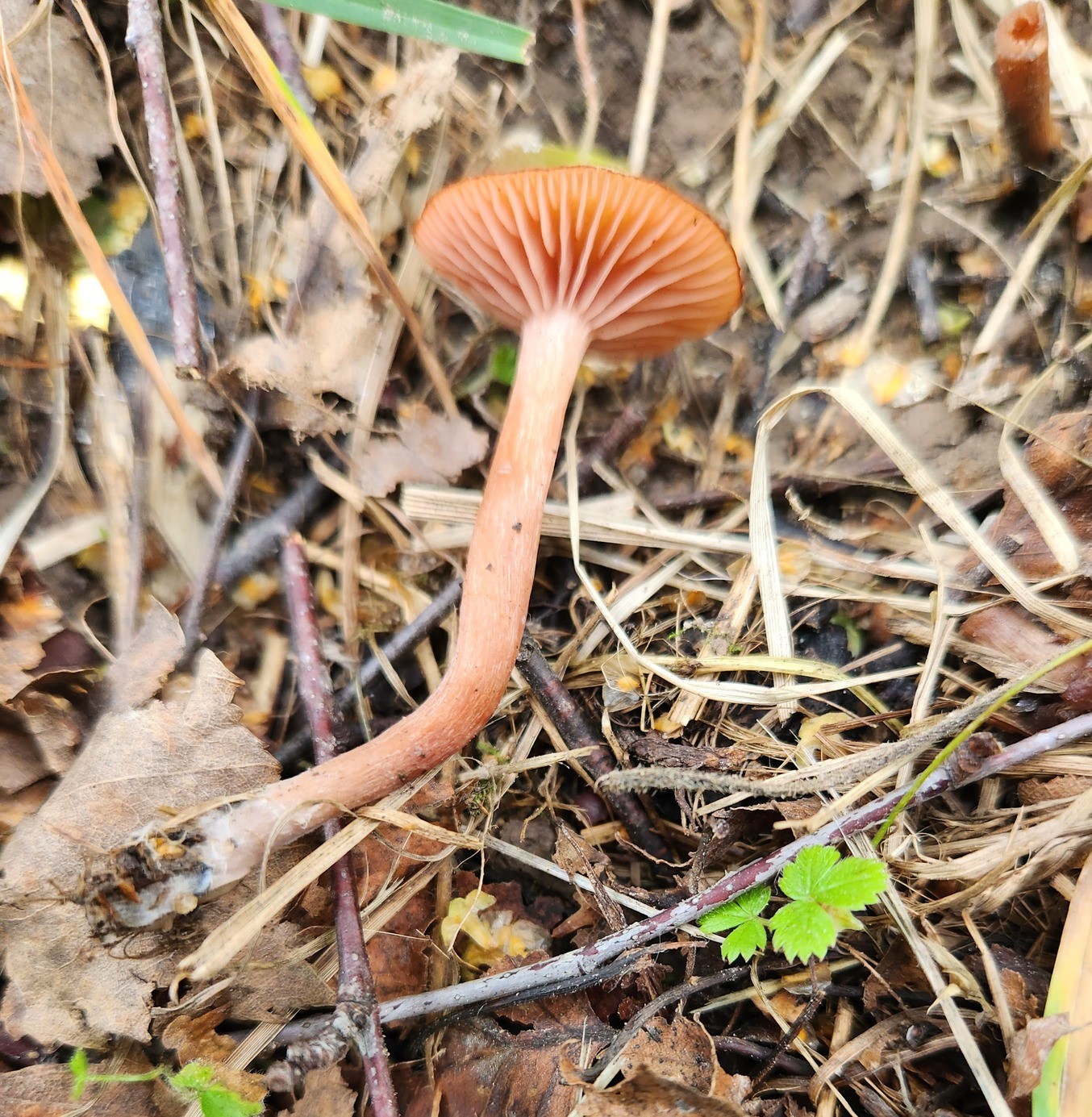
A typical representative of toadstools, common mushrooms, and other umbrella terms. In other words, a victim of LBM — "little brown mushroom." An inconspicuous, unremarkable fungus, like all mushrooms grouped under this term. Currently, significant taxonomic shifts are underway within the genus Laccaria! Taxa are being clarified, consolidated, or changing their rank.
In English-speaking contexts, this mushroom has earned the name "Deceiver" due to its variable appearance, high lability regarding substrate and mycorrhizal partners, and wide distribution. And recently, the fungus has confirmed its reputation. It turned out that what until recently was called Laccaria laccata in California is actually an Australian species — Laccaria amica. And most likely, this is not the last deception from this unassuming mushroom.
Cap up to 5 cm in diameter, convex, with a depression in the center, irregularly rounded, with a hygrophanous (as if water-soaked) margin, finely scaly or fibrous, pinkish-brown-ochre or yellowish-reddish, later fading to whitish. Gills adnate or slightly decurrent, thick, broad, waxy, concolorous with the cap, with a white powdery coating.
8–13 cm high and up to 0.5 cm wide, thin, even, concolorous with the cap.
Whitish, thin, brittle. Taste slightly sweet.
Weak, mushroom-like, pleasant.
Spore print white. Spores cylindrical.
Widespread in forests, forest edges, parks, and gardens, avoiding only excessively wet, dry, or shaded places. It is a facultative mycorrhiza-former with birch, beech, and pine. This species is capable of forming basidiomata without the involvement of a host plant.
Under normal conditions, Deceiver is difficult to confuse with anything else; however, when faded, the mushroom becomes similar to the equally faded Amethyst Deceiver (Laccaria amethystina), which differs only by a somewhat thinner stipe, and also to the Bicoloured Deceiver (Laccaria bicolor), which is distinguished by its lilac gills. In some cases, young specimens of Laccaria laccata resemble the Fairy Ring Champignon (Marasmius oreades), which is easily distinguished by its white gills. The Large Deceiver (Laccaria proxima) is indeed large, and has a characteristically superficially fibrous stipe and a truly scaly cap.
Some consider Deceiver to be a pioneer species.
Add new comment