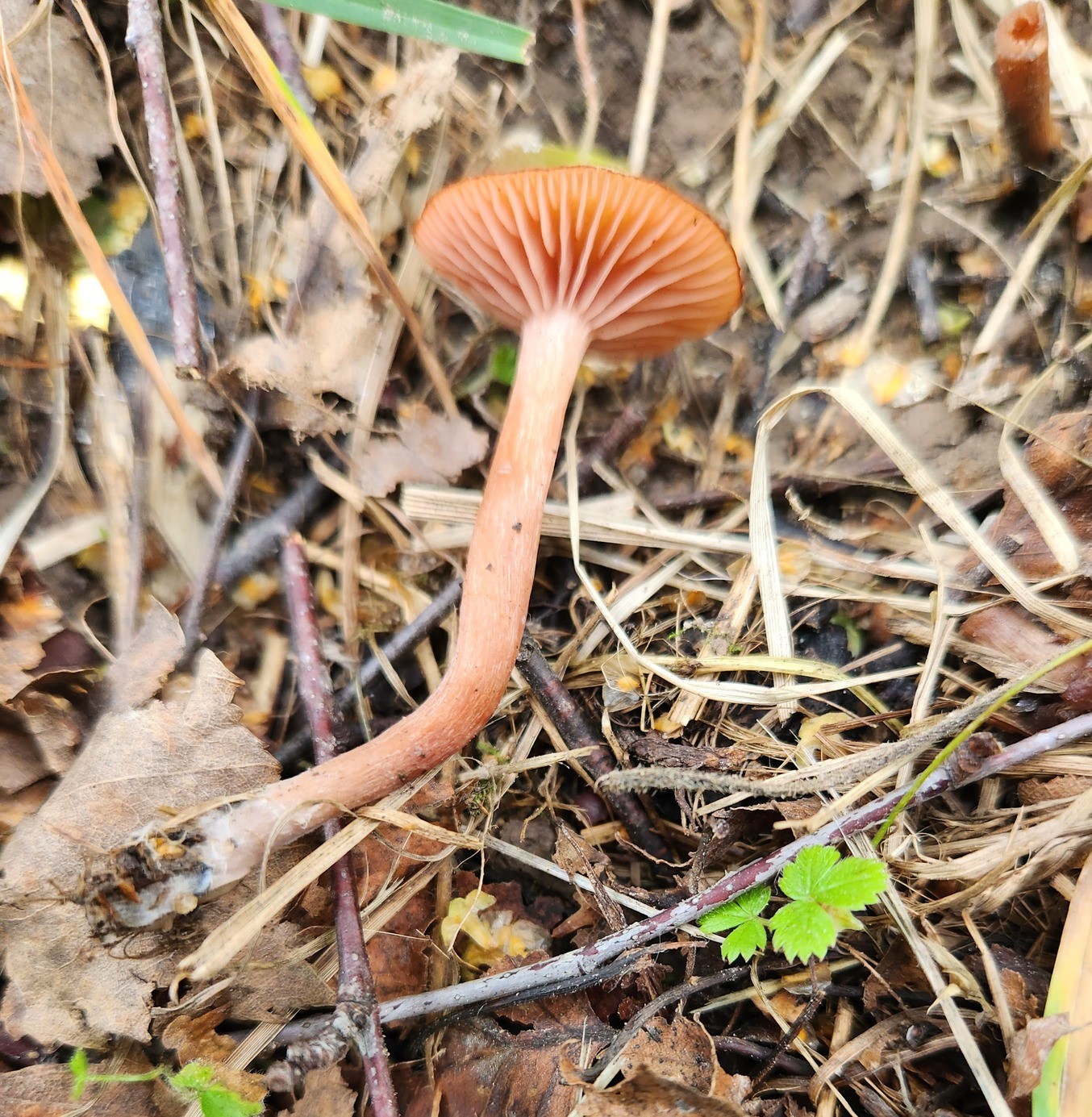
Family: Hydnangiaceae
Hydnangiaceae (Hydnangiaceae) — family of fungi within order Agaricales (Agaricales).
The family was separated in 1928 and initially included genera with gastroid fruit bodies of underground or aboveground location; after conducting phylogenetic research the family also enriched with widely known genus Laccaria (Laccaria), which originally belonged to Tricholomataceae and forming agaricoid fruit bodies. Hydnangiaceae – very small family, covering less than hundred species in four genera, the largest of which is recently transferred Laccaria.
Fruit bodies closed, truffle-shaped (in type genus Hydnangium), secotioid (in monotopic genus Podohydnangium) or agaricoid (in genus Laccaria), small sizes. Flesh of species with gastroid fruit bodies – not dense, with labyrinth-like cavities resembling those in truffles; shell thin, dense, location underground. Agaricoid fruit bodies – clearly differentiated into cap and stem, thin-fleshy, in some species brightly colored; hymenophore developed, lamellar. Veils absent. Caps 1-10 cm in diam., convex, then flat with downturned edge, often with small pit in center. Cuticle not developed. Edge often uneven, ribbed, thin. Gills adnate or decurrent, from almost white to dark-pink or purple. Stems long, 4-17 cm high and 2-10(15) mm thick, usually covered with scales or light fibers. Spores light-colored. Flesh thin-fleshy, dense, "collapsing" upon drying; taste and smell usually indistinct.
All Hydnangiaceae species considered mycorrhiza formers. Grow in forests, parks, gardens and other biotopes suggesting presence of trees; some species of Laccaria inhabit recovering and young forests. Widely distributed in regions with temperate, tropical and subtropical climate.
Representatives of this family have no economic significance in food, household or pharmaceutical aspects. Some species of Laccaria considered edible mushrooms of low quality. Toxic species, apparently, absent. In forestry have value as mycorrhiza formers, including accelerating recovery of damaged forest lands. Genome of Laccaria bicolor species fully sequenced.