Decorated tricholomopsis (Tricholomopsis decora)
Index Fungorum Tricholomopsis decora (Fr.) Singer
MycoBank Tricholomopsis decora (Fr.) Singer, Schweiz. Z. Pilzk
Decorated knight, Olive-yellow knight.
The Russian name "ryadovka" (knight) refers to one of the characteristic features of this genus: the mushrooms grow in rows, which in turn may form "fairy rings". However, this does not apply to the decorated knight, as it grows on fallen wood and stumps of coniferous trees.
From decor, ōris — beauty, ornament, propriety, charm, elegance.
Agaricus decorus Fr., Syst. mycol. (Lundae) 1: 108 (1821)
Clitocybe decora (Fr.) Gillet, Hyménomycètes (Alençon): 171 (1874)
Cortinellus decorus (Fr.) P. Karst., Bidr. Känn. Finl. Nat. Folk 32: 25 (1879)
Tricholoma decorum (Fr.) Quél., C. r. Assoc. Franç. Avancem. Sci. 11: 389 (1883)
Gyrophila decora (Fr.) Quél., Enchir. fung. (Paris): 10 (1886)
Pleurotus decorus (Fr.) Sacc., Syll. fung. (Abellini) 5: 342 (1887)
Dendrosarcus decorus (Fr.) Kuntze, Revis. gen. pl. (Leipzig) 3 (2): 463 (1898)
Tricholoma rutilans var. decorum (Fr.) Maire, Étude synth. genre Tricholoma: 107 (1916)
Agaricus decorus var. inundatus Fr., Syst. mycol. (Lundae) 1: 108 (1821)
Agaricus decorus Fr., Syst. mycol. (Lundae) 1: 108 (1821) var. decorus
Tricholomopsis decora f. longispora A.N. Petrov, Mikol. Fitopatol. 17 (1): 44 (1983)
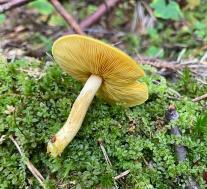
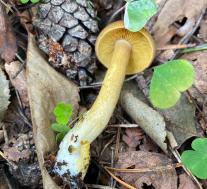
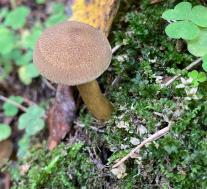
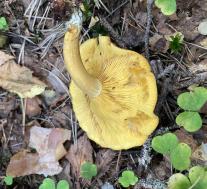
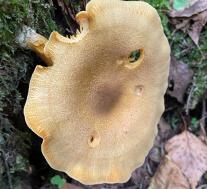
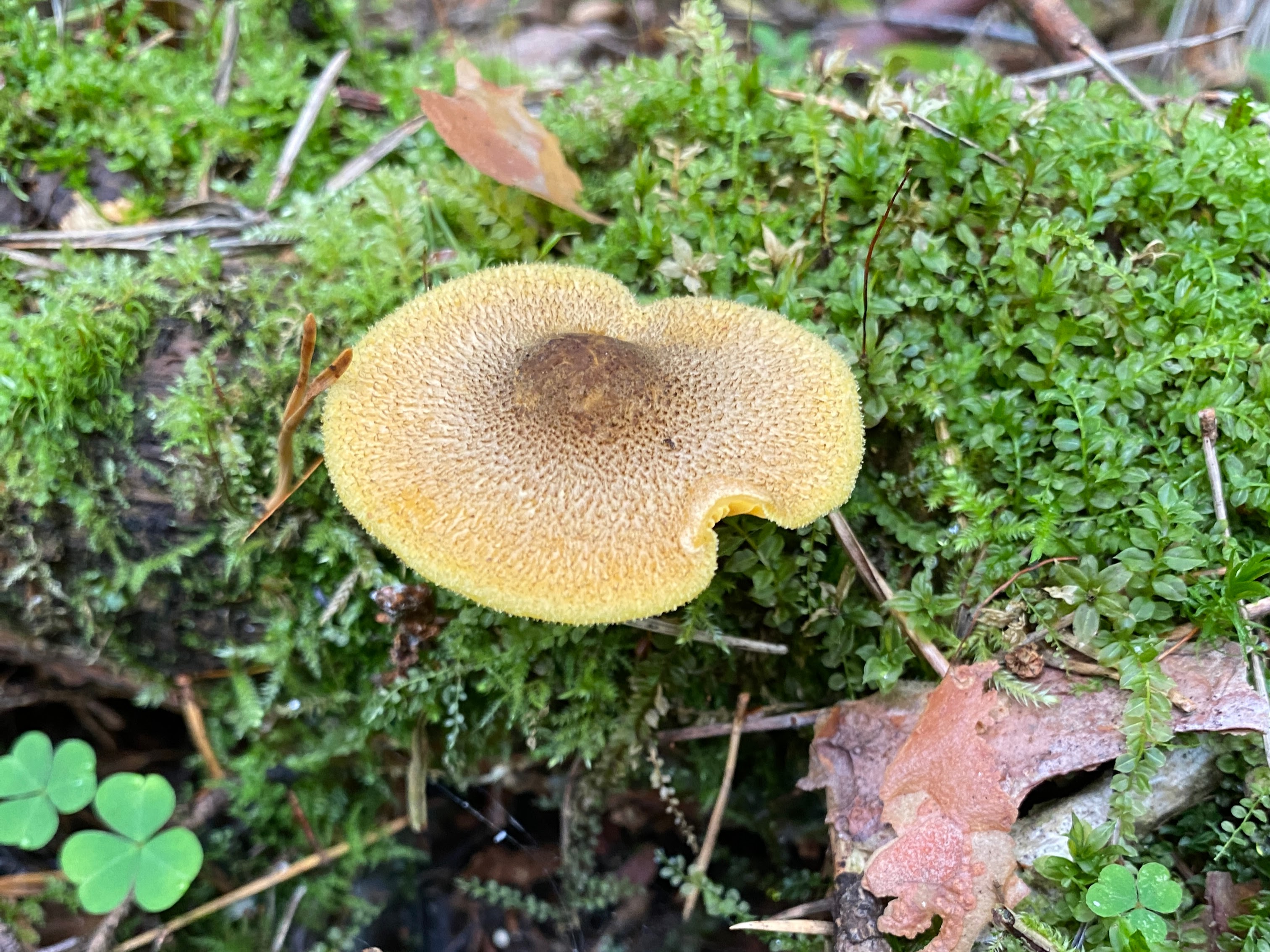
3–10 cm in diameter; initially convex with an inrolled margin, becoming plano-convex and slightly depressed in the center at maturity, sometimes with a small umbo. Surface dry, yellow, covered with soft, woolly, raised scales of yellowish-brown or olive color. Hymenophore lamellate. Gills broadly adnate or emarginate-adnate, bright yellow, with finely serrated, slightly darker margins.
3–8 cm high, 0.5–1.5 cm in diameter, cylindrical, often curved. Coloration same as the cap—yellow, with darker longitudinal fibers and scales.
Yellowish-brown, yellow. Taste bitter, unpleasant.
Weak, woody.
Spore print white. Spores broadly ellipsoid, thin-walled. Stipe cuticle a cutis 2.5–15 μm thick, composed of cylindrical, colorless hyphae, sometimes with finely incrusted walls. Clamp connections present in all tissues.
Xylotroph. Grows in moist, shady coniferous and mixed forests, singly or in small groups, on dead wood of conifers—mainly pine and spruce—especially on old stumps and decaying fallen logs, often moss-covered. Widespread in North America and Eurasia.
Plums and custard (Tricholomopsis rutilans) is perhaps the most striking representative of the genus Tricholomopsis. Yellow gills and purple-red scales on the cap and stipe allow reliable identification of this species in the field. Another closely related species, Tricholomopsis sulfureoides, differs by its pale yellow fruiting bodies and the absence of dark raised scales on the cap. Flammula-like tricholomopsis (Tricholomopsis flammula) is quite similar to the plums and custard, except for the stipe, which lacks red scales.
Species of *Tricholomopsis* distributed mainly in the Holarctic are distinguished from those occurring in the Southern Hemisphere.
Add new comment