Plums and custard (Tricholomopsis rutilans)
Index Fungorum Tricholomopsis rutilans (Schaeff.) Singer
MycoBank Tricholomopsis decora (Fr.) Singer
False knight yellow-red, Red sand mushroom, Reddening knight, Yellow-red honey mushroom.
Rutilāns — reddening, blushing. Present active participle of rutilo, āvī, ātum, āre — to be reddish, to become reddish in color, to blush.
Pleurotus decorus (Fr.) Sacc., Syll. Fung. 5: 342 (1887)
Tricholoma decorum (Fr.) Quél., Compt. Rend. Assoc. Franç. Avancem. Sci. 11: 389 (1883)
Clitocybe decora (Fr.) Gillet, Les Hyménomycètes ou Description de tous les Champignons (Fungi) qui Croissent en France avec l'indication de leurs propriétés utiles ou vénéneuses 1: 171 (1874)
Cortinellus decorus (Fr.) P. Karst., Bidrag Kännedom Finlands Natur Folk 32: 25 (1879)
Gyrophila decora (Fr.) Quél., Enchiridion Fungorum in Europa media et praesertim in Gallia Vigentium: 11 (1886)
Tricholoma rutilans var. decorum (Fr.) Maire, Étude synth. genre Tricholoma: 107 (1916)
Dendrosarcus decorus (Fr.) Kuntze: 463 (1898)
Agaricus rutilans subsp. decorus (Fr.) Romell, Sv. Fl. Skol., Krypt. ed. 2: 162 (1898)
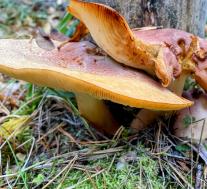
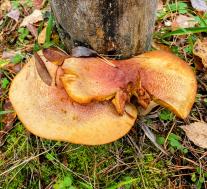
A large, brightly colored mushroom that appears abundantly in coniferous forests toward the end of summer, provoking mixed reactions among the public: some, due to its vivid, almost "chemical" coloration, unconditionally classify it as poisonous, while others attempt to taste it—and once again confirm that "all that glitters is not gold." Incidentally, this knight is sometimes crowned with the title of "ornamental mushroom"—an honor bestowed upon very few fungi to date.
3–26 cm in diameter; initially convex, expanding at maturity to plano-convex or flattened, usually with a broad central umbo. In young fruiting bodies, the margin is inrolled; with age, it straightens and becomes wavy. Surface dry, yellow-orange, entirely covered with numerous small, fibrous, purplish-red scales. In young specimens, the scales are densely packed, making the caps appear entirely purplish-red. As the mushroom grows, the spaces between scales widen, the cap overall lightens, becoming yellow-orange with a purplish-red center. Occasionally, the brightly colored scales fade in sunlight, giving the entire cap a uniform golden hue.
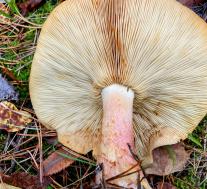
Gills numerous, adnate or emarginate-adnate, color varying from pale yellow to bright yellow, developing brown spots with age.
2.5–8.5 cm high, 10–25 mm in diameter, cylindrical or thickened toward the base, usually curved, solid; hollow in old fruiting bodies; color and texture similar to the cap—pale yellow to yellow with purplish-red fibrous scales. Like the cap, it lightens with age; the colored scales become sparser but do not disappear completely.
Yellowish in the cap and upper part of the stipe, golden-yellow at the base of the stipe. Taste mild, slightly bitter, astringent.
Weakly expressed, pleasant.
Spore print white. Spores broadly ellipsoid, rarely broadly ovate.
Terrestrial-litter saprotroph. Grows in coniferous and mixed forests, in clearings, gardens, and parks, on dead wood, stumps, and roots of conifers—especially near dry pines—in groups. Widespread on all continents (except Antarctica). In Russia, found throughout the forest zone.
The yellow-red knight is characterized by its large, fleshy fruiting bodies and bright red-purple coloration, which generally persists with age (at least in the center of the cap and, partially, on the stipe). The rarely encountered flammula-like false knight (T. flammula) is a small, thinly fleshy mushroom that grows on forest litter and near decaying wood, singly or in small clusters.
Decorated knight (T. decora) is more slender in build, resembling species of Pholiota rather than Tricholomopsis, and lacks red tones in its coloration.
Add new comment