Fairy inkcap (Coprinellus disseminatus)
Index Fungorum Coprinellus disseminatus (Pers.) J.E. Lange
MycoBank Coprinellus disseminatus (Pers.) J.E. Lange
Fairy inkcap, fairy bonnet or trooping crumble cap.
Disseminatus, Latin, scattered, spilled. From dissemino, avi, atum, are, to scatter, to spread.
Agaricus disseminatus Pers., Commentarius D. Iac. Christ. Schaefferi fungorum Bavariae indigenorum icones pictas: 87 - Basionym
Coprinus disseminatus (Pers.) Gray, A natural arrangement of British plants 1: 634 (1821)
Psathyrella disseminata (Pers.) Quél., Mém. Soc. Émul. Montbéliard Ser. 2, 5: 153 (1872)
Pseudocoprinus disseminatus (Pers.) Kühner, Botaniste 20: 156 (1928)
Coprinarius disseminatus (Pers.) P. Kumm., Der Führer in die Pilzkunde: 68 (1871)
Agaricus pallescens Schaeff., Fungorum qui in Bavaria et Palatinatu circa Ratisbonam nascuntur Icones 4: 48 (1774)
Amanita digitaliformis Lam., Encyclopédie Méthodique, Botanique 1-1: 110 (1783)
Agaricus striatellus Batsch, Elenchus fungorum: 69 (1783)
Pilosace pallescens (Schaeff.) Kuntze, Revisio generum plantarum 3 (3): 503 (1898)
Coprinellus disseminatus subsp. disseminatus (?)
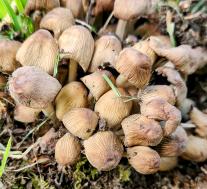
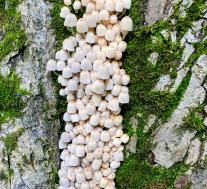
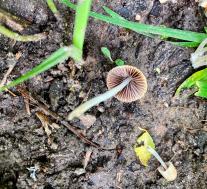
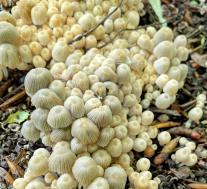
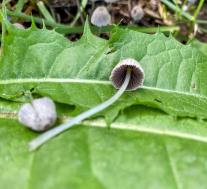
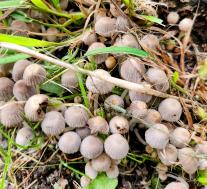
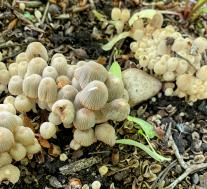
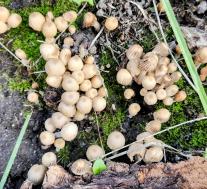
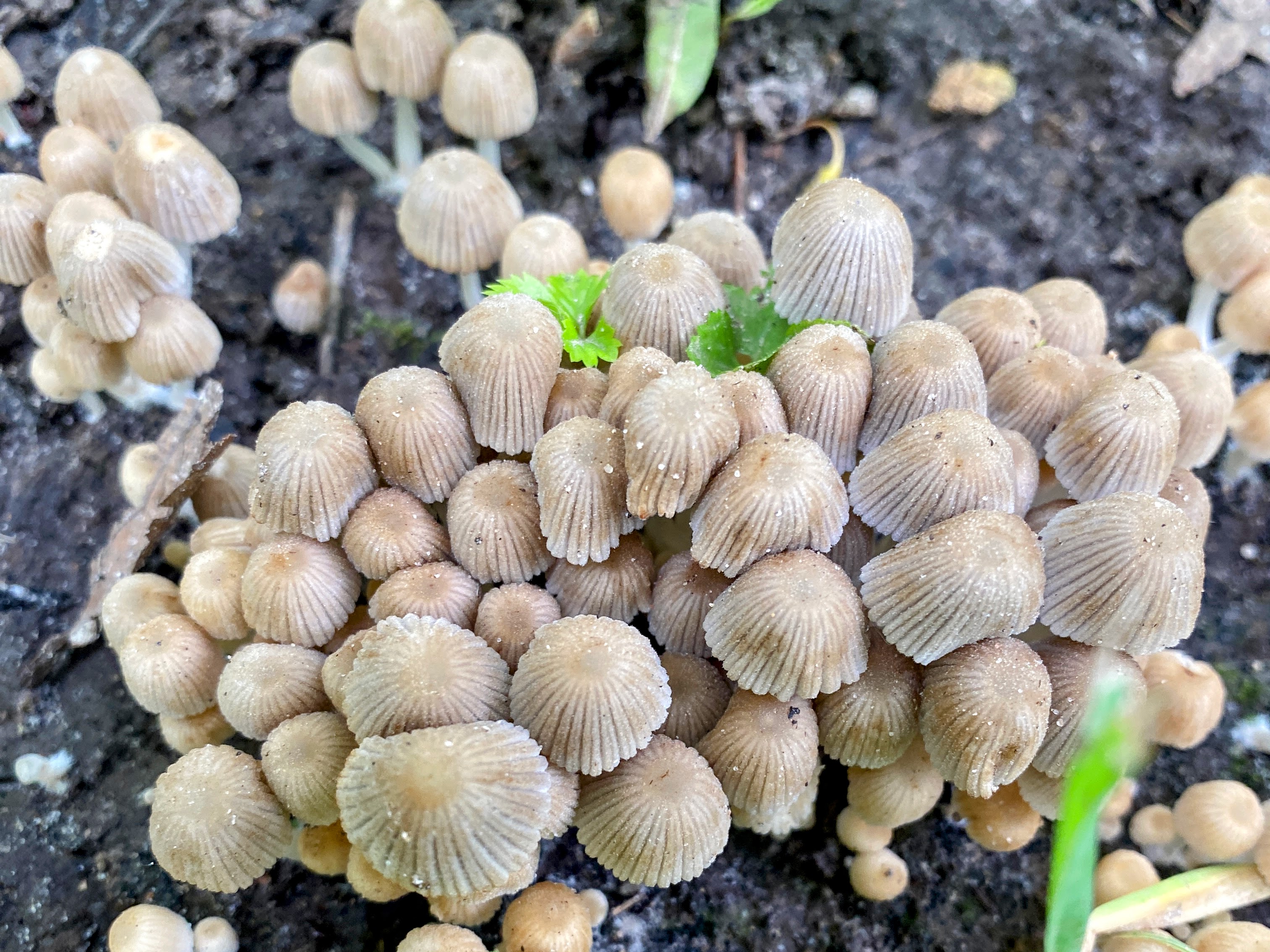
A small cap-and-stem mushroom with an extremely repulsive appearance, which is not interested in manure and grows in large colonies on fallen logs and old rotten stumps. It can be found both in forests and in urban centers, and is primarily known for its abundant fruiting.
The shape of the cap is egg-shaped, then bell-shaped, and in full maturity, it is almost flat to распростертой.
The color of the cap is yellowish or brownish in young, unopened mushrooms, and ash-gray with a cream or reddish tint, fawn, or dirty white in opened caps, with a dark gray or ochre center, and the cap is covered with radiant, darker-colored radial stripes (translucent gills).
Cap surface: dry, matte, radially ribbed. When magnified, you can see the hairs and fine shiny plaque.
Cap edge: almost smooth or slightly jagged, thin, straightened, sometimes radially cracked.
There is no private veil. The overall impression is very thin, quickly disappearing, and remains on the cap in the form of a fine granular coating.
The plates are narrowly grown, almost free, initially white, creamy, darkening to almost black when ripe.
The stem is 20-60 mm long, 1-1.5 mm in diameter, central, cylindrical, hollow, fragile, white, grayish, with a white flaky pubescence. Hollow.
Very thin, whitish, in maturity blackening in the cap and spreading into slime or drying out, in the stem - very fragile, brittle, watery. In the process of autolysis, black slime is formed.
Weak, mushroom-like.
The spore powder is black. The spores are 6.5 – 9.5 × 4.0 – 6.0 μm, Q = 1.45 – 1.90, ellipsoid, almond-shaped, with a large germ pore of 1.3 – 1.5 μm. The basidia are 16 – 40 × 5 – 8 μm, club-shaped, and 4-spored.
Saprotroph on decaying wood of various deciduous species (apparently, it prefers aspen and linden especially). It grows in large groups-colonies, extremely rarely - solitary "in the neighborhood" of the already disappeared or barely started to grow colony. It is found frequently. Distribution: throughout the territory of Russia. It is probably found throughout the northern temperate zone, where there is a suitable substrate (that is, except for the deserted areas).
Psathyrella pygmaea is characterized by warmer brown tones in the color of the cap and non—blackening plates.
Coprinellus disseminatus can promote seed germination and the development of Cremastra appendiculata orchids
Add new comment