Fairy Ring Mushroom (Marasmius oreades)
Index Fungorum Marasmius oreades (Bolton) Fr.
MycoBank Marasmius oreades (Bolton) Fr.
Meadow Mushroom, Clove-scented Mushroom, Meadow Marasmius.
Orēadēs, um, noun — Oreads, mountain nymphs. Nominative plural of Orēas, -adis, f. — an Oread, a mountain nymph.
Scorteus oreades (Bolton) Earle, Bulletin of the New York Botanical Garden 5: 415 (1906)
Collybia oreades (Bolton) P. Kumm., Der Führer in die Pilzkunde: 116 (1871)
Scorteus oreades (Bolton) Earle ex Redhead, Index Fungorum 276: 1 (2015)
The genus name Marasmius (Негниючник in Russian, literally "non-rotting") most likely refers to the mushroom's remarkable ability to withstand severe desiccation and resume metabolic activity after receiving sufficient moisture. This is not merely a matter of rehydration: cellular respiration and sporulation processes are restored. The mechanism is thought to involve high concentrations of trehalose—a sugar that acts as a xeroprotectant, preventing cellular damage during drying. Upon rehydration, trehalose is broken down, allowing normal cellular function to resume. This same trehalose is responsible for the pleasant, slightly sweet taste of the mushroom.
The species epithet oreades can be loosely translated as "of the mountain nymphs" or "magical," referring to the mushroom's frequent formation of "fairy rings" or "witches' circles." According to folklore, these rings marked the spots where nymphs, fairies, and leprechauns danced under the moonlight.
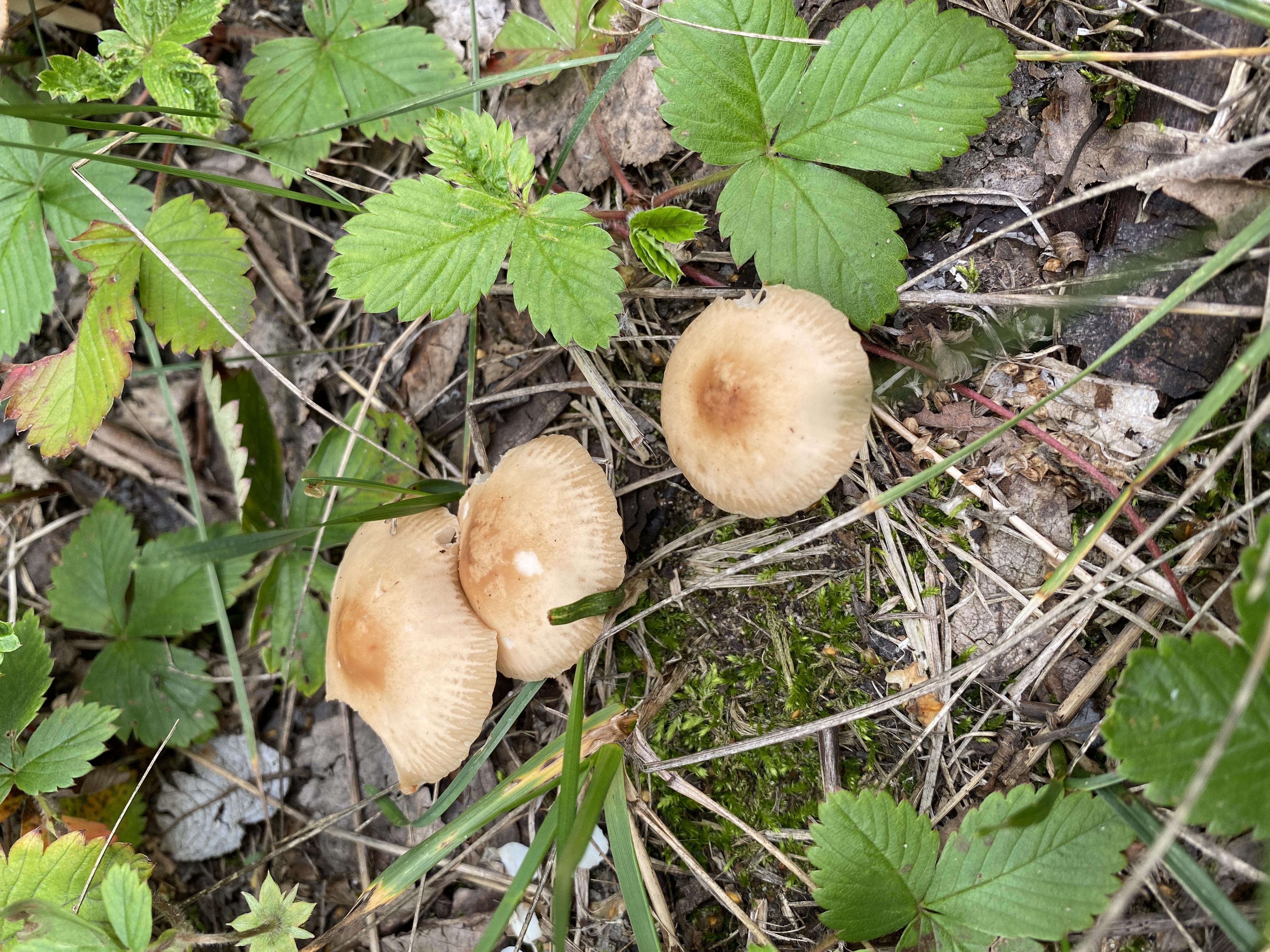
Cap 3–7 cm in diameter, leather-yellow, with a translucently striate, often ribbed margin; bell-shaped in young specimens, becoming expanded with a broad central umbo in mature ones. In wet weather, the cap is sticky, yellowish-brown or reddish-ochre, sometimes with faint zoning; in dry weather, it becomes lighter, pale cream. The center of the cap is always darker than the margins.
Gills broad, distant, light cream to creamy-yellowish.
Stem up to 10 cm high, up to 0.8 cm in diameter; relatively tall, even, cartilaginous, elastic, light leather-colored, with a whitish bloom.
Flesh thin, pale yellowish, with a very pleasant taste.
Odor pleasant, faintly reminiscent of cloves or bitter almonds.
Spore print white. Spores ellipsoid, slightly almond-shaped.
Litter saprotroph. Distributed in Eurasia, including Iceland and Japan, North Africa, North America, Argentina, Australia, and the Canary Islands. In the Russian Federation, it is widespread and common in the European part of Russia, the North Caucasus, and the Altai and Primorsky Krai. It grows on soils with rich herbaceous litter, in meadows and pastures, forest edges, along field and forest roads, in clearings, often on village streets, in large groups and rows. Frequently forms "fairy rings."
The Fairy Ring Mushroom can be confused with the edible Oak-loving Collybia (Collybia dryophila), which occurs from May to December in deciduous and coniferous forests and differs by its more crowded whitish or ochre-cream gills, a hollow-tubular stem, and a less pleasant odor.
It can also be mistaken for the poisonous Ivory Funnel (Clitocybe dealbata), which likewise prefers open habitats and forms "fairy rings," but differs by its whitish cap lacking a central umbo, crowded decurrent gills, and a mealy odor of the flesh.
In Chinese medicine, these mushrooms are used as an anticonvulsant, as well as for relaxing muscles, treating tendons and veins, lumbago, and leg pain. The mushroom contains the antibiotic scorodonin, which was previously isolated from submerged cultures of the fungus Marasmius scorodonius. This antibiotic inhibits the growth of bacteria, yeasts, and filamentous fungi. In cells of the ascites form of Ehrlich carcinoma, scorodonin effectively suppresses the incorporation of thymidine and uridine into DNA and RNA, while the incorporation of leucine into protein remains unaffected.
Add new comment