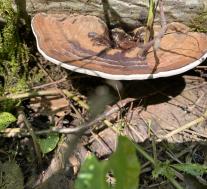
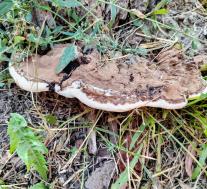
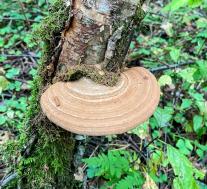
Perennial. Sessile, bracket-shaped.
Resupinate to more or less flat, sometimes tongue-shaped and elongated when young, rarely hoof-shaped; highly variable in size depending on habitat, 5–40 (70) cm in diameter, 1.5–12 cm thick at the base. Arranged on the substrate singly or in small groups at different levels; may fuse together and envelop branches, twigs, or plant stems encountered during growth.
Surface uneven, wavy, often concentrically tuberculate, covered with a thin crust that thickens and hardens over time, shiny in section; initially beige or gray, darkening with maturity to gray-brown or brown, becoming red-brown by the end of the growing season due to covering spores. Margin thin or rounded into a ridge, uneven, white or beige, sterile.
Hymenophore tubular; tubes vertically layered, often with visible thin interlayers of sterile tissue between layers, concolorous with the context, becoming filled with white mycelium with age. Layering forms during the growth of the fruiting body, which occurs in stages: under favorable conditions, during active growth, a new layer of tubes forms and develops on the hymenophore surface. Hymenophore surface white, then yellowish, darkening to brown when touched or damaged. Pores with even margins, round or ovoid, small: 4–6 per 1 mm.
Flat Ganoderma (Ganoderma applanatum)
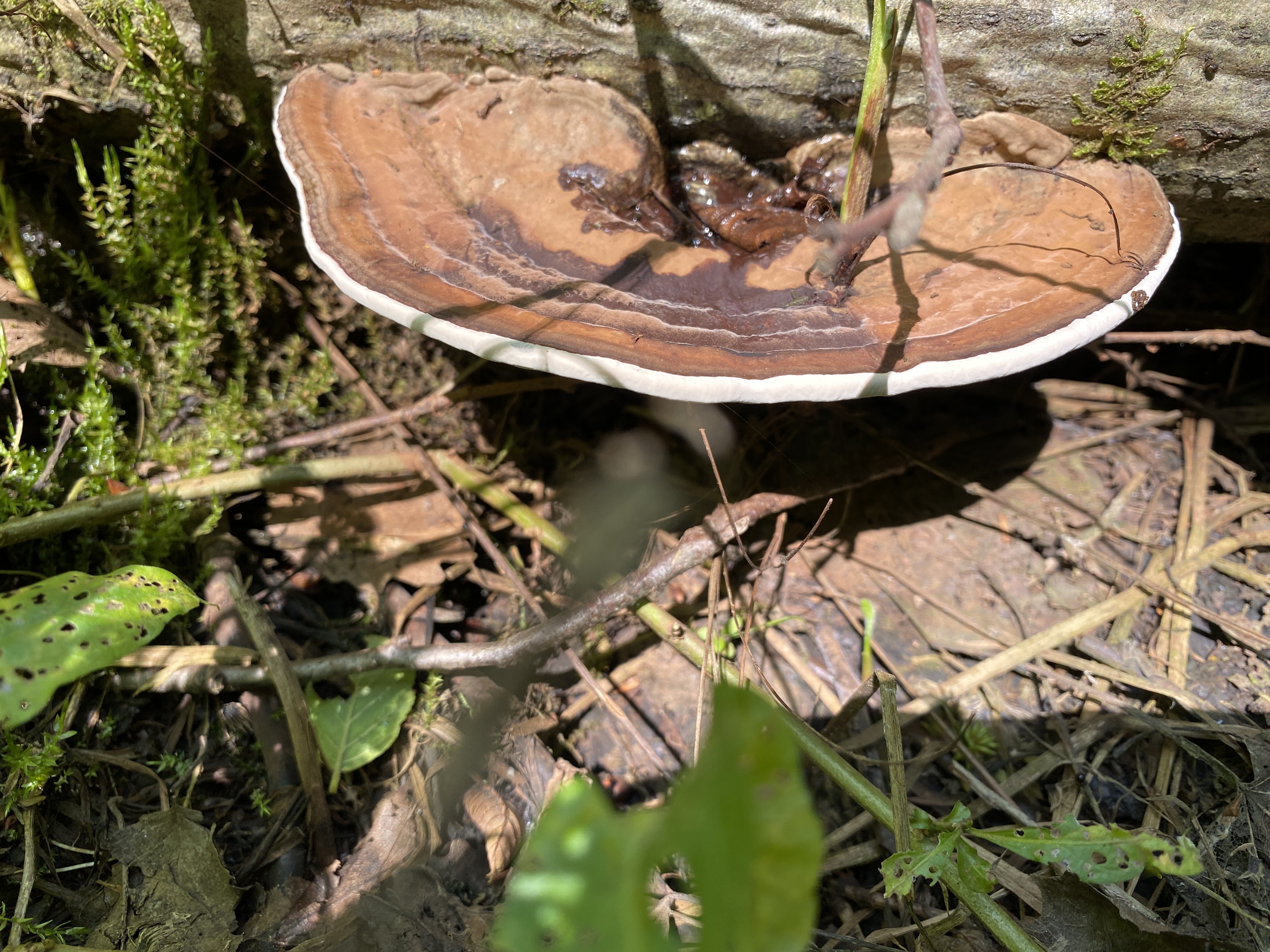
Index Fungorum Ganoderma applanatum (Pers.) Pat.
MycoBank Ganoderma applanatum (Pers.) Pat.
Flat Ganoderma, artist's conk.
Applanatus, a, um мик. flattened, compressed. From ap-, ad- (proximity, nearness) + planus, a, um (flat, level) + -ātus, a, um (suffix denoting quality).
Fomes applanatus (Pers.) Gillet, Les Hyménomycètes ou Description de tous les Champignons (Fungi) qui Croissent en France avec l'indication de leurs propriétés utiles ou vénéneuses 1: 686 (1878)
Elfvingia applanata (Pers.) P. Karst., Bidrag Kännedom Finlands Natur Folk 48: 334 (1889)
Placodes applanatus (Pers.) Quél., Enchiridion Fungorum in Europa media et praesertim in Gallia Vigentium: 171 (1886)
Polyporus applanatus (Pers.) Wallr., Flora Cryptogamica Germaniae 2: 591 (1833)
Phaeoporus applanatus (Pers.) J. Schröt., Kryptogamen-Flora von Schlesien 3.1 (4): 490 (1888)
Friesia applanata (Pers.) Lázaro Ibiza, Revta R. Acad. Cienc. exact. fis. nat. Madr.: 587 (1916) rius var. applanatus (Pers.) Pers., Synopsis methodica fungorum: 536 (1801)
Boletus fomentarius var. applanatus (Pers.) Pers., Synopsis methodica fungorum: 536 (1801)
Flat Ganoderma is known in Japan as kofuki-saru-no-koshikake (literally "powder-covered monkey's bench"), and in China as shu-she-ling-zhi (树舌灵芝), where it has long been used in traditional medicine. Research has shown that Flat Ganoderma contains compounds with potent anti-tumor, antibacterial, and anti-fibrotic properties. Flat Ganoderma belongs to the same genus as the famous lacquered polypore, or "reishi", also known as the mushroom of immortality.
Hard, cork-like, felt-fibrous when torn, red-brown with white veins.
Strong, mushroom-like.
Spore print rusty-brown. Spores broadly ellipsoid, truncate at the apex, with a double wall: the inner layer transparent and smooth, the outer layer reddish-brown and warty.
Grows widely in deciduous, coniferous, and mixed forests, as well as in gardens and parks, on dying trees, stumps, fallen wood, and processed timber. Occasionally found on living trees. Prefers deciduous species (Betula, Fagus, Fraxinus, Juglans, Malus, Populus, Quercus, Salix). Infection of trees occurs through wounds at the roots or base of the trunk; from there, the mycelium penetrates into the central part of the trunk and ascends. The fungus causes white or yellowish corrosive rot of roots and trunk bases.
Commonly encountered throughout the year. Widespread, predominantly in the temperate zone of the Northern Hemisphere.
G. applanatum is a complex of very similar species, which can be distinguished only through genetic research or crossing experiments.
Flat Ganoderma can reach impressive sizes while maintaining a smooth, flat hymenophore surface. The hymenophore is very light—white or beige—and even light pressure on damaged areas causes it to turn brown. Due to this feature, which allows drawings to be made on its surface, the mushroom is known in English as "Artist's Conk" or "Artist's Fungus."
Add new comment