Fragrant Funnel (Clitocybe fragrans)
Говорушка благоухающая
Current name

Index Fungorum    Clitocybe fragrans (With.) P. Kumm.

MycoBank    Clitocybe fragrans (With.) P. Kumm.

Other names

Clitocybe fragrans. It bears the evocative English name "Fragrant Funnel," which can be translated literally as "aromatic funnel."

Systematic position
Specific epithet etymology

Fragrāns, antis — fragrant, sweet-smelling, aromatic. Present active participle of fragro, -, - āre — to be fragrant, to emit a sweet scent.

Synonyms

Agaricus fragrans With., A botanical arrangement of British plants. Ed. 2 3 (2): 307 (1792)- Basionym

Lepista fragrans (With.) Harmaja, Karstenia 15: 14 (1976) 

Omphalia fragrans (With.) Gray, A natural arrangement of British plants 1: 613 (1821) 

Pseudolyophyllum fragrans (With.) Raithelh., Metrodiana: 73 (1978)
General description

A pronounced scent of anise seed is the key identifying feature of this mushroom.

Habit
Fruiting body
Agaricoid (cap and stipe)
Hymenophore
Lamellate (gills present, including folded or rudimentary)
Fruiting period (list)
JulJuly (21st–31st)AugAugust (1st–10th)August (11th–20th)August (21st–31st)SepSeptember (1st–10th)September (11th–20th)September (21st–30th)OctOctober (1st–10th)November (11th–20th)
Mushroom cap

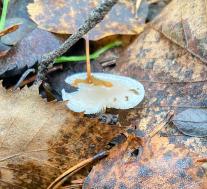
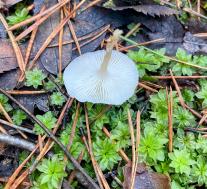
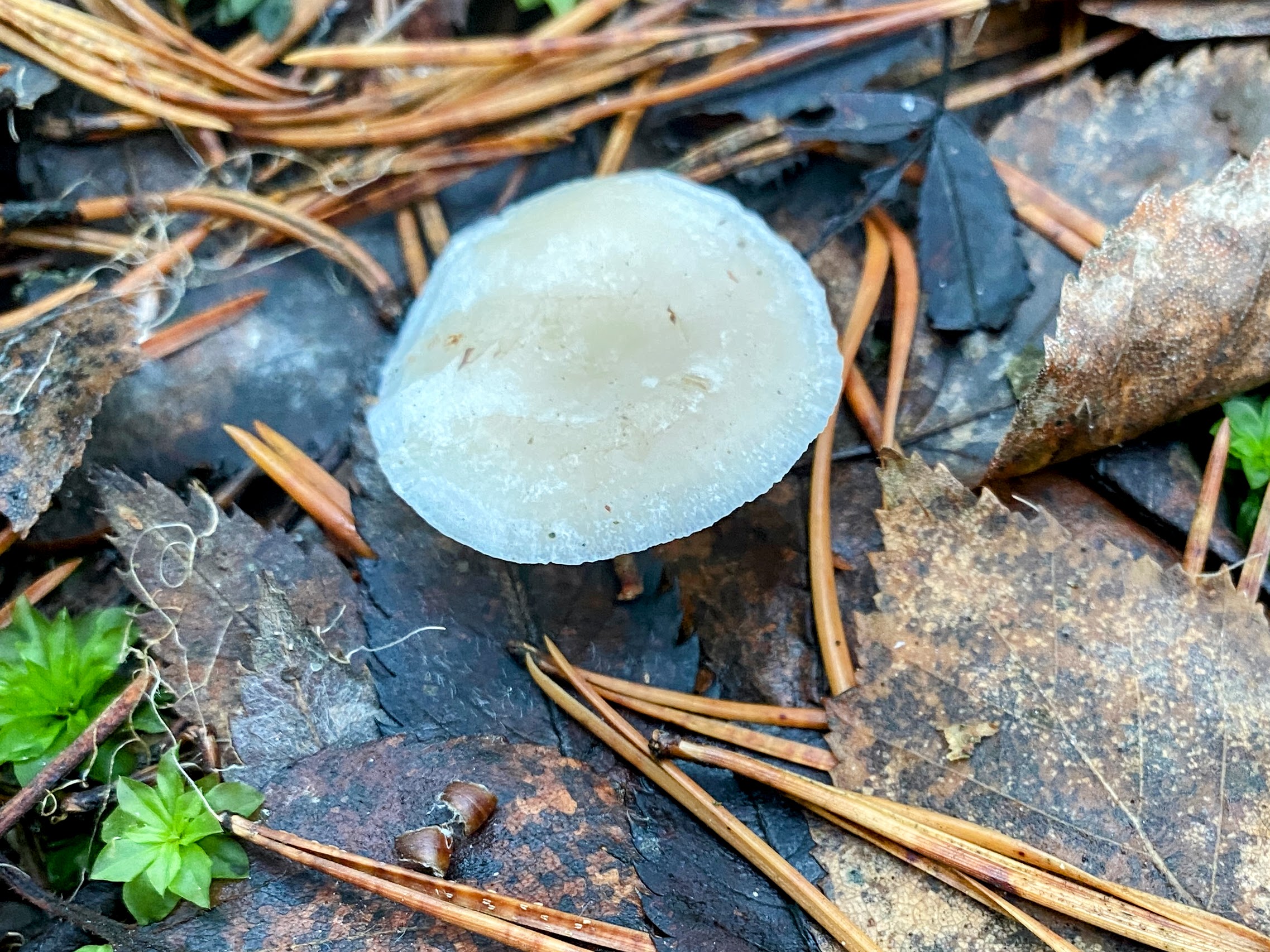
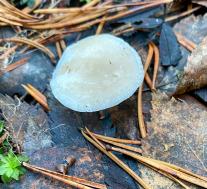
3–5 cm in diameter, convex when young, then expanding to become convex-depressed and eventually funnel-shaped. The cap coloration is vaguely pale, ranging from whitish to yellowish-gray or ochre; the surface is hygrophanous, and in wet weather, watery concentric zones may appear on the cap, especially noticeable toward the margin. The edge is striate (with the gills visible through the ribs).

The gills are narrow, adnate or slightly decurrent onto the stipe, white in young specimens, and gradually darkening with age to ochre-gray.

Stem

Relatively long and slender — 3–6 cm tall and 0.1–0.3 cm thick, cylindrical, even, solid when young and becoming hollow with maturity. The stipe is colored like the cap or slightly paler (if the cap is relatively dark). At the base of the stipe, a white mycelial down is clearly visible — another important diagnostic feature.

Flesh

Thin, brittle, whitish, watery. Taste is characteristic — anise-like.

Microscopy

Spore print: white. Spores measuring 6.5–8 × 3.5–4 µm, elliptical in shape, smooth, and non-amyloid.

Ecology and distribution

The Fragrant Funnel (Clitocybe fragrans) is not very common and is found in coniferous and mixed forests, on forest litter—especially spruce needles—forming numerous colonies in favorable years.

Fruiting

July–October.

Nutritional properties
Conditionally edible

It is edible after preliminary boiling. However, collection by inexperienced foragers is not recommended due to its similarity to poisonous Clitocybe species. Rather, this mushroom serves as a seasoning — it's hard to imagine a full mushroom dish made from Fragrant Funnel, as the anise scent persists even during cooking.

Similar species

The intense anise scent, very similar to that of the larger and differently colored Scented Collybia (Collybia odora), allows for fairly reliable distinction of the Fragrant Funnel from its numerous relatives.

Link to this page for printed editions
Shipovalov A.G. Fragrant Funnel (Clitocybe fragrans) - Mushrooms of Vologda Region [Electronic resource] URL: https://xn----7sbancweblffgklubds60aja.xn--p1ai/en/fragrant-funnel-clitocybe-fragrans (accessed: 13.04.2026).
Share link

Add new comment

One file only.
2 MB limit.
Allowed types: png jpeg jpg jpe gif webp svg.
Allowed types: png gif jpg jpeg webp svg.

Plain text

  • No HTML tags allowed.
  • Lines and paragraphs break automatically.
  • Web page addresses and email addresses turn into links automatically.
Add image
Maximum 8 files.
2 MB limit.
Allowed types: png jpeg jpg jpe gif webp svg.
Allowed types: png gif jpg jpeg webp.
January (1st–10th)
January (1st–10th)
January (11th–20th)
January (11th–20th)
January (21st–31st)
January (21st–31st)
February (1st–10th)
February (1st–10th)
February (11th–20th)
February (21st–28th/29th)
March (1st–10th)
March (1st–10th)
March (11th–20th)
March (11th–20th)
March (21st–31st)
March (21st–31st)
April (1st–10th)
April (1st–10th)
April (11th–20th)
April (11th–20th)
April (21st–30th)
April (21st–30th)
May (1st–10th)
May (1st–10th)
May (11th–20th)
May (11th–20th)
May (21st–31st)
May (21st–31st)
June (1st–10th)
June (1st–10th)
June (11th–20th)
June (11th–20th)
June (21st–30th)
June (21st–30th)
July (1st–10th)
July (1st–10th)
July (11th–20th)
July (11th–20th)
July (21st–31st)
July (21st–31st)
August (1st–10th)
August (1st–10th)
August (11th–20th)
August (11th–20th)
August (21st–31st)
August (21st–31st)
September (1st–10th)
September (11th–20th)
September (21st–30th)
October (1st–10th)
October (1st–10th)
October (11th–20th)
October (11th–20th)
October (21st–31st)
October (21st–31st)
November (1st–10th)
November (1st–10th)
November (11th–20th)
November (21st–30th)
December (1st–10th)
December (1st–10th)
December (11th–20th)
December (21st–31st)