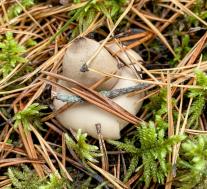
Fringed Earthstar (Geastrum fimbriatum)

Звездовик бахромчатый
Current name

Index Fungorum  Geastrum fimbriatum Fr.

MycoBank  Geastrum fimbriatum Fr.

Other names

Fringed Earthstar, Sessile Earthstar.

Systematic position
Specific epithet etymology

Fimbriatus, a, um — fringed. From *fimbria, ae* f., fringed edge + *-atus, a, um*, denoting a quality.

Synonyms

Geastrum fimbriatum f. pallidum A.H. Sm., Puffballs and their Allies in Michigan: 94 (1951)

Geastrum fimbriatum var. melanocyclum Dörfelt, Kiet & A. Berg bis, Feddes Repert. Spec. Nov. Regni veg. 115(1-2): 172 (2004)

Geastrum fimbriatum var. pseudohieronimii Calonge & M. Mata, in Calonge, Mata & Carranza, An. Jard. bot. Madr. 62(1): 34 (2005)

Geastrum rufescens var. minor Pers., Syn. meth. fung. (Göttingen) 1: 134 (1801)

Geastrum sessile Pouzar, Folia geobot. phytotax. 6: 95 (1971)

Geastrum tunicatum Vittad. [as 'Geaster tunicatus'], Monogr. Lycoperd. (Torino): 162 (18 of prepr.) (1842)

Lycoperdon sessile Sowerby, Col. fig. Engl. Fung. Mushr., Suppl. (London)(no. 28 [no. 1 of suppl.]): [87] (1809)

Habit
Fruiting body
Rounded, star-shaped, phalloid, nidularioid (gasteroid)
Hymenophore
Absent or difficult to classify
Fruiting period (list)
JulJuly (1st–10th)July (11th–20th)July (21st–31st)AugAugust (1st–10th)August (11th–20th)August (21st–31st)SepSeptember (1st–10th)September (11th–20th)September (21st–30th)OctOctober (1st–10th)October (11th–20th)
Fruit body

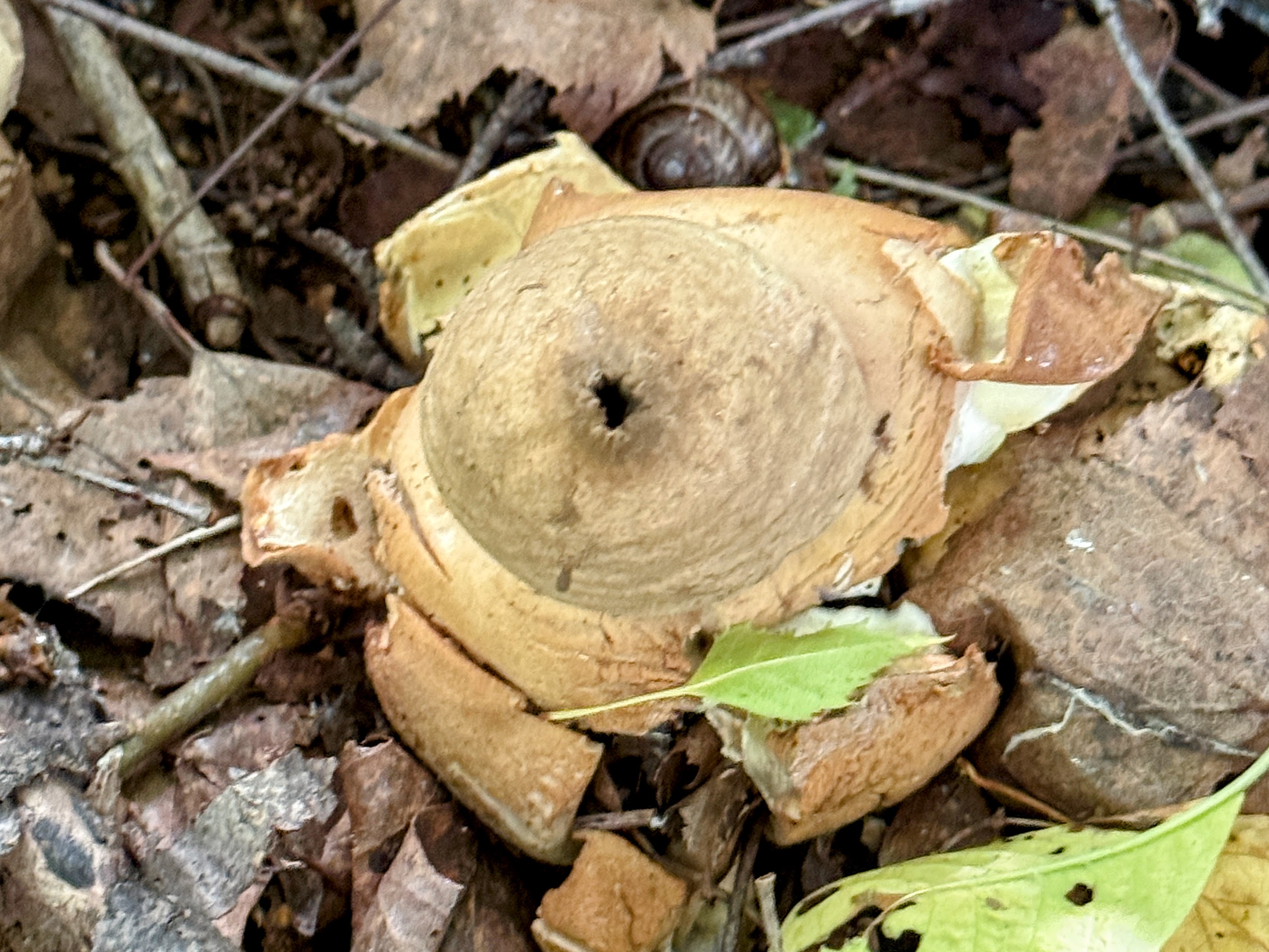
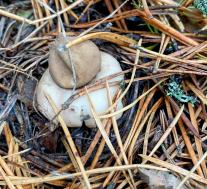
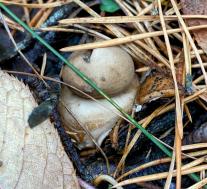
Fruiting bodies initially closed, spherical, flattened at the base, bluntly pointed at the apex, about 2.5 cm wide, covered by a peridium bearing yellowish mycelial cords over its entire surface; mature fruiting bodies opened, 3.5–8 cm wide.

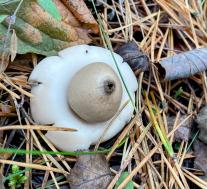
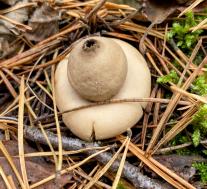
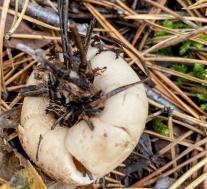
Peridium four-layered, consisting of exoperidium and endoperidium. Exoperidium three-layered, firm, splitting from the top downward to the middle or ⅔ of its length into 6–8 (sometimes 15) unequal, acute lobes that bend downward and form a "cup" enclosing the endoperidium. The outer mycelial layer is comparatively soft, thin, paper-like, light ochre, sometimes with a faint pearly sheen, soon deciduous. The middle fibrous layer is creamy or light ochre, smooth. The inner fleshy layer is initially whitish-ochre, then brownish, 0.5 mm thick, smooth or cracked and partially deciduous.

Base slightly concave.

Spherical gleba enclosed by the endoperidium, 1.4–2.5 cm wide. Endoperidium single-layered, thin, soft, initially whitish-ochre, then brownish, smooth, sessile, without an apophysis at the base; at the apex it opens by a pore furnished with a low conical, fibrous-fringed peristome, without a ring, sometimes lighter in color and with a shallow depression around it.

Gleba becoming powdery at maturity, light ochre or brown. Columella dense, thin, fusiform, 0.5 cm long, sometimes so soft as to be virtually absent.

Flesh

In the exoperidium: white, brittle. Taste weak, mushroom-like.

Odor

Weak, mushroom-like.

Microscopy

Spore print brown. Spores spherical, 3.0–3.7 µm in diameter, finely warted.

Ecology and distribution

On soil, predominantly in coniferous forests, less frequently in deciduous forests; occurs rarely. Prefers sandy soils.

Fruiting

July–October.

Nutritional properties
Edible

Technically an edible mushroom. However, it has no culinary value.

Conservation status
Red Data Book of Saint Petersburg (2018).

Status 3. Rare species.

Red Data Book of Tver Oblast.

Status 3. Rare species.

Similar species

Among other common representatives of its genus, Geastrum fimbriatum is distinguished by its unevenly splitting exoperidium (not resembling a neat little star in the moss as closely), by the fact that the lightly colored exoperidium grows through fragments of forest litter, and also by the noticeable "fringed rim" around the spore-release opening in mature specimens. There are many similar species (to name a few: Geastrum triplex — with a three-layered exoperidium, G. rufescens — reddish in color, G. pectinatum — this one has its spore sac on a stalk, and so on), but for the most part they can be confidently distinguished from the Fringed Earthstar by external characteristics.

Link to this page for printed editions
Shipovalov A.G. Fringed Earthstar (Geastrum fimbriatum) - Mushrooms of Vologda Region [Electronic resource] URL: https://xn----7sbancweblffgklubds60aja.xn--p1ai/en/fringed-earthstar-geastrum-fimbriatum (accessed: 13.04.2026).
Share link

Add new comment

One file only.
2 MB limit.
Allowed types: png jpeg jpg jpe gif webp svg.
Allowed types: png gif jpg jpeg webp svg.

Plain text

  • No HTML tags allowed.
  • Lines and paragraphs break automatically.
  • Web page addresses and email addresses turn into links automatically.
Add image
Maximum 8 files.
2 MB limit.
Allowed types: png jpeg jpg jpe gif webp svg.
Allowed types: png gif jpg jpeg webp.
January (1st–10th)
January (1st–10th)
January (11th–20th)
January (11th–20th)
January (21st–31st)
January (21st–31st)
February (1st–10th)
February (1st–10th)
February (11th–20th)
February (21st–28th/29th)
March (1st–10th)
March (1st–10th)
March (11th–20th)
March (11th–20th)
March (21st–31st)
March (21st–31st)
April (1st–10th)
April (1st–10th)
April (11th–20th)
April (11th–20th)
April (21st–30th)
April (21st–30th)
May (1st–10th)
May (1st–10th)
May (11th–20th)
May (11th–20th)
May (21st–31st)
May (21st–31st)
June (1st–10th)
June (1st–10th)
June (11th–20th)
June (11th–20th)
June (21st–30th)
June (21st–30th)
July (1st–10th)
July (1st–10th)
July (11th–20th)
July (11th–20th)
July (21st–31st)
July (21st–31st)
August (1st–10th)
August (1st–10th)
August (11th–20th)
August (11th–20th)
August (21st–31st)
August (21st–31st)
September (1st–10th)
September (11th–20th)
September (21st–30th)
October (1st–10th)
October (1st–10th)
October (11th–20th)
October (11th–20th)
October (21st–31st)
October (21st–31st)
November (1st–10th)
November (1st–10th)
November (11th–20th)
November (21st–30th)
December (1st–10th)
December (1st–10th)
December (11th–20th)
December (21st–31st)