Humpback Chanterelle (Cantharellula umbonata)
Index Fungorum Cantharellula umbonata (J.F. Gmel.) Singer
MycoBank Cantharellula umbonata (J.F. Gmel.) Singer
Tuberculate Cantharellula (or Bumpy Cantharellula).
Umbonatus, Lat., having a boss, humpbacked. From umbo, onis m boss, protrusion in the center of a shield + -atus, a, um quality.
Agaricus molliculus Britzelm., Ber. naturhist. Augsburg 28: 144 (1885)
Cantharellus dichotomus var. brevior Sacc., Syll. fung. (Abellini) 5: 487 (1887)
Cantharellus umbonatus (J.F. Gmel.) Pers., Neues Mag. Bot. 1: 106 (1794)
Cantharellus umbonatus var. brevior Peck, Bull. N.Y. St. Mus. nat. Hist. 1(no. 2): 36 (1887)
Cantharellus umbonatus var. dichotomus Peck, Bull. N.Y. St. Mus. nat. Hist. 1(no. 2): 36 (1887)
Cantharellus umbonatus var. subcaeruleus Peck, Bull. N.Y. St. Mus. nat. Hist. 1(no. 2): 36 (1887)
Clitocybe mollicula (Britzelm.) Sacc., Syll. fung. (Abellini) 5: 147 (1887)
Clitocybe umbonata (J.F. Gmel.) Konrad, Bull. trimest. Soc. mycol. Fr. 47(1): 146 (1931)
Leotia lubrica var. umbonata (J.F. Gmel.) Wallr., Fl. crypt. Germ. (Norimbergae) 2: 551 (1833)
Merulius umbonatus J.F. Gmel., Syst. Nat., Edn 13 2(2): 1430 (1792)
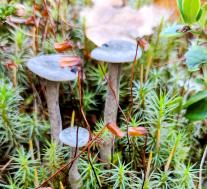
This mushroom doesn't stand out for anything special except for its limited study. At the same time, it is included in the IUCN Red List as a species of Least Concern.
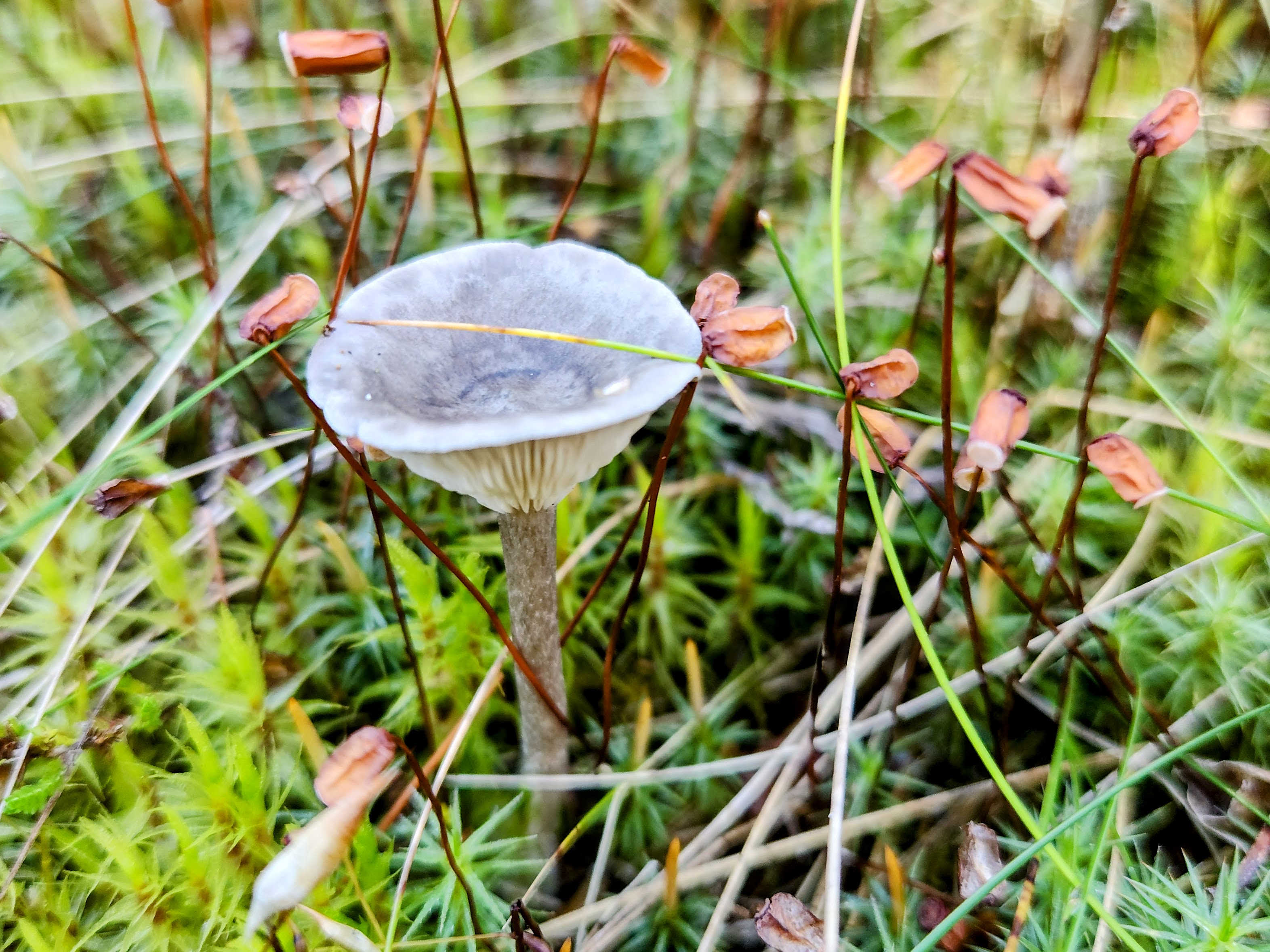
1.7–5.5 cm in diameter, initially convex, then funnel-shaped with a small, often sharp umbo in the center. Margin inrolled in young fruiting bodies, becoming slightly wavy with age. Surface smooth, finely velvety, smoky-gray to mouse-gray with a steel-blue tint, paler toward the margin.
Gills decurrent on the stipe, forked-branched, creamy-white, becoming grayish or acquiring a reddish tint with age, reddening on damaged areas.
3.5–10 cm long, 0.2–0.8 cm in diameter, cylindrical, light gray, with longitudinally arranged white fibers, and white tomentose pubescence at the base.
Whitish, light, weakly pinkening when cut.
Weak, pleasant, mushroom-like.
Spore print white. Spores cylindrical.
Grows either in symbiosis or as a parasite on mosses (Polytrichum, Dicranum, Pleurozium) in coniferous forests, on sandy soils. Widely distributed in northeastern North America and Europe.
The Humpback Chanterelle has no poisonous or inedible look-alikes among mushrooms growing in Russia.
Add new comment