Late Oyster Mushroom, Velvet Oyster (Sarcomyxa serotina)
Index Fungorum Sarcomyxa serotina (Pers.) V. Papp
MycoBank Sarcomyxa serotina (Pers.) P. Karst
Green oyster mushroom, Alder oyster mushroom, Willow vinukha, Late Panellus.
Sērotinus, a, um — late, belated; ripening late. From sērus, a, um: late; belated; later, mature, not young; occurring late; ripening late; 2) twilight, early evening; 3) old, perennial.
Panellus serotinus (Pers.) Kühner, Compte rendu hebdomadaire des Sciences de l'Academie des sciences, Paris: 1889 (1950)
Pleurotus serotinus (Pers.) P. Kumm., Der Führer in die Pilzkunde: 104 (1871)
Hohenbuehelia serotina (Pers.) Singer, Lilloa 22: 254 (1951)
Panus serotinus (Pers.) Kühner, Bull. Mens. Soc. Linn. Lyon 49: 895 (1980)
Acanthocystis serotinus (Pers.) Maire, Publ. Junta Ci. Nat. Barcelona Sèr. Botànica. 15 (2): 63 (1934)
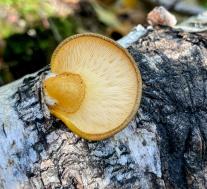
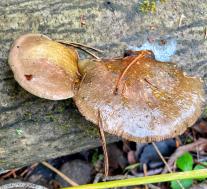
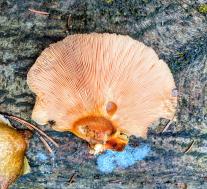
In Japan, this mushroom is called Mukitake (ムキタケ) and is considered one of the most delicious and beneficial mushrooms. It is used for soups and baked dishes. It is cultivated on an industrial scale in Japan and several European countries.
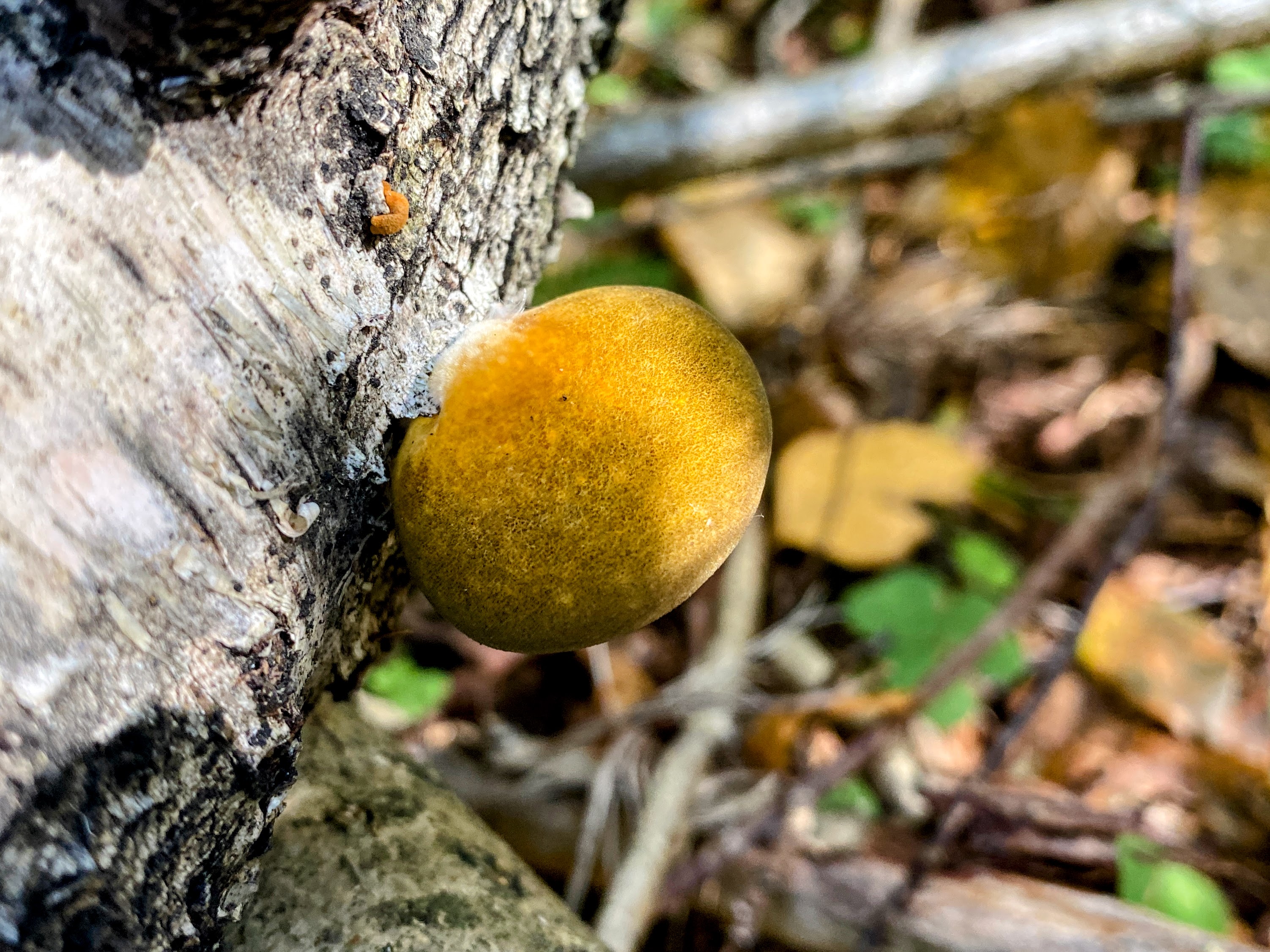
3–15 cm in diameter. In young specimens ear-shaped or shell-shaped. Later becoming flat to expanded. In young fruiting bodies the margin is rolled inward in a ridge, then unfolds. The cap is not differentiated from the stipe at the base. Coloration olive-green, intense, with lemon or brownish tones. After frosts, color tones may shift to reddish or purple. Surface smooth, glossy or matte; may be slightly velvety at the base.
Gills adnate, not crowded, forked-branched. Waxy in consistency, ranging from creamy to intensely orange.
Short, lateral. Often rudimentary. Differentiated only at the base. Cartilaginous in consistency. Rounded. Olive-orange. With punctate scaliness. Without ring or volva.
Flesh white, two-layered: upper layer gelatinous-cartilaginous, becoming brittle when dry; lower layer fleshy-fibrous (in the stipe almost cartilaginous in consistency). Taste depends on the substrate of growth, ranging from bitter-astringent to mushroom-like.
Pleasant, mushroom-like. Intensifies with age.
Spore print pale yellow. Spores cylindrical, thin-walled.
On drying and dead trees. Causes white rot. On stumps and fallen wood. Causes white rot. Grows in clusters. Associated with broadleaf trees. Widespread everywhere except the Far East, where it is replaced by the species Sarcomyxa edulis.
There are no similar species in terms of morphology, fruiting body formation periods, or ecological characteristics.
Research has shown that there are two separate species: *Sarcomyxa serotina* and *S. edulis* (the latter does not occur in Europe). The latter is cultivated for food purposes in China and Japan.
Add new comment