Miller (Clitopilus prunulus)
Index Fungorum Clitopilus prunulus (Scop.) P. Kumm.
MycoBank Clitopilus prunulus (Scop.) P. Kumm.
Sweetbread mushroom. In Germany it is called Mehlpilz
Prūnulus, i n. m small plum. From prūnum, ī n, plum (fruit) + -ulus, a, um diminutive.
Agaricus prunulus Scop., Flora carniolica. Ed. 2 2: 437, no 1508 (1772) - basionym
Omphalia prunula (Scop.) Zaw., Enum. plant. Galic. Bucow. (Breslau): 167, no. 2657 (1835)
Paxillus prunulus (Scop.) Quél., Enchiridion Fungorum in Europa media et praesertim in Gallia Vigentium: 92 (1886)
Rhodosporus prunulus (Scop.) J. Schröt., in Cohn, Krypt.-Fl. Schlesien (Breslau) 3.1(33–40): 618 (1889)
Hexajuga prunula (Scop.) Fayod, Annls Sci. Nat., Bot., sér. 7 9: 389 (1889)
Orcella prunulus (Scop.) Kuntze, Revis. gen. pl. (Leipzig) 2: 863 (1891)
Hyporrhodius prunulus (Scop.) Henn., in Engler & Prantl, Nat. Pflanzenfam. (Leipzig) 1(1**): 257 (1898)
Pleuropus prunulus (Scop.) Murrill, N. Amer. Fl. (New York) 10(2): 104 (1917)
Paxillopsis prunulus (Scop.) J.E. Lange, Fl. Agaric. Danic. 5(Taxon. Consp.): Vl (1940)
Agaricus orcellus Bull., Hist. Champ. Fr. (Paris) 2(1): 519, pl. 591 (1792)
Agaricus prunulus subsp. orcellus (Bull.) Stev. [as 'orcella'], British Fungi (Hymenomycetes) 1: 203 (1886)
Agaricus orcella Bull., Herb. Fr. (Paris) 13: pl. 591 (1793)
Pleuropus orcellus (Bull.) Gray, Nat. Arr. Brit. Pl. (London) 1: 615 (1821)
Clitopilus orcella (Bull.) P. Kumm., Führ. Pilzk. (Zerbst): 97 (1871)
Paxillus prunulus var. orcella (Bull.) Quél., Enchiridion Fungorum in Europa media et praesertim in Gallia Vigentium: 92 (1886)
Hexajuga orcella (Bull.) Fayod, Annls Sci. Nat., Bot., sér. 7 9: 409 (1889)
Hyporrhodius orcella (Bull.) Henn., in Engler & Prantl, Nat. Pflanzenfam. (Leipzig) 1(1**): 257 (1898)
Clitopilus prunulus var. pinetorum Sacc., Fl. ital. crypt. (Florence) 1(14): 545 (1915)
Clitopilus prunulus var. amarus Joss., Bull. mens. Soc. linn. Soc. Bot. Lyon 10: 93 (1941)
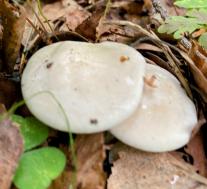
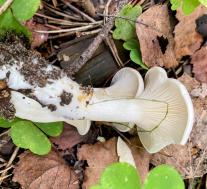
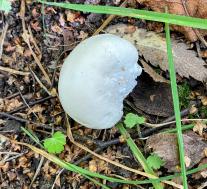
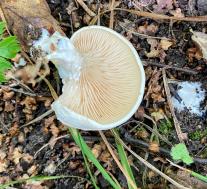
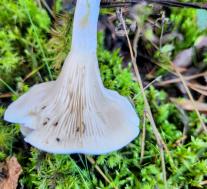
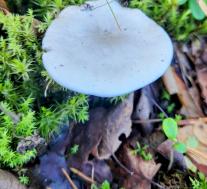
25–80 mm in diameter, hemispherical and convex when young, opening to a spreading shape when ripe, sometimes with a wide tubercle in the center or, conversely, depressed. The edge is smooth, becoming strongly wavy with age. The surface is smooth, matte, slightly velvety; slightly sticky in damp weather; white, beige, gray, sometimes with yellow or pink tones.
The gills are decurrent, white, beige, with a pink tint, turning light pink when ripe.
25–40 mm long, 5–10 (15) mm in diameter, cylindrical, sometimes swollen towards the base, longitudinally fibrous, finely pubescent, the same color as the cap.
Thick, white, and dense, the mushrooms become flabby in older ones. The taste is sweet and starchy; the floury aroma diminishes significantly during cooking.
Sweet, fruity and mushroomy, with a distinct floury note.
Spore powder is pink. Spores (9.0) 10.5 – 12.5 (14.0) × (4.5) 5.5 – 6.5 (8.0) µm, Q = 1.3 – 2, ellipsoid, almond-shaped, with 6 – 8 longitudinal ribs.
It grows solitary and in groups in deciduous and mixed forests, parks, and avenues, on rich soils. It was long considered a mycorrhizal fungus with rose-colored and (rarely) coniferous trees (spruce, bishop's pine); later, evidence emerged that the sagebrush is likely a symbiont or parasite of the olive-brown oak tree (Suillellus luridus), which, in turn, forms mycorrhiza with birch and, probably, linden. It can be assumed that several feeding patterns are present in nature for this species.
Clitopilus cystidiatus is distinguished by the sterile margin of its gills, which are covered with abundant, narrow cheilocystidia, sometimes slightly thickened at the ends. According to our observations, this mushroom is somewhat larger than the willow cherry and has a less pleasant, more mycologically classic "mealy" odor of the flesh. It is found in areas where another large bolete mushroom, the netted porcini (Boletus reticulatus), grows.
Clitocybe rivulosa and other large white talkers (many of which are poisonous) are similar in habit and whitish coloration; they have a subjectively less pleasant, sharply mealy odor; its gills lack a pink tint.
Pleuromutilin, a secondary metabolite and natural antibiotic with a relatively broad spectrum of activity, has been isolated from fungi of the genus Clitopilus. It is active against gram-positive and gram-negative bacteria, mycoplasmas, and intracellular pathogens (e.g., chlamydia and Legionella pneumophila).
Add new comment