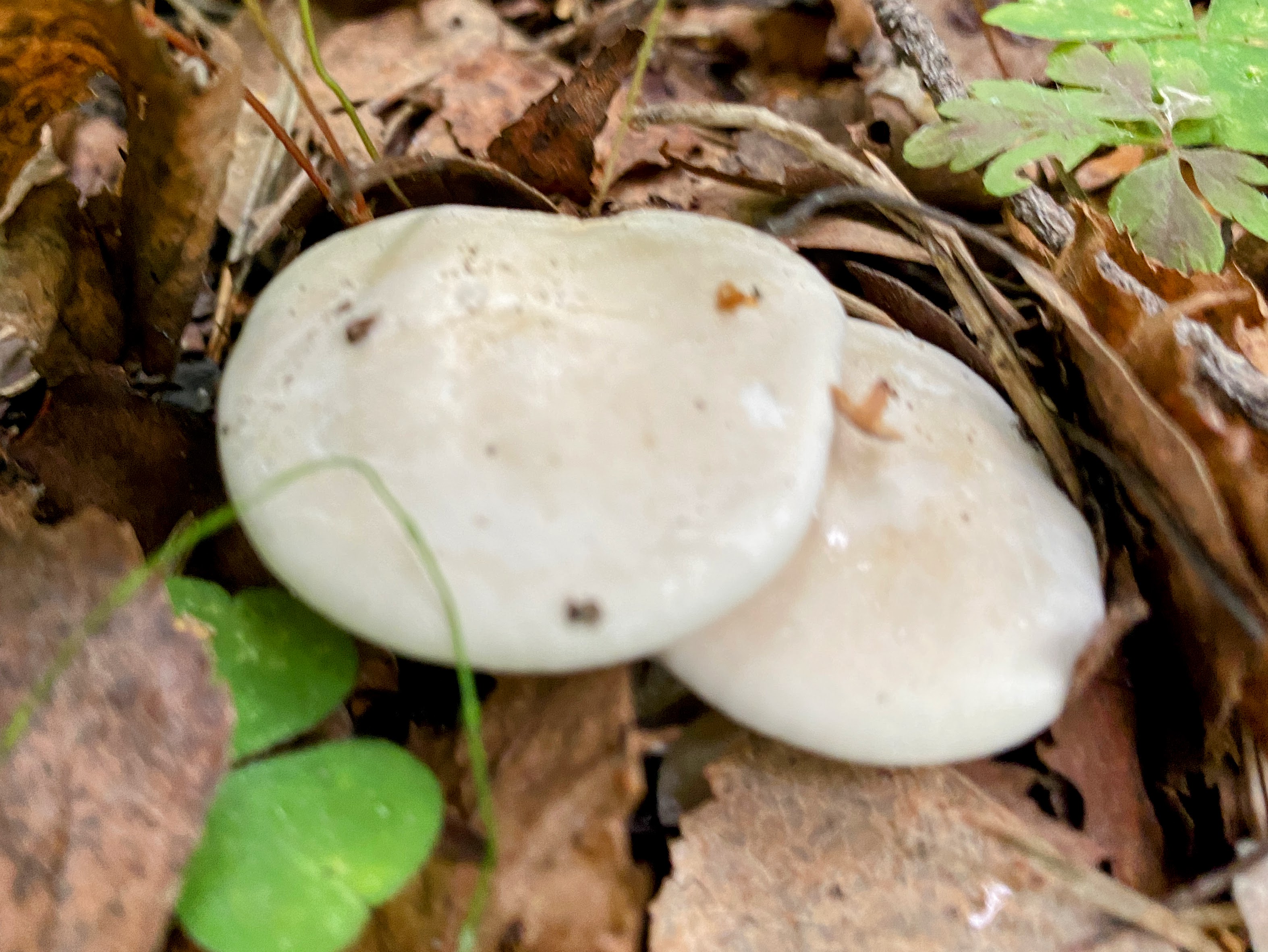
Family: Entolomataceae
Family of fungi within order Agaricales (Gilled mushrooms).
First described by the Czech mycologist František Kotláb; earlier, in 1951, another Czech mycologist, Zdeněk Pouzar, had already proposed establishing the family Rhodophyllaceae — Rhodophyllaceae. The genera assigned to this family were previously mainly included in Tricholomataceae; the key characteristic of belonging to the Entolomataceae is spores with a characteristic structure of the sheath. The spores of Entolomataceae are angular in shape, ornamented, and have characteristic warty or ribbed thickenings. Currently, the family comprises over 2,000 species grouped into 20 genera; some of these genera are also considered subgenera within Entoloma. The most well‑known living expert on entolomatous fungi is the Dutch mycologist Mahil Nordelos.
In the taxonomy of the family Entolomataceae, two main directions traditionally continue to develop, diverging mainly in the assessment of the ranks of the taxa that make up the genus Entoloma in the broad sense. The first group of authors considers it to be a single species-rich genus with a complex intrageneric structure (Romagnesi 1974, 1978; Noordeloos 1992, 2004). While the second, currently represented by American scientists, distinguishes more than a dozen genera in the genus Entoloma s.l. (Orton, 1991a, b; Largent, 1994; Baroni and Matheny, 2011). Cases of paraphyly revealed during phylogenetic analysis force the former to combine genera, and their opponents to describe new ones. Thus, the basal position of the /prunuloides clade in relation to other representatives of Entoloma s.l. in the first case, it does not contradict the established generic concept (Co-David et al., 2009; Morgado et al., 2013), in the second, it leads to the need to describe a new genus Entocybe, characterized by a primitive morphology of basidiospores, between that of the genera Entoloma and Rhodocybe (Baroni et al., 2011).
Fruiting bodies are agaricoid, less commonly gasteroid or secotioid, and vary in size. Caps range from 0.5-1 cm to 18-20 cm in diameter, initially hemispherical or rounded-flattened, and prostrate, flat, or broadly funnel-shaped when mature. Coloration varies, but is most often faded: white, gray, or brownish. The surface is usually dry and matte, less commonly dull-shiny, smooth or fibrous, and sometimes weakly zonally colored. Spathes and coverslips are absent. Hymenophore is lamellar; gills are adnate or descending, light-colored, and in many genera they turn pink or red with age, and may also become yellow or brownish. Spore powder is light-colored: white, cream, or pinkish. The spores are angular, ornamented, with wart-like or ribbed outgrowths. The stipes range from 0.5 to 2-3 times the cap diameter, are cylindrical, less commonly narrowed or slightly thickened at the base, or club-shaped, and usually lack an internal cavity or have a narrow cavity. The stipe surface is smooth or finely scaly, fibrous, and longitudinally finely furrowed. Due to the absence of veils, the annulus and volva are always absent. The flesh of small species is thin, sometimes almost undeveloped; in larger species, it is fleshy, soft, or fibrous, with a farinaceous or unpleasant odor. The taste is usually neutral, sometimes musty or bitter.
Mycorrhizae-forming fungi with various deciduous and, less commonly, coniferous trees, and, less commonly, ground or litter saprotrophs; some species are mycelial symbionts or parasites of other fungi, including carpophoran parasites (Entoloma abortivum), and saprotrophs on woody debris. They are found in any moderately or excessively moist biotopes. They are distributed worldwide.
The number of edible species is small: these are mainly species of the genus Clitopilus (sour cherries) and some early-fruiting species of Entoloma (E. clypeatum, E. sepium, etc.). Many Entoloma species are poisonous, containing unidentified toxins that irritate the digestive system. The toxicity or edibility of most species has not been established. Being mostly mycorrhizae-forming fungi, Entoloma species are not cultivated artificially; They also find little use in other sectors of the economy. A number of species that form mycorrhiza with garden trees can be useful in horticulture, improving the growing conditions of cultivated crops.